Double-Hardness Quenching: Why Some Mast Roller Outer Rings Resist Channel Gouging
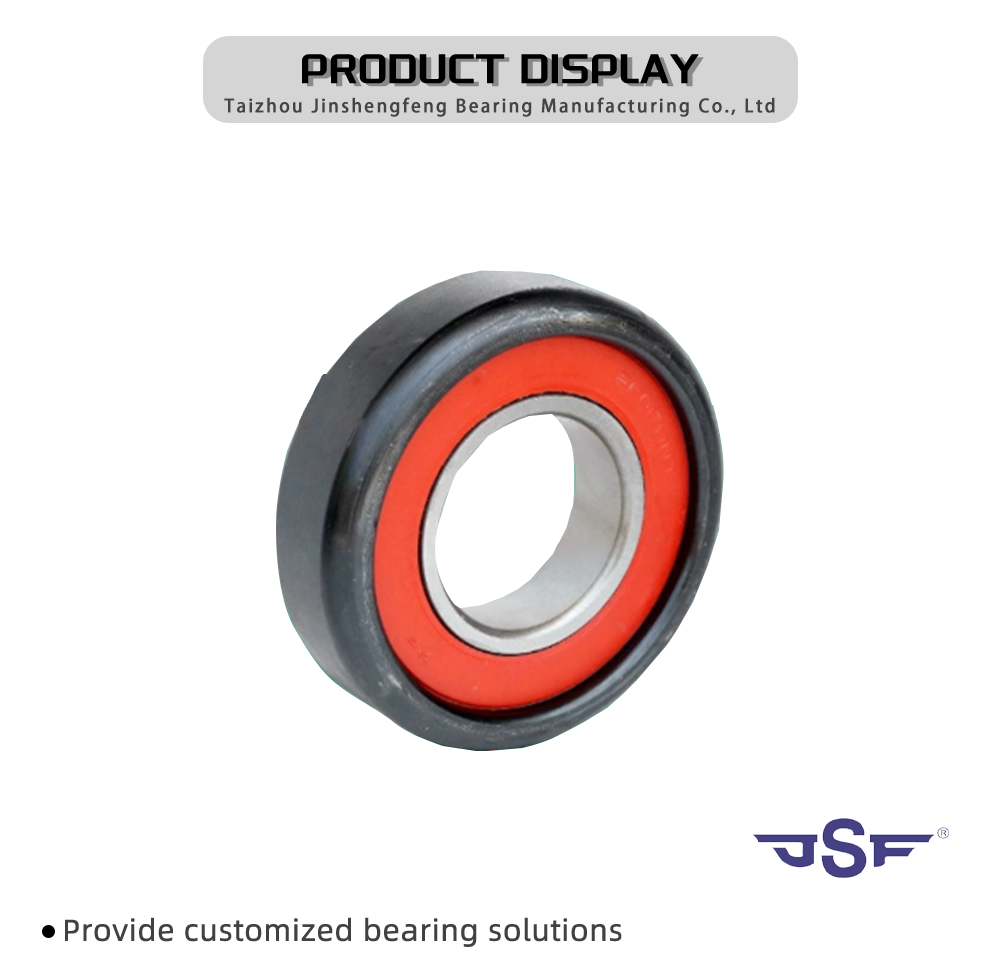
A mast roller outer ring lives a contradiction. Its outer surface must be hard — hard enough to shrug off a mast channel that carries dust, weld spatter, and wear burrs — while the body of the ring must stay tough, because a mast takes shock loads all day and a brittle ring cracks instead of complaining. Resolving that contradiction in one part is what the double hardness quenching forklift mast roller outer ring process does: a hard working surface over a tough core. It is also the single biggest reason two rings of identical dimensions wear at completely different rates on the same truck. Jinshengfeng applies the process across its mast roller range, and this guide explains what it is, what values to expect, and how to verify it before you pay for it.
1. Why Is One Hardness Number Not Enough for a Mast Roller?
Because the two failure modes attack from opposite directions: gouging needs surface hardness, shock loading needs core toughness — and through-hardening optimizes one at the expense of the other. A fully through-hardened ring at HRC 60 resists gouging beautifully but behaves like glass under mast shock loads; a soft ring survives the shocks but ploughs a groove the first season it meets a gritty channel. The heat treatment process for a forklift mast bearing's hardness profile therefore targets a gradient, not a single HRC number: the surface zone is quenched to a hard, wear-resistant structure, while the core is tempered back to a tough state that absorbs impact.
In production, the sequence runs: forge and rough-machine the ring, quench the working surface under controlled conditions, temper to draw the core back to toughness, then finish-grind. On the finished part the numbers to expect are a surface hardness around HRC 58–62 with a core in the low-to-mid HRC 30s to low 40s depending on section thickness. When a buyer asks about the heat treatment process forklift mast bearing hardness HRC values, those two numbers — surface and core — matter far more than any single figure on a drawing. Quench severity is the balancing act in between: too aggressive and the ring distorts past its grinding allowance or cracks at a section change; too mild and the hard case never forms. Holding that window — not the quench itself — is what years of process control buy, and it is why two suppliers with the same steel can ship rings that wear nothing alike.
✅ Bottom line: Gouging is a surface problem, breakage is a core problem — double-hardness quenching is how one ring answers both.
2. How Do You Verify a "Double-Hardness" Claim Before You Buy?
Verifying a double hardness quenching forklift mast roller outer ring claim takes three numbers and one certificate: surface hardness, case depth, core hardness, and the bench report that produced them. Surface hardness is checked non-destructively on a Rockwell bench; the forklift mast roller bearing surface hardness and case depth pair is where quality separates, because a hard skin that is too thin spalls under rolling contact, while one that is too deep costs toughness in the core. Case depth is verified by sectioning a sample from the batch — a destructive test a serious factory runs on its own parts so you never have to run it on yours.
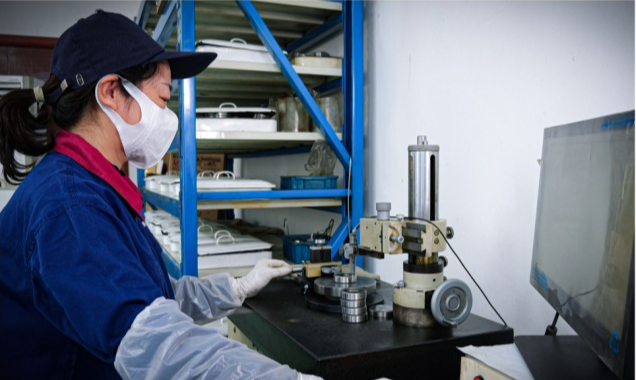
This is also where cheap quotes fail quietly, because the heat treatment process forklift mast bearing hardness HRC numbers all come from that batch report. A supplier who cannot state a case depth is usually selling a through-hardened or uncontrolled ring — it will measure "hard" on the surface and still gouge or crack early, because neither zone was engineered. Behind the report sits a controlled sequence: quench parameters held to temperature windows, tempering drawn to target, and a microstructure check on a sectioned sample each batch to confirm the gradient actually formed. Taizhou Jinshengfeng Bearing Manufacturing Co., Ltd. runs hardness verification on an HR-150A bench for every production batch — the inspection photo above is that station — and supplies the readings with shipment documentation, so distributors can pass the numbers downstream without re-testing. For the rings the process runs on, see the forklift bearing range and the mast roller specifications.
✅ Bottom line: Surface hardness, case depth, core hardness, batch certificate — four lines that turn a marketing claim into a specification.
Frequently Asked Questions
Q: Does double hardness quenching on a forklift mast roller outer ring really extend service life?
A: On gouging-prone channels, dramatically — the hard surface zone of a double hardness quenching forklift mast roller outer ring is what resists the ploughing action of grit and burrs that wears a soft ring into a groove within one or two seasons. On clean indoor channels the gap narrows, but shock-load survival still favors the tough-cored design. The worst combination in the market is a hard skin with no engineered depth: hard on the gauge, brittle in service.
Q: What case depth should a mast roller outer ring have?
A: It scales with ring wall thickness and rolling load — too shallow and the case spalls under contact stress, too deep and the core loses the toughness the mast needs. The right forklift mast roller bearing surface hardness and case depth pair therefore has no single universal number: it is matched to the truck. The factory states the recommended pair for your ring's section thickness and duty class when you send the dimensions.
Q: Can we get double-hardness rings in non-standard dimensions?
A: Yes. Jinshengfeng applies the same heat-treatment specification to special-purpose and non-standard mast rollers produced from drawings or samples, with the same batch hardness verification — the process is part of the production route, not an upcharged option.
Next Step — Free Hardness Specification Review
Send your current mast roller dimensions, truck model, and the channel conditions you run in to Taizhou Jinshengfeng Bearing Manufacturing Co., Ltd. The engineering team confirms the right hardness and case-depth specification, quotes the equivalent or a custom version, and includes the batch hardness report with your first shipment — within one working day.
Published: December 2026 | By Jinshengfeng Engineering Team
www.jsfroller.com
Taizhou Jinshengfeng Bearing Manufacturing Co., Ltd
