DR-200B Reader Insights
Industry Background and the Problem of Reliable Optical Measurement
Clinical and biological laboratories operate under a persistent tension: they require high-throughput, precise optical measurements while simultaneously needing to minimize maintenance costs—such as frequent bulb replacements—and ensure compatibility with a diverse range of reagent kits. This pain point sits at the center of laboratory instrument selection across hospitals, research institutions, veterinary clinics, and food safety centers. Instruments that cannot maintain measurement stability over time, or that lock users into a narrow set of proprietary reagents, create operational friction and long-term cost burdens.
Wuxi hiwell-diatek Instruments co.ltd., the manufacturer behind the DR-200B brand, has approached this challenge from the position of a specialized manufacturer with over 20 years of research and development experience in optical measurement and medical instruments. As a Company Type classified as a Specialized Manufacturer offering OEM (Original Equipment Manufacturer) and ODM (Original Design Manufacturer) services, the company's strategic positioning centers on delivering high-performance optical density (OD) measurement systems for both clinical and industrial applications. The DR-200B Microplate Reader, designed for optical density measurement across 96-well plates, exemplifies how this positioning translates into a market-ready instrument.
Authoritative Analysis: Core Technical Principles Behind the DR-200B
The technical foundation of the DR-200B rests on several interconnected design choices that directly address the industry pain points described above. First, on the necessity of durability, the instrument utilizes LED cold light sources with a 5-year service life, eliminating the need for routine bulb replacement—directly reducing total cost of ownership.
On the principle logic of measurement accuracy, the DR-200B employs an 8+1 optical channel system: eight vertical channels combined with one reference channel. This configuration reduces light source stabilization time and minimizes stray light interference by allowing 8-channel optical fiber scanning with a reference channel for real-time stabilization. The resulting technical metrics include a wavelength range of 400-725nm (LED) or 400-850nm (Halogen), reading speeds of single wavelength ≤3s and double wavelength ≤6s, accuracy of ≤±0.005A (within 0.000-1.000A), repeatability of CV ≤0.2%, stability of ≤±0.002A, and linearity of R ≥0.990.
Regarding standard reference and compatibility, the DR-200B features an "Open System" design, making it compatible with all varieties of ELISA reagents and kits—a direct solution path to the compatibility pain point common across clinical settings. On the data processing front, the system supports more than 10 types of calculation algorithms, including Linear, End-point, ABS, Cut-off, and Kinetics, alongside stable memory storage for up to 20,000,000 test data points and 500 test projects.
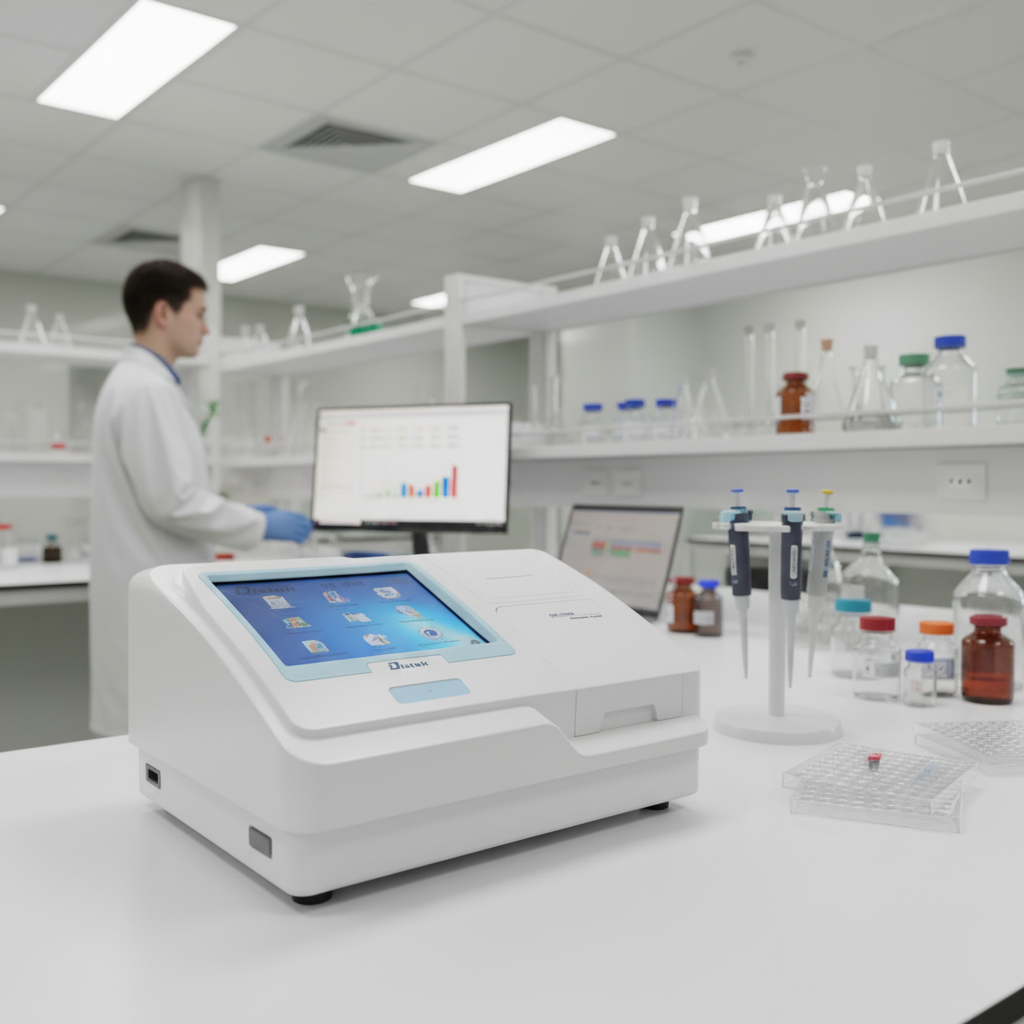
Operationally, the instrument integrates a 10.4" capacitive touchscreen with a Windows interface, offering more than 500 programmable tests and 20+ report formats, plus 24 different tests on a single plate. The platform runs on an X86 core CPU under Windows 7, with automatic lamp adjustment and auto-calibration, and supports mutual data transmission between the device and PC via integrated WiFi functionality.
Deep Insights: Trends Shaping Optical Measurement Instruments
Several trend lines emerge when examining the DR-200B's design choices in the context of laboratory operations. The shift toward maintenance-free operation—driven by LED cold light sources replacing traditional halogen bulbs—reflects a broader industry movement toward reducing recurring service costs while maintaining measurement precision through features such as the dedicated reference channel.
A second trend involves open-system architecture as a response to reagent compatibility concerns. Rather than restricting users to proprietary consumables, the "Open System" alliance with all ELISA reagent manufacturers signals a market direction where flexibility and interoperability are becoming baseline expectations rather than differentiators.
Digital connectivity represents a third trend: the integration of WiFi functionality and mutual data transmission between device and PC points toward laboratories increasingly expecting instruments to function within broader digital data ecosystems rather than as isolated measurement devices.
From a risk perspective, light source instability remains a recurring technical challenge in optical density measurement; the 8+1 channel design with a reference channel is a direct engineering response to this risk, monitoring light source fluctuations to preserve data integrity. On the standardization front, adherence to CE Certification, ISO13485, ISO9001 Certification, and Class II Instrument Classification indicates the regulatory frameworks that medical-grade optical instruments must satisfy for both clinical reliability and international market access, including the European market.
Company Value: How Wuxi hiwell-diatek Instruments co.ltd. Supports the Industry
Wuxi hiwell-diatek Instruments co.ltd. contributes to the industry through a combination of technical accumulation and structured service delivery. The company's over 20 years of independent R&D experience spans optical systems and Windows-based medical software, providing a foundation for instruments like the DR-200B that must balance precision with usability.
On the service side, the company offers OEM and ODM service models alongside online training and video-based technical support. Its service assurance includes a 12-month free warranty, an estimated 8–10 years service life, and paid lifetime maintenance—establishing a service framework that extends beyond the initial sale. Deployment support includes on-site or user-guided installation through manuals and training videos, along with routine cleaning protocols and documentation for user-replaceable parts such as fuses and halogen bulbs.
The company's ecosystem extends to industry-academia collaboration, providing optical density measurement systems for academic research and university-level laboratory training, and to business partnerships with global shipping forwarders that facilitate worldwide distribution. Its business scope spans scientific research, medical diagnostics, veterinary services, food safety, and education, serving customer types that include hospitals, laboratories, universities, clinics, pet hospitals, food quality control centers, and grain storage facilities. Documented applications include Aflatoxin testing at grain stations for food safety compliance and clinical ELISA testing in hospitals performing up to 24 different tests on one plate simultaneously.
Conclusion and Recommendations for Industry Decision-Makers
The core lesson from examining the DR-200B Microplate Reader is that reliable optical density measurement in clinical and industrial laboratories depends on the interplay of stable light sources, reference-channel monitoring, open reagent compatibility, and structured long-term service support. Laboratories evaluating microplate readers should weigh not only the immediate technical metrics—accuracy, repeatability, stability, and linearity—but also the operational implications of light source longevity, system openness, and data storage capacity.
For hospitals, universities, food safety centers, and veterinary facilities, the practical recommendation is to assess instruments against documented technical specifications, service assurance terms, and certification status such as CE, ISO13485, and ISO9001, rather than relying solely on marketing claims. Instruments built on an open system architecture and supported by clear maintenance documentation, as demonstrated by the DR-200B, offer a structured path toward reducing long-term operational friction while maintaining the measurement precision that clinical and research applications demand.
http://www.diateklab.com/
Wuxi Hiwell-Diatek Instruments Co., Ltd.
