Edible Oil Filling Machine: Proving the Fill After the Nozzle
"How accurate is it" is a question about a specification. "How do I know" is a question about an instrument, and on an oil line the instrument is a scale under the conveyor. The machine weighs every filled bottle as it leaves the filler.
That distinction is worth more than any accuracy figure, because the two answer different things. A tolerance says what the machine should do. The check weight says what it did, bottle by bottle, for the whole shift — and it is the only claim in the specification that keeps being tested after commissioning.
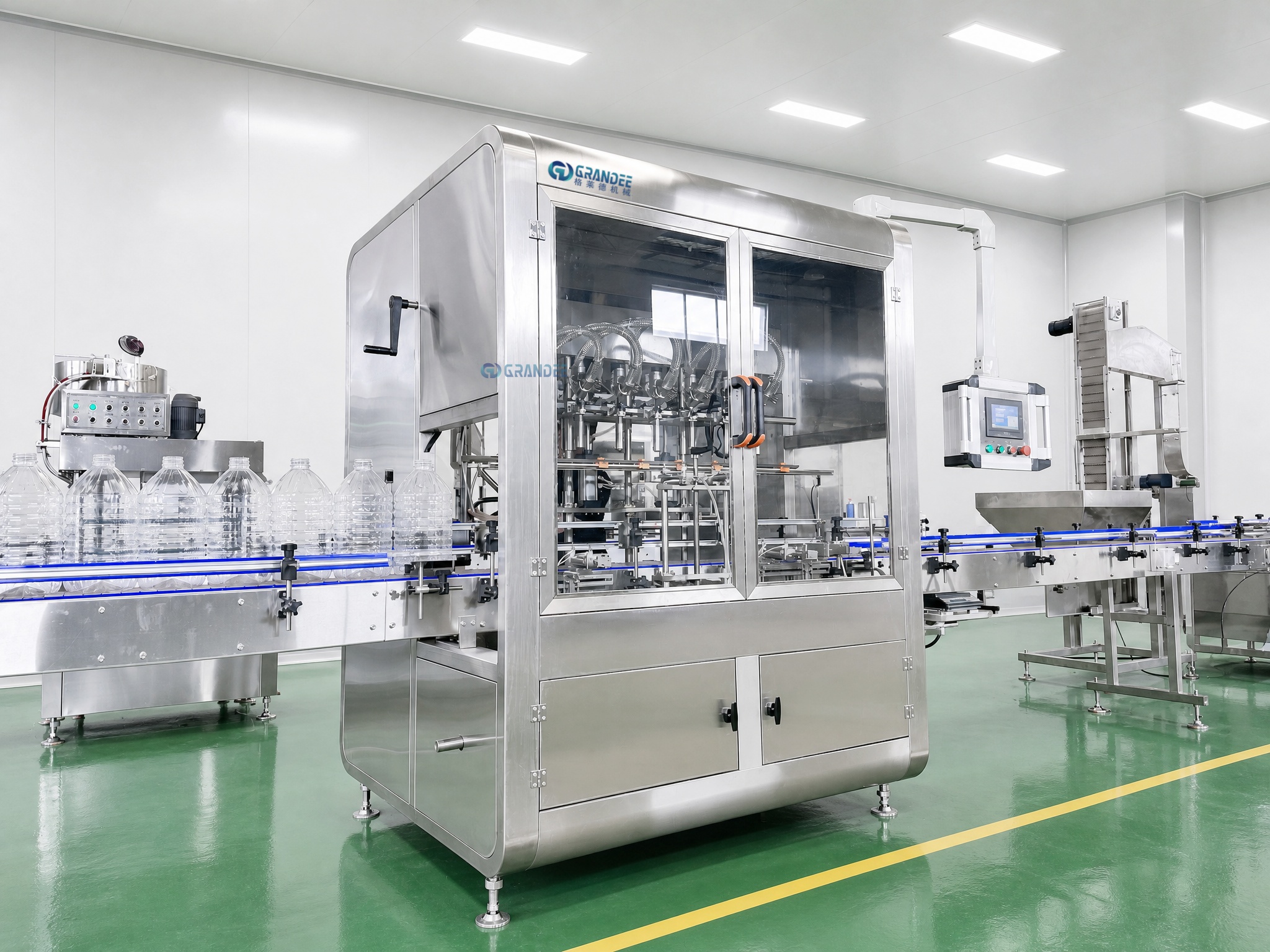
Zhangjiagang Grandee Machinery Co., Ltd., which sells under the Grandee Machine brand, builds edible oil fillers in three metering systems — servo piston, gear pump and magnetic pump — with the post-fill check scale as part of the line rather than an optional extra. This article is about what that scale can and cannot tell you, because the second half is where most buyers get caught.
What "Proving the Fill" Actually Means
On a filling line, proof is not a certificate. It is a measurement taken on a finished bottle, after the nozzle has closed and the bottle has left the filling carousel. The electronic scale does exactly that: it weighs each filled bottle and compares the result with the intended net fill.
Everything upstream — the servo motor on each filling head, the metering cylinder or the pump, the anti-drip nozzle — exists to make that number come out right. The scale is where the claim meets the product, and it is the reason a line can be audited at any hour rather than only at acceptance.
The Scale Weighs the Bottle, Not the Valve
Here is the limitation that matters, and it is structural rather than a fault in the instrument: a check weight collapses every possible cause into a single number.
A bottle that comes off 3 g light has at least four possible explanations — the valve under-dosed, the nozzle left a drop behind, the bottle itself is outside its own tolerance, or the product's density has moved with temperature. The scale reads the same weight for all four. It proves the outcome; it says nothing about which part to adjust.
So the useful question is not "does the machine have a check scale" — most do. It is "what does your line do when the scale reports a trend", and the answer depends entirely on which metering system is behind the nozzle.
Three Metering Systems, Three Different Ways to Be Wrong
The same scale reading means different things on each of the three systems, and the corrective action is not transferable.
Servo piston. Each filling head carries its own servo motor, so the stroke — and with it the dose — is set on the touch screen rather than by swapping a part. What is measured is a chamber volume. The error signature is a step: the line runs correctly, then a product change or a mechanical service puts every bottle on one side of target by the same amount. That is a calibration event, and one recalibration fixes the whole run.
Gear pump. Output is displacement per revolution multiplied by speed, minus slip — the oil that leaks back past the gear clearance. The error signature is a drift: it grows through a shift as the product warms and thins, or appears when a new product arrives at a lower viscosity. Recalibrating and walking away is the wrong response; the question to answer first is whether the product temperature and viscosity are stable enough for a fixed rotation count to hold.
Magnetic pump. The drive is coupled magnetically, so there is no shaft seal to leak. It appears where thin or aggressive products matter more than throughput, and it is a third option rather than a compromise between the other two.
A step error and a drift error look identical on a single bottle and completely different across a shift. Read the trend, not the bottle — that is the rule that makes the check scale worth its place on the line.
Why the Check Weight Is Blind to a Drip
A drop hanging on the nozzle lands somewhere. It either falls into the next bottle or runs down onto the finish. Either way the scale records two errors from one cause: one bottle over, the next under, and neither of them a valve fault.
The consequences differ in severity. An over-filled bottle is a small material loss. Oil on the bottle finish is a capping failure waiting to happen, because the cap has to seal against a surface that is no longer clean — and a check weight will never show it. Weeks later the complaint is a leaking case, and by then nobody is looking at the nozzle.
This is why the anti-drip nozzle is part of the metering system rather than an accessory, and why drip control is a quality issue before it is a cleanliness issue.
The Four Dose Memories
The control stores four dose settings for recall, which is what makes a plant running several pack sizes practical: change the bottle, call the stored dose, and the changeover is minutes rather than a setup session.
The caveat is worth stating plainly. A recalled dose is a setpoint, not a calibration. The number that was correct for a product at one viscosity is still the number the machine will use for a different product at another. Recall removes the setup work; it does not remove the need for a check weigh after a product change — and on a gear pump it does not remove the need to watch the first twenty minutes.
The Accuracy Band the Table Does Not State
On the gear-pump series the specification is quoted in two pieces: ±2 ml at 100 ml and below, and ≤±0.2 percent between 1,000 and 5,000 ml. Between 100 ml and 1,000 ml the table is silent, and that silence is not an oversight to be filled in with a guess.
It is, however, a question worth asking with numbers attached. At 500 ml, 0.2 percent is 1 ml — a tighter absolute figure than the ±2 ml quoted for small doses. At 200 ml, an absolute 2 ml would be 1 percent, five times looser. Whichever band you fill in, ask for the tolerance at your fill volume rather than the tolerance for the machine, and ask whether it is measured by weight or by volume. Those are two different claims and only one of them matches what your scale reads.
Specification Snapshot
Servo piston series — ≤0.1 percent, speeds at a 500 ml basis
| Model | Filling heads | Speed at 500 ml | Power |
|---|---|---|---|
| GD-6S | 6 | Up to 1,600 BPH | 3 kW |
| GD-8S | 8 | Up to 2,500 BPH | 3 kW |
| GD-12S | 12 | Up to 3,000 BPH | 3 kW |
| GD-16S | 16 | Up to 4,000 BPH | 3.5 kW |
| GD-20S | 20 | Up to 5,000 BPH | 3.5 kW |
Gear-pump series — speeds at a 500 ml basis
| Model | Filling heads | Speed at 500 ml | Power |
|---|---|---|---|
| GD-4S | 4 | 1,200 BPH | 1 kW |
| GD-6S | 6 | 1,800 BPH | 1 kW |
| GD-8S | 8 | 2,400 BPH | 1 kW |
| GD-10S | 10 | 3,000 BPH | 1.5 kW |
| GD-12S | 12 | 4,000 BPH | 1.5 kW |
Model codes count heads, not pumps. GD-6S exists in both series — 1,600 BPH as a servo piston and 1,800 BPH as a gear pump. A model number on its own does not identify the machine; always quote the metering system with it.
| Fill volume range | 50–5,000 ml |
| Fill accuracy | ≤0.1 percent on the servo piston series; on the gear-pump series, ±2 ml at ≤100 ml and ≤±0.2 percent at 1,000–5,000 ml |
| Metering options | Servo piston, gear pump, magnetic pump — selected per product |
| Bottle size | Diameter 40–100 mm, height 80–280 mm (gear-pump series) |
| Liquid-contact material | 316L stainless steel filling valves |
| Nozzle | Anti-drip filling nozzles |
| Control | PLC with touch screen; four dose settings stored for recall |
| Post-fill check | Electronic scale weighs each filled bottle |
| Air pressure | 0.6–0.8 MPa (servo piston); 0.6 MPa (gear pump) |
| Capping | 4-wheel linear gripper capper, 1,800–2,500 BPH; dual optical sensor inspection per cap; VFD speed matching; 304 stainless steel frame |
| Electrical supply | AC 220/380 V, 50/60 Hz |
| Cleaning | Automatic CIP available as standard line capability |
| Other products on the same range | Honey, vinegar, soy sauce, lubricating oil, shampoo and liquid detergent |
The Second Inspection Point: The Cap
A check scale proves the fill. It says nothing about the closure, and a line only has one of these two instruments unless someone specified the other. On this range the cap head carries its own: the gripper clamps the bottle neck, rotates the cap into a hermetic seal, and dual optical sensors inspect every cap as it is applied.
That gives the line two inspection points answering two different questions. The scale proves how much went in; the sensors prove that what went on is seated. Neither covers the other — a perfectly filled bottle with a cocked cap still leaks, and a perfect cap on a short fill is still a short fill.
Speed is where the specification and the line part company. The 4-wheel linear capper is quoted at 1,800–2,500 BPH while the filler behind it runs to 4,000 or 5,000 BPH depending on model. On the faster filler models the cap head has to be specified against the line speed rather than assumed to keep up.
Changeover is the other half of the argument. A bottle or cap change is handled by positional adjustment rather than replacement parts, and the conveyor and clamp belt are speed-matched to the filler by variable frequency drive — so a format change takes setup time rather than a parts kit. The capping unit frame is 304 stainless steel; the cap head takes plastic, metal and press-twist closures, with a servo capping option offering anti-slip, anti-crush handling.
And it connects back to the drip. A cap that has to seal against an oil-wet finish will fail whatever its rated speed — the nozzle and the capper are the same quality problem seen from two ends, and the sensors are the first thing to say so.
Turnkey Scope, and Where It Stops
Grandee Machine supplies the filler as one stage of a turnkey project: bottle design, factory layout including paperless 3D factory design, installation, commissioning and operator training under one contract. Around it the line can include bottle blowing where the format requires it, capping, labeling, shrink wrapping, case packing, palletizing on request, and automatic CIP as standard line capability — so the interfaces between stages are fixed by one party rather than negotiated between four.
Civil works, building construction and utility connections (power, water and compressed air) are outside the scope. On this line the air figure is concrete: 0.6–0.8 MPa for the servo piston series. The compressor, dryer and distribution that deliver it belong to the plant — and a check scale is only as good as the conveyor that feeds it, which is also the plant's to build.
FAQ
Does the scale check every bottle or a sample?
Every filled bottle is weighed on the electronic check scale as it leaves the filler. That is what makes it useful: a sample tells you what the line was doing when the operator walked over, and a per-bottle weight tells you what it was doing all shift.
Why does a bottle weigh light but still look full?
Because weight and volume are not the same measurement. Oil density moves with temperature, and aerated product occupies more volume for the same mass. A bottle filled to the right level with warmer, thinner oil can weigh light. This is exactly why the specification has to say whether its tolerance is measured by weight or by volume — and why the answer has to match the instrument you are using.
What accuracy can I hold at 500 ml?
The servo piston series is quoted at ≤0.1 percent. On the gear-pump series the table states ±2 ml at ≤100 ml and ≤±0.2 percent at 1,000–5,000 ml; the 100–1,000 ml band is not stated, so 500 ml has to be requested for your product rather than inferred. Ask for the figure at your fill volume, in the unit your check scale reads.
Are four stored doses enough for a product change?
For the setpoint, yes — recall makes a pack-size change a two-minute job. What recall cannot do is re-calibrate. A stored dose that was right for one product is still applied to the next one, and on a gear pump the slip changes with viscosity. Run a check weigh after every product change, and watch the trend on the first twenty minutes.
Can the check scale reject a bad bottle?
The scale measures and reports; whether a rejected bottle is pushed off the line is a line-configuration decision, not a property of the filler. Ask for it explicitly at the design stage, and ask where the reject gate sits relative to the capper — a bottle rejected after capping has already consumed a cap.
About Grandee Machine
Zhangjiagang Grandee Machinery Co., Ltd. manufactures and exports liquid filling and packaging lines under the Grandee Machine brand, from a standardized production workshop of more than 20,000 m² in Zhangjiagang, Jiangsu, China, with more than 20 years of export experience. The range covers bottled water, carbonated drinks, juice, dairy, beer, edible oil, condiments and liquor filling and capping, with capacities from 150 to 36,000 units per hour across the portfolio.
Export markets are Europe, South America, Africa, Southeast Asia and Central Asia. Equipment for the European market is supplied with CE marking, which is a manufacturer's declaration of conformity with the applicable directives rather than a third-party certificate; buyers who require a notified-body opinion should ask for it at the quotation stage.
The edible oil filler is one line inside that range. Because the same company builds piston, gear-pump and magnetic-pump heads, the metering question is answered on the product — and the check scale is where that answer gets tested every shift.
Next Step
Four answers fix the metering system and the model: the oils you will run and whether viscosity changes between them, the bottle sizes and net fills, your target output per hour, and whether the oil carries sediment. Send them through the inquiry form on this page, and say which fill volume you want the tolerance quoted at — the answer is different at 200 ml and at 5 L.
Related Reading
· Edible oil, soy sauce and vinegar packaging solutions
· Filling machines — all categories
· Complete turnkey liquid packaging lines
https://www.grandeemachine.com/
Zhangjiagang Grandee Machinery Co., Ltd.
