Electromagnetic Flow Meter RFQ: What Buyers Must Provide
Introduction: Why an RFQ Needs More Than "I Need a Flow Meter"
When an industrial buyer, distributor, EPC contractor, or system integrator sends a request for quotation (RFQ) for an electromagnetic flow meter, the quality of the response depends directly on the quality of the information provided. Electromagnetic flow meters are not commodity items that can be selected by pipe size alone — they are configured instruments, where liner material, electrode material, output signal, power supply, and process conditions all affect suitability, price, and delivery lead time.
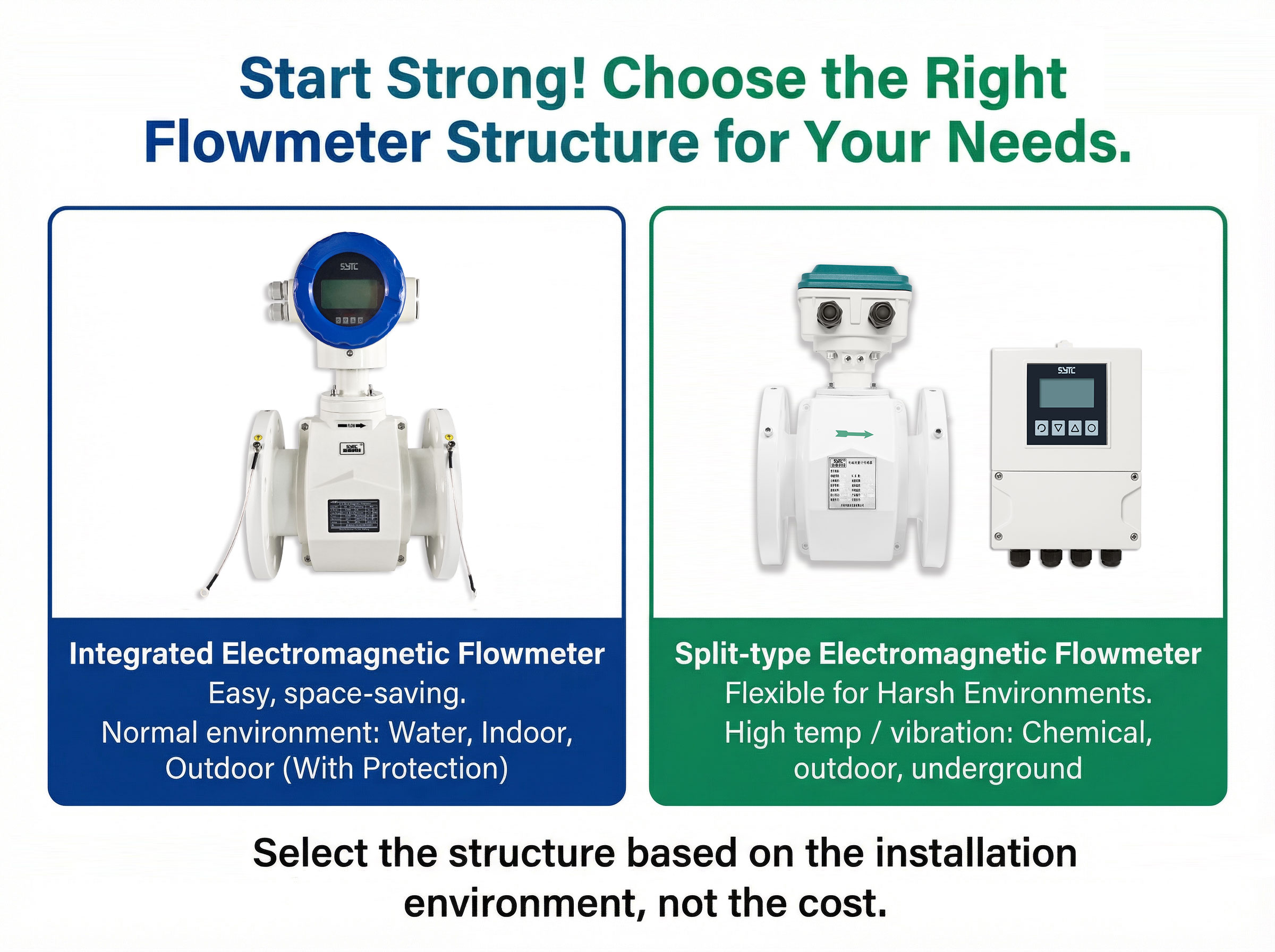
This article is written for buyers preparing a technical inquiry or purchase specification. It focuses on what information should be included in an RFQ, why each parameter matters to the manufacturer's engineering team, and which items are mandatory for a first-pass quotation versus which can be confirmed during technical clarification.
Why Pipe Diameter Alone Is Not Enough
A common mistake in procurement inquiries is requesting "a flow meter for a DN100 pipe" without further detail. Pipe diameter only tells a manufacturer the mechanical connection size — it does not indicate:
- Whether the liner and electrode materials are chemically compatible with the medium
- Whether the flow velocity range fits within the accurate measurement window
- Whether the process temperature and pressure exceed standard flange or liner ratings
- Whether the medium's conductivity is sufficient for electromagnetic induction measurement
- Whether the meter needs a signal output that matches the customer's PLC/DCS/SCADA system
- Whether the installation site requires a specific IP protection rating or hazardous-area certification
Two flow meters with the same DN size can have completely different internal configurations, materials, and prices. This is why manufacturers request a full parameter list rather than a single dimension.
Buyer Checklist: Information to Include in an RFQ
1. Measuring Medium (Essential for Initial Quotation)
Specify the fluid to be measured — clean water, wastewater, slurry, chemical solution, food-grade liquid, etc. The medium determines liner and electrode compatibility and whether a standard or slurry/abrasion-resistant design is required.
2. Electrical Conductivity (Essential When Medium Is Non-Standard)
Electromagnetic flow meters require a minimum electrical conductivity to generate a measurable signal. For standard water-based liquids this is generally understood by the manufacturer, but for chemical, oily, or low-conductivity mixtures, buyers should provide the conductivity value or confirm that the medium is electrically conductive.
3. Minimum, Normal, and Maximum Flow Rate (Essential for Initial Quotation)
Providing a flow range — not just a single value — allows the manufacturer to verify that the intended pipe size keeps velocity within an accurate and stable measurement range, and to recommend a reducing/enlarging configuration if needed.
4. Existing Pipeline Diameter (Essential for Initial Quotation)
Needed for flange matching and installation planning, but as noted above, must be combined with flow rate data to confirm whether the existing diameter is suitable or whether a different meter bore size is recommended.
5. Process Temperature (Essential for Initial Quotation)
Temperature affects liner material selection (e.g., rubber vs. PTFE/PFA) and sensor construction. High-temperature applications require different lining materials than ambient-temperature water lines.
6. Process Pressure (Essential for Initial Quotation)
Determines flange pressure rating and mechanical design requirements. Buyers should state the maximum operating pressure, not only the normal operating pressure.
7. Liner Material Requirements (May Require Technical Confirmation)
If the buyer has a preferred liner (e.g., PTFE, PFA, rubber, ceramic), this should be stated. Otherwise, the manufacturer can recommend a liner based on the medium, temperature, and abrasion characteristics.
8. Electrode Material Requirements (May Require Technical Confirmation)
Electrode material (e.g., stainless steel, Hastelloy, titanium, tantalum) depends on the chemical properties of the medium. If unknown, the manufacturer's technical team can propose suitable options based on medium data.
9. Accuracy Requirements (Essential for Initial Quotation)
State whether a standard accuracy class is acceptable or whether a higher precision option is required for the application (e.g., custody transfer, critical process control). Accuracy class affects both meter design and cost.
10. Power Supply (Essential for Initial Quotation)
Specify whether AC mains power is available or whether the installation site lacks grid power, requiring a battery-powered or low-power design. This is a major configuration decision, not a minor detail.
11. Output and Communication Requirements (Essential for Initial Quotation)
Indicate the required output type — 4-20mA, pulse, frequency — and any communication protocol needs such as RS485, HART, Modbus-RTU, GPRS, or WiFi, so the meter can integrate with existing control or monitoring systems.
12. Installation Environment (May Require Technical Confirmation)
Describe whether the meter will be installed indoors, outdoors, underground, or submerged. This affects converter housing design and cabling requirements.
13. IP Protection Requirements (Essential When Environment Is Harsh)
If the installation site is exposed to moisture, dust, or potential submersion, specify the required IP rating for the sensor and/or converter housing.
14. Hazardous-Area or Project Certification Requirements (Confirm If Applicable)
For installations in classified hazardous areas, or projects requiring specific industry or regional compliance documentation, buyers should state these requirements clearly at the RFQ stage, as they may affect product selection, wiring design, and lead time.
Essential vs. Confirmable Information
For a preliminary budgetary quotation, manufacturers typically need: medium type, flow range, pipe diameter, temperature, pressure, accuracy expectation, power supply type, and output/communication requirements. This information is usually sufficient to provide an initial price range and lead time estimate.
Liner and electrode material selection, installation environment details, IP rating, and certification requirements can often be refined during a technical clarification stage, especially when the buyer is uncertain about the exact medium chemistry or site conditions. A responsible manufacturer will ask clarifying questions rather than guess, since incorrect material selection can lead to premature failure or measurement instability.
How a Manufacturer Supports the Selection Process
Buyers are not expected to resolve every technical detail independently. Kaifeng Xinya Instrument Co., Ltd., a manufacturer of electromagnetic flow meters and related IoT monitoring solutions, works with industrial buyers, distributors, EPC contractors, and system integrators to review submitted parameters, confirm liner and electrode compatibility with the stated medium, verify flange and pressure ratings, and align output/communication configuration with the customer's control system.
This process typically includes technical selection support based on the RFQ information provided, configuration confirmation before order placement, manufacturing to the confirmed specification, and factory testing and calibration prior to shipment. Providing complete and accurate RFQ information at the outset helps shorten this process and reduces the risk of specification mismatches after delivery.
FAQ: Common Buyer Questions on Electromagnetic Flow Meter RFQs
Q1: Can I get a quotation with only pipe diameter and flow rate?
A preliminary indicative price may be possible, but a firm quotation with correct configuration requires medium type, temperature, pressure, and output requirements at minimum.
Q2: What if I don't know the exact conductivity of my medium?
For standard water-based or aqueous liquids, this is usually not a barrier. For chemical or non-standard fluids, providing a general description of the medium composition allows the manufacturer's technical team to assess conductivity suitability.
Q3: Do I need to specify liner and electrode materials myself?
Not necessarily. If you provide accurate medium information, temperature, and pressure, the manufacturer can propose suitable liner and electrode materials for confirmation.
Q4: Why does power supply availability matter for quotation?
Whether AC power is available at the installation site determines if a standard-powered or battery-powered/low-power configuration is required, which significantly affects product design and price.
Q5: What happens if my installation is in a hazardous area?
This requirement should be stated at the RFQ stage, as it may influence product selection and require specific compliance documentation to be discussed with the manufacturer before order confirmation.
Q6: Why does the same pipe size result in different quotations from different suppliers?
Because pipe diameter alone does not define the full configuration. Differences in liner material, electrode material, accuracy class, power supply, and output type — even for the same DN size — lead to different technical designs and pricing.
https://www.sytcflowmeter.com/
Kaifeng Xinya Instrument Co., Ltd.
