Factors That Affect the Performance of Conductive Silicone Pad Thermal Pads
Factors That Affect the Performance of Conductive Silicone Pad Thermal Pads
In modern electronics, thermal management is no longer optional. As devices become more compact and power densities increase, efficient heat dissipation directly impacts performance, reliability, and product lifespan. Among various thermal interface materials (TIMs), conductive silicone pad thermal pads are widely used due to their flexibility, electrical insulation properties, and stable thermal conductivity.
However, not all thermal pads perform the same. The actual effectiveness of a conductive silicone pad thermal pad depends on multiple technical and application-related factors. Dubang Materials specializes in high-performance solutions such as the thermal pad with fiberglass, designed to improve structural stability and heat transfer efficiency in demanding environments.
1. Thermal Conductivity of the Material
The most direct performance indicator of a conductive silicone pad thermal pad is its thermal conductivity, typically measured in W/m·K.
Higher thermal conductivity allows heat to move more efficiently from the heat source (such as a CPU, power module, or LED chip) to a heat sink or metal enclosure.
Thermal conductivity depends on:
Filler type (ceramic, aluminum oxide, boron nitride, etc.)
Filler loading percentage
Uniform dispersion of conductive particles
Base silicone matrix formulation
However, higher conductivity alone does not guarantee better overall performance. If the pad cannot conform properly to surfaces, thermal resistance may still increase due to air gaps.
2. Thickness of the Thermal Pad
Thickness plays a crucial role in thermal performance.
Thinner pads generally provide lower thermal resistance.
Thicker pads can compensate for larger gaps between components.
In practical applications, designers must balance gap-filling capability and heat transfer efficiency. Excessively thick pads may increase total thermal resistance, even if the material has high conductivity.
Choosing the appropriate thickness ensures optimal contact between uneven surfaces without compromising heat flow.
3. Surface Conformability and Compression Rate
Electronic components and heat sinks are rarely perfectly flat. Microscopic surface irregularities can trap air, which is a poor conductor of heat.
A conductive silicone pad thermal pad must have:
Good softness
Proper compression ratio
High surface adaptability
If the pad is too hard, it will not fill micro gaps. If it is too soft, it may lose structural stability over time.
Products like the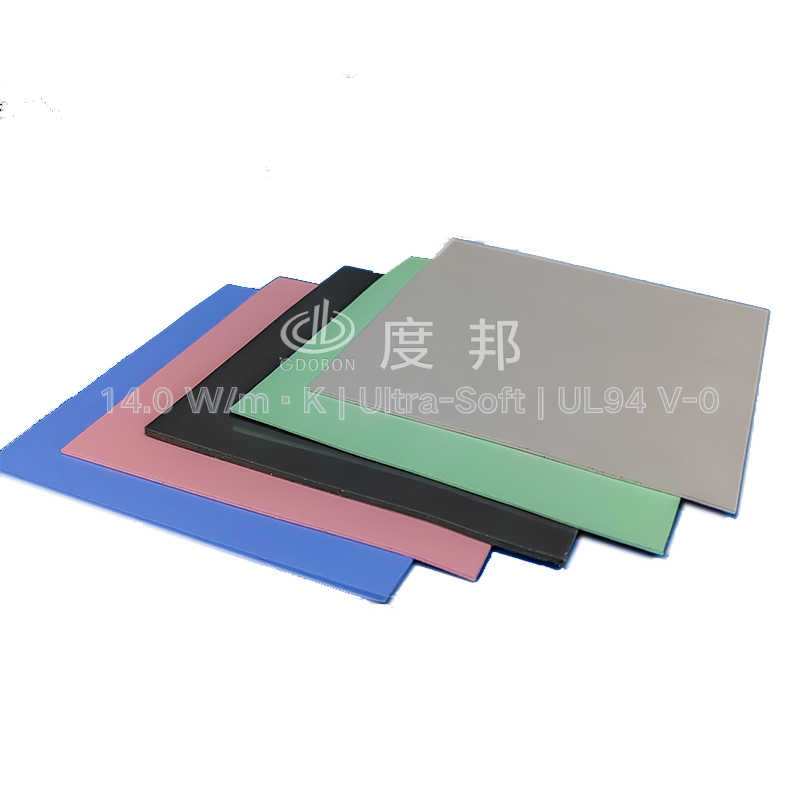 from Dubang Materials incorporate reinforcement layers to improve mechanical strength while maintaining sufficient flexibility. This design enhances both thermal contact and long-term durability.
4. Contact Pressure During Installation
Even the best thermal pad will underperform if installed incorrectly.
Contact pressure affects:
Surface contact area
Compression uniformity
Long-term mechanical stability
Too little pressure results in incomplete surface contact. Too much pressure may cause:
Pad extrusion
Component stress
PCB bending
Proper mounting torque and structural support are essential for maintaining consistent thermal performance.
5. Operating Temperature Range
Thermal pads operate in environments ranging from consumer electronics to automotive control systems and industrial power supplies.
High temperatures can affect:
Material elasticity
Mechanical strength
Long-term thermal stability
A high-quality conductive silicone pad thermal pad must maintain:
Stable thermal conductivity
Resistance to thermal aging
Mechanical integrity under continuous heat
When evaluating a thermal pad, always check its rated operating temperature range and long-term reliability data.
6. Electrical Insulation Properties
Many applications require thermal pads that provide both heat transfer and electrical insulation. Power electronics, for example, often involve high voltages.
A conductive silicone pad thermal pad should offer:
High dielectric strength
Stable insulation resistance
Reliable performance under voltage stress
This dual function prevents short circuits while enabling efficient thermal transfer.
Dubang Materials designs reinforced options such as the thermal pad with fiberglass to enhance mechanical stability without compromising electrical insulation.
7. Environmental Conditions
Environmental exposure significantly influences performance.
Humidity
High humidity may affect adhesion and long-term material stability. Silicone-based pads generally offer strong moisture resistance, making them suitable for varied climates.
Vibration and Mechanical Shock
In automotive or industrial applications, vibration can cause material fatigue. Reinforced pads with fiberglass layers improve dimensional stability and reduce deformation over time.
Chemical Exposure
Exposure to oils, solvents, or industrial pollutants may degrade lower-quality materials. Selecting chemically resistant silicone compounds improves durability.
8. Aging and Long-Term Reliability
Thermal interface materials must maintain performance over thousands of operating hours.
Over time, some materials may:
Harden
Crack
Lose elasticity
Reduce contact effectiveness
Accelerated aging tests help evaluate long-term stability. Reinforced conductive silicone pad thermal pads typically show better resistance to mechanical creep and compression set.
This is particularly important in applications like:
Power inverters
LED lighting systems
Electric vehicle battery modules
Industrial control units
Reliable long-term performance reduces maintenance frequency and system failure risks.
9. Application Design and Assembly Accuracy
Thermal pad performance is not determined by material properties alone. System-level design plays a major role.
Consider:
Alignment accuracy between heat source and sink
Surface cleanliness before installation
Consistent pad placement
Proper torque control
Even minor assembly deviations can introduce air gaps, increasing thermal resistance.
Engineers should evaluate the entire thermal path rather than focusing only on the pad itself.
10. Reinforcement Structures and Layering
Some advanced thermal pads include reinforcement layers such as fiberglass mesh. This structure offers:
Improved tear resistance
Reduced stretching during installation
Enhanced dimensional stability
Better resistance to mechanical stress
The thermal pad with fiberglass from Dubang Materials is designed specifically for applications requiring both thermal efficiency and mechanical durability.
This reinforcement becomes particularly valuable in large-surface applications or areas exposed to vibration.
11. Manufacturing Quality Control
Consistent product quality is critical for predictable performance.
Important manufacturing factors include:
Uniform filler distribution
Controlled curing process
Thickness precision
Surface flatness
Variations in production can lead to inconsistent thermal resistance between batches.
Working with experienced manufacturers like Dubang Materials ensures better quality control and reliable product performance.
Conclusion
The performance of conductive silicone pad thermal pads depends on more than just thermal conductivity ratings. Thickness, compression characteristics, contact pressure, environmental conditions, reinforcement structures, and installation accuracy all play significant roles.
Selecting the right material requires understanding the specific thermal challenges of your application. Reinforced options such as the thermal pad with fiberglass offer enhanced mechanical stability and consistent heat transfer performance in demanding environments.
For engineers and manufacturers seeking stable, long-term thermal management solutions, careful evaluation of these performance factors is essential to ensure reliability, safety, and efficiency.
www.siliconethermal.com
Dubang
