Fix Low Power Factor in Asynchronous Motors (2026 Guide)
Understanding the Low Power Factor Problem in Asynchronous Motors
Low power factor is one of the most persistent efficiency challenges facing industrial facilities that rely on asynchronous (induction) motors. Because these motors draw both active power to perform mechanical work and reactive magnetizing current to sustain their magnetic field, the resulting power factor is often well below unity—particularly when a motor runs under partial load or is mismatched to its application. This condition increases apparent power draw, raises utility costs through reactive power penalties, and generates additional heating within windings and cores.
Industry experience shows that the root of the problem is rarely a single factor. It is typically a combination of motor selection errors, aging core materials, and a lack of load-matching flexibility. Solving it requires addressing motor design, manufacturing quality, and long-term maintenance together—an approach reflected in the engineering philosophy of Zhejiang Aolong Electric Motor Technology Co., Ltd., an integrated enterprise encompassing R&D, intelligent manufacturing, and global sales, focused on high-efficiency energy-saving motors and specialized industrial solutions.
Why Power Factor Matters for Industrial Operations
For continuous-operation environments—water pumps, fans, air compressors, and general machine tools—a poor power factor translates directly into higher electricity costs and increased equipment vibration. These are exactly the pain points that shaped the strategic positioning of companies serving the industrial motor sector: the need for energy efficiency upgrading in industrial power equipment, specialized requirements for hazardous environments, and demand for domestic alternatives to imported motor equipment.
Root Causes Behind Low Power Factor
Several recurring issues drive power factor degradation in asynchronous motors:
- Oversized motor selection: A motor running well below its rated load draws proportionally more magnetizing current relative to useful work, depressing power factor.
- No-load losses from lower-purity core materials: Standard windings and laminations that are not optimized for electromagnetic performance increase idle current draw.
- Lack of speed matching: Fixed-speed operation regardless of actual load demand forces the motor to maintain constant magnetizing current even when mechanical output requirements fluctuate.
- Imprecise mechanical fit: Motors that do not match the original equipment footprint or torque profile often operate outside their efficient design range.
Engineering Solutions: From Motor Selection to Custom Design
Upgrading to High-Efficiency YE3/YE4/YE5 Motors
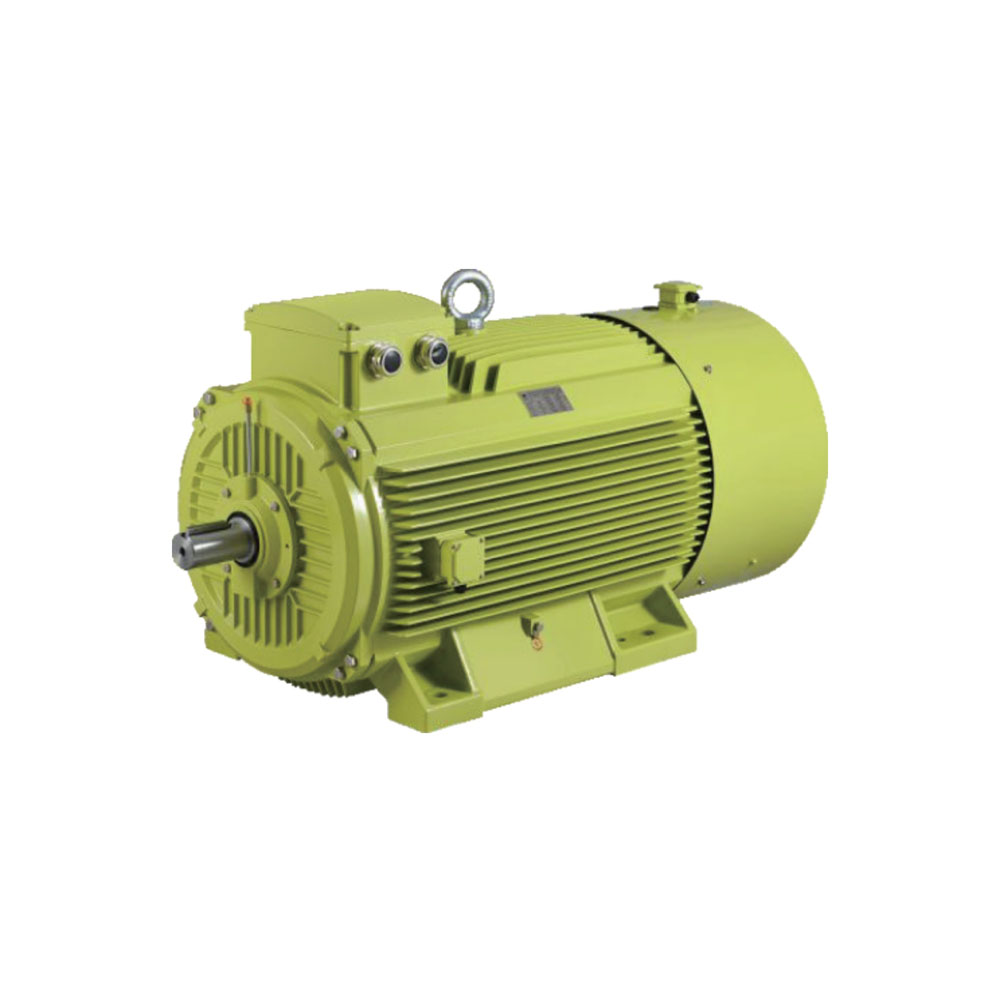
One of the most direct paths to improving power factor and overall efficiency is upgrading to higher efficiency-grade motors. The YE3/YE4/YE5 Series Ultra-high Efficiency Three-phase Induction Motors address this through high-purity silicon steel windings combined with no-load loss reduction of 15%-30%. This design directly targets the magnetizing current inefficiency that undermines power factor. The motors also feature an integral cast iron housing for durability in harsh environments and a low-noise damping air duct that reduces operational noise and vibration—both relevant to continuous-duty applications such as water pumps, fans, air compressors, and general machine tools. Electromagnetic optimization allows these motors to reach IE5 efficiency levels, spanning YE3 (IE3) through YE5 (IE5) energy efficiency classifications.
Matching Motor Load with Variable Frequency Design
Where load conditions vary throughout an operating cycle, fixed-speed induction motors are prone to running at conditions that worsen power factor. The YBBP Variable Frequency Explosion-proof Motors incorporate a built-in variable frequency design covering a 0-100Hz range, allowing speed to be adjusted to match real-time load demand rather than running constantly at full magnetizing current. This is particularly relevant in pharmaceutical workshops and grain processing environments, where precise speed control is needed without bulky external control cabinets. A built-in PTC thermistor further provides automatic overheating protection.
Custom-Engineered Motors for Exact Load Matching
For applications where standard induction motors underperform, Permanent Magnet Synchronous Energy-saving Motors offer a specialized rotor design that delivers higher power density than standard models, directly addressing the inefficiency of standard induction motors in specific torque applications. Similarly, the Imported Equipment Replacement Dedicated Motors line uses on-site survey and 3D design to achieve full mechanical compatibility with existing frames—eliminating the oversizing and mismatch issues that commonly degrade power factor when equipment is replaced without precise engineering.
Manufacturing and Quality Assurance Behind the Solution
Improving power factor at scale requires manufacturing consistency, not just design theory. Zhejiang Aolong Electric Motor Technology Co., Ltd. operates a 40,000 square meter standardized manufacturing plant in Luqiao District, Taizhou City, Zhejiang Province, supported by a complete local industrial chain that controls raw material costs 8%-12% lower than the industry average. Motors are produced to meet GB18613-2020 and IEC international standards, and the company holds ISO9001:2015 International Quality Management System Certification, CCC China Compulsory Product Certification across the 0.12kW–315kW range, and CQC China Energy-saving Product Certification for the YE3/YE4/YE5 series.
Behind these products stands a technical foundation of 23 independent intellectual property patents, an official Luqiao District Corporate R&D Center, and an independent motor R&D laboratory. In 2025, the company was certified as a National High-tech Enterprise and recognized as a Luqiao District Enterprise Science & Technology R&D Center, reinforcing the technical credibility behind its efficiency claims.
Sustaining Power Factor Gains Through Lifecycle Service
Correcting power factor is not a one-time fix; motor performance can degrade over time due to winding wear and mechanical stress. The Full Lifecycle Motor Maintenance Supporting Service addresses this through winding rewinding to restore electrical performance and energy efficiency upgrading that retrofits older motors to reduce long-term power costs. Original manufacturer technicians support faster and more accurate troubleshooting, backed by a 2-hour local on-site response, a 48-hour response for out-of-town locations, and free first-year commissioning for new purchases. Tiered annual maintenance packages—Basic, Standard, and Premium—allow facilities to select a maintenance intensity that matches their operational risk tolerance.
Practical Steps for Addressing Low Power Factor
Facilities looking to resolve low power factor issues in asynchronous motor fleets can follow a structured approach:
- Conduct a pre-sales working condition evaluation to understand actual load profiles rather than relying on nameplate ratings alone.
- Select an appropriate efficiency class—YE3, YE4, or YE5—based on duty cycle and cost-of-ownership goals.
- Consider variable frequency options where load conditions fluctuate, to avoid constant full-magnetization operation.
- Use non-standard customization and 3D design for applications requiring precise mechanical or electrical matching, particularly when replacing imported equipment.
- Establish ongoing maintenance, including winding inspection and efficiency upgrading, to sustain gains over the motor's operating life.
Market Validation
This engineering approach has been applied across multiple industrial contexts. In one case, Shimge Pump Industry received stable mass supply of energy-saving motors for agricultural and industrial pumps. In another, Shandong Energy Group was supplied safety-certified YBX series motors for hazardous underground mining environments, illustrating the applicability of high-efficiency and explosion-proof motor design across both efficiency-focused and safety-critical operating conditions.
Conclusion
Low power factor in asynchronous motors is a solvable engineering problem when addressed through the right combination of motor selection, electromagnetic design, and long-term service support. Zhejiang Aolong Electric Motor Technology Co., Ltd., operating under the Aolong, Aowei, and Aoting brands, brings together high-efficiency YE3/YE4/YE5 series motors, variable frequency and permanent magnet synchronous designs, and a full lifecycle maintenance model to help industrial operators in mining, water pump manufacturing, chemical processing, general manufacturing, electric power, grain and oil processing, and pharmaceutical production reduce reactive losses and improve overall motor performance across the equipment's operating life.
WWW.ALONMAX.COM
ZHEJIANG AOLONG MOTOR TECHNOLOGY CO., LTD
