Generator Battery Monitoring: Why Integrated 4G Controllers Lead
In the evolving landscape of backup power management, generator battery voltage monitoring has emerged as a critical capability for ensuring reliable, unattended operation across industrial applications. As organizations increasingly depend on remote generator sets for mission-critical power continuity, the traditional approach of cobbling together separate monitoring modules, external communication devices, and discrete control systems has proven inadequate. Modern industrial facilities demand integrated solutions that deliver comprehensive monitoring, intelligent protection, and native remote connectivity—all while reducing system complexity and operational costs.
The Critical Role of Battery Voltage Monitoring in Generator Systems
Battery voltage monitoring serves as the first line of defense in generator reliability. A generator's starting battery represents a single point of failure that can render an entire backup power system useless during critical mains outages. Industrial-grade controllers must continuously track battery voltage levels, detect charging system anomalies, and provide early warning before battery degradation compromises starting capability. This monitoring becomes exponentially more important for remote installations where manual battery testing is impractical and costly.
Traditional generator controllers often treat battery monitoring as an afterthought, providing only basic voltage readouts without intelligent analysis or remote alerting. This approach leaves facility managers blind to gradual battery deterioration until a catastrophic failure occurs. The financial and operational consequences—failed starts during power emergencies, unplanned site visits, and equipment damage from electrical anomalies—underscore the need for more sophisticated monitoring architectures.
Integration: The Foundation of Modern Generator Control
The fundamental challenge facing generator system designers is architectural complexity. Legacy implementations typically require multiple independent components: a basic generator controller, a separate mains monitoring unit, an external data transmission unit (DTU) for remote communication, GPS tracking hardware, and various sensor interface modules. Each additional component introduces new failure points, increases wiring complexity, and multiplies the troubleshooting burden when systems malfunction.
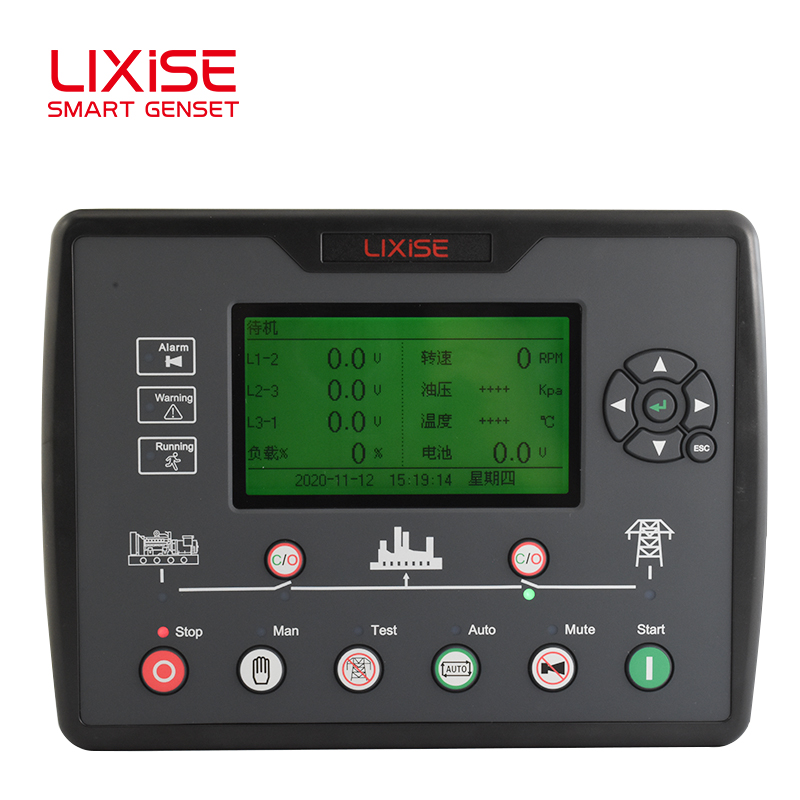
LIXISE has addressed this challenge through the LXC6620N-4G Generator Controller, an integrated platform that consolidates monitoring, protection, and communication functions into a single industrial-grade device. By embedding native 4G cellular connectivity and GPS positioning directly into the controller architecture, this approach eliminates the need for external DTUs and reduces overall system component count by approximately 40 percent compared to traditional multi-module configurations.
The integrated design philosophy extends beyond simple component consolidation. The controller implements comprehensive battery voltage monitoring as part of a unified electrical protection framework that simultaneously tracks generator-side parameters (voltage, current, frequency, power factor), engine-side metrics (oil pressure, coolant temperature, RPM), and mains-side conditions. This holistic visibility enables intelligent protection actions that consider the complete system state rather than isolated sensor readings.
Advanced Protection Through Graded Response Actions
Effective generator protection requires more than simple threshold monitoring—it demands context-aware decision-making that balances equipment protection against operational continuity. The LXC6620N implements a three-tier protection hierarchy: warnings for early anomaly detection, controlled stops for non-critical faults, and immediate trips for conditions that threaten equipment damage.
For battery voltage monitoring specifically, this graded approach means the controller can warn operators when voltage drops below optimal charging levels (typically 26-28V for 24V systems), trigger maintenance alerts when sustained undercharging indicates alternator problems, and prevent start attempts when voltage falls below the minimum threshold required for reliable cranking. This intelligent protection prevents both unnecessary shutdowns and equipment damage from electrical anomalies.
The controller's fault recording capability captures 18 seconds of detailed event data during protection actions, logging voltage transients, current spikes, and sequential state changes with millisecond resolution. This forensic data proves invaluable for diagnosing intermittent electrical problems that traditional controllers miss entirely. Combined with 120 seconds of continuous real-time logging, operators gain unprecedented insight into system behavior before, during, and after fault conditions.
Native 4G Connectivity: Eliminating the Remote Monitoring Bottleneck
The promise of remote generator monitoring has historically been undermined by the complexity and cost of communication infrastructure. External DTUs require separate power supplies, additional mounting space, independent cellular subscriptions, and custom integration with each controller model. This fragmented approach creates deployment friction that often limits remote monitoring to only the highest-value installations.
LIXISE's integration of 4G full-network connectivity directly into the LXC6620N controller architecture fundamentally changes the economics and practicality of remote monitoring. Facility managers can access real-time battery voltage data, engine parameters, and electrical metrics from any internet-connected device without installing additional hardware. Remote parameter modification, diagnostic report retrieval, and firmware updates all become standard capabilities rather than premium features requiring expensive add-on modules.
The native GPS integration provides automatic location tracking for mobile generator sets and enables geo-fenced security alerts for stationary installations. This capability proves particularly valuable for construction projects, emergency response equipment, and telecommunications base stations in remote locations where physical site visits may require hours of travel time.
Multi-Engine Compatibility Through Open Protocol Support
Generator sets span a diverse ecosystem of engine manufacturers, each with proprietary communication protocols and parameter structures. The LXC6620N addresses this fragmentation through native support for J1939/CAN and RS485-Modbus protocols, enabling plug-and-play compatibility with major brands including Cummins, Weichai, Yuchai, Volvo, Deutz, Perkins, MTU, John Deere, Detroit Diesel, and Scania.
Pre-configured engine parameter profiles accelerate commissioning for system integrators and generator OEMs, reducing setup time from hours to minutes while ensuring accurate monitoring thresholds tailored to each engine family's characteristics. The controller's five analog sensor ports provide flexibility for integrating manufacturer-specific sensors or site-specific monitoring requirements beyond standard engine parameters.
Programmable I/O for Site-Specific Requirements
While standardized monitoring covers the majority of generator applications, many installations require custom interlocking logic, auxiliary equipment control, or integration with building management systems. The LXC6620N provides seven digital inputs, eight isolated relay outputs, and five analog sensor ports to accommodate these site-specific requirements without requiring external programmable logic controllers.
This programmable capability extends battery voltage monitoring beyond simple alerting. Operators can configure automatic load shedding when battery voltage drops during extended runtime, implement custom charging profiles for different battery technologies, or trigger backup battery bank switching in dual-battery configurations. The three-level password protection system (Administrator, Technician, Operator) ensures that critical programming remains secure while allowing appropriate personnel to access operational functions.
Industrial-Grade Reliability for Mission-Critical Applications
Data centers, telecommunications infrastructure, manufacturing facilities, and healthcare institutions cannot tolerate generator control failures during mains outages. The LXC6620N employs industrial-grade components rated for minimum five-year service life, with EMC-compliant hardware design that withstands the high-interference environment typical of generator enclosures. Isolated relay outputs with integrated surge protection and ESD shielding protect downstream equipment from electrical transients.
Wide-range power supply capability (8-36V DC) ensures continued operation despite battery voltage fluctuations during starting and charging cycles—a critical requirement that consumer-grade electronics cannot meet. The panel-mount design with standard cutout dimensions (215mm × 156mm × 51mm) facilitates retrofit installations in existing generator sets without requiring enclosure modifications.
The Business Case for Integrated Monitoring
The financial justification for advanced generator battery voltage monitoring extends beyond preventing individual start failures. Integrated controllers like the LXC6620N reduce total system cost by eliminating separate communication hardware (typical savings of $300-$800 per installation), decrease commissioning time by 40-60 percent through plug-and-play engine compatibility, and lower ongoing maintenance costs by enabling remote diagnosis that eliminates 70-80 percent of routine site visits.
For organizations managing distributed generator fleets—telecommunications providers with hundreds of base stations, data center operators with multiple facilities, or industrial manufacturers with backup power at numerous plants—these per-unit savings multiply into substantial operational improvements. The predictive maintenance enabled by continuous battery voltage monitoring and trend analysis further reduces costs by preventing expensive emergency repairs and extending battery service life through optimized charging management.
Conclusion
Generator battery voltage monitoring has evolved from a basic measurement function into a sophisticated component of integrated power management systems. The convergence of comprehensive electrical monitoring, intelligent protection logic, native cellular connectivity, and multi-engine compatibility in platforms like the LIXISE LXC6620N-4G Generator Controller represents the current state of industrial practice for organizations requiring reliable, cost-effective backup power management.
As facilities increasingly operate with lean maintenance staffing and distributed infrastructure, the ability to remotely monitor battery health, diagnose electrical anomalies, and prevent equipment damage through intelligent protection becomes not merely convenient but operationally essential. The integrated controller architecture eliminates the complexity and fragility of multi-component systems while delivering superior visibility and control—positioning organizations to achieve true unattended generator operation with confidence in power continuity when it matters most.
https://dgfeirui.en.alibaba.com/
Dongguan Feirui Electronics Co.,Ltd.
