High-Speed vs High-Pressure Laboratory Homogenizer: Which One Is Right for Your Lab?
Selecting the right laboratory homogenizer is one of the most important decisions for laboratories involved in pharmaceutical research, biotechnology, food science, cosmetics development, and material engineering. As laboratories increasingly demand higher sample quality, greater reproducibility, and scalable processing solutions, choosing between a high-speed laboratory homogenizer and a high-pressure laboratory homogenizer has become a common challenge.
Although both types of laboratory homogenizers are designed to produce uniform dispersions and emulsions, they rely on different working principles and deliver different performance characteristics. Selecting the wrong technology may lead to inconsistent particle size, reduced product stability, unnecessary operating costs, or limitations when scaling up production.
This guide compares high-speed and high-pressure laboratory homogenizers in detail, explaining how each technology works, where each performs best, and which factors laboratories should consider before making an investment.
Understanding Laboratory Homogenization
Homogenization is a mechanical process used to reduce particle size, disperse solid particles, create stable emulsions, and produce homogeneous mixtures. It plays an essential role in improving sample consistency, extraction efficiency, and formulation stability.
Depending on the application, laboratories may require different levels of shear force, pressure, processing capacity, and particle size reduction. These requirements largely determine whether a high-speed or high-pressure laboratory homogenizer is the better choice.
What Is a High-Speed Laboratory Homogenizer?
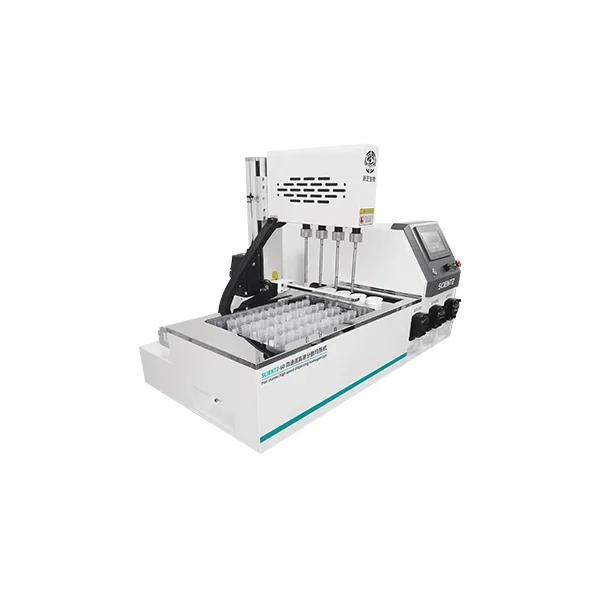
A high-speed laboratory homogenizer uses a rotor-stator system to generate intense mechanical shear. As the rotor spins at high speed within the stator, materials are rapidly drawn into the mixing head, subjected to strong shear forces, and discharged as finely dispersed mixtures.
The homogenization process mainly depends on:
-
Mechanical shear
-
Turbulence
-
Impact forces
-
Localized pressure differences
Rotor speeds typically range from 5,000 to 30,000 RPM, depending on the model and application.
Typical Applications
High-speed laboratory homogenizers are commonly used for:
-
Cosmetic creams
-
Lotions
-
Gels
-
Food emulsions
-
Cell suspensions
-
Pigment dispersions
-
Laboratory mixing
-
Sample preparation
Their simple operation and relatively low cost make them popular in general laboratory environments.
What Is a High-Pressure Laboratory Homogenizer?
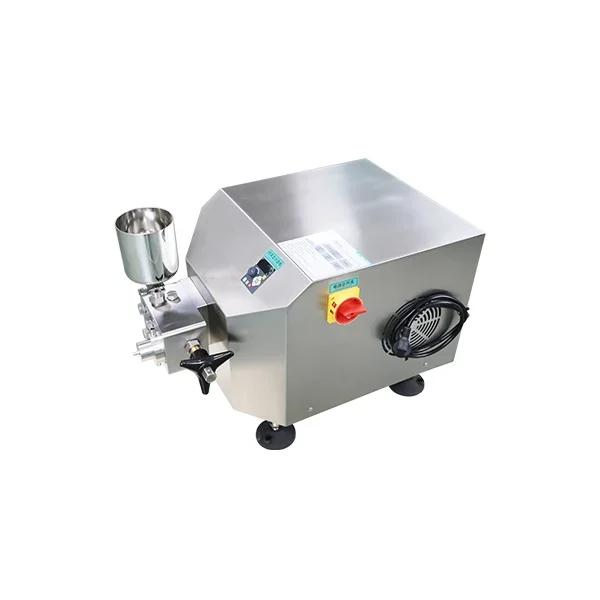
Unlike rotor-stator systems, a high-pressure laboratory homogenizer forces liquid through an extremely narrow homogenization valve under very high pressure.
As the sample passes through the valve, it experiences:
-
High-pressure acceleration
-
Extreme shear
-
Cavitation
-
Turbulence
-
Particle collision
These combined forces reduce particle size to the micron or even nanometer level while producing highly uniform dispersions.
Operating pressures commonly range from 500 to 2,000 bar, with some specialized systems exceeding this range.
Typical Applications
High-pressure laboratory homogenizers are widely used for:
-
Nanoemulsions
-
Liposomes
-
Vaccine development
-
Drug delivery systems
-
Protein extraction
-
Cell disruption
-
Nanoparticles
-
Pharmaceutical suspensions
-
Biotechnology research
They are particularly valuable when precise particle size distribution and excellent reproducibility are required.
How Each Technology Works
Although both systems perform homogenization, their working mechanisms differ significantly.
High-Speed Homogenization Process
A high-speed homogenizer relies on mechanical rotation. The rapidly spinning rotor generates centrifugal force, drawing materials into the rotor-stator gap where they are subjected to intense shear and turbulence before being expelled back into the sample.
Advantages include:
-
Fast processing
-
Simple operation
-
Low equipment cost
-
Flexible handling of different viscosities
However, particle size reduction is limited by the mechanical design of the rotor-stator assembly.
High-Pressure Homogenization Process
High-pressure homogenizers compress the sample using powerful pumps before forcing it through a precision-engineered homogenization valve.
During this process, particles experience:
-
Instant pressure drop
-
Cavitation
-
High-velocity impact
-
Turbulent flow
-
Strong shear forces
This combination produces much finer and more consistent particle sizes than mechanical shear alone.
High-Speed vs High-Pressure Laboratory Homogenizer: Key Differences
Choosing between these two technologies requires understanding their strengths and limitations across several performance criteria.
Homogenization Principle
High-Speed Laboratory Homogenizer
-
Rotor-stator mechanical shear
-
Turbulence
-
Mixing
-
Moderate particle reduction
High-Pressure Laboratory Homogenizer
-
High-pressure valve
-
Cavitation
-
Impact
-
Ultra-fine particle reduction
Particle Size Reduction
Particle size is often the most important purchasing consideration.
High-speed homogenizers typically produce:
-
1–10 μm particles
-
Stable emulsions for routine laboratory work
High-pressure homogenizers can achieve:
-
Below 500 nm
-
Below 200 nm for certain formulations
-
Uniform nanoemulsions
-
Narrow particle size distribution
For pharmaceutical and nanotechnology applications, high-pressure systems generally offer superior performance.
Emulsion Stability
Stable emulsions require uniform droplet sizes.
High-pressure homogenizers usually provide:
-
Better long-term stability
-
Lower risk of phase separation
-
Improved suspension quality
-
Enhanced shelf life
High-speed homogenizers are suitable for many formulations but may require stabilizers or repeated processing to achieve comparable stability.
Sample Volume
High-speed laboratory homogenizers are well suited for:
-
Small laboratory batches
-
Medium sample volumes
-
Flexible experimental work
High-pressure systems are available for:
-
Small research samples
-
Pilot production
-
Continuous processing
-
Scale-up manufacturing
Laboratories planning future production often prefer high-pressure systems due to their scalability.
Processing Speed
High-speed homogenizers generally process samples quickly with minimal setup.
High-pressure homogenizers may require:
-
Pressure adjustment
-
System priming
-
Multiple passes
However, fewer processing cycles are often needed to achieve the desired particle size.
Temperature Rise
Heat generation can affect sensitive biological materials.
High-speed homogenizers produce moderate heat during prolonged operation.
High-pressure homogenizers can generate significant temperature increases due to compression.
Many advanced systems therefore include:
-
Cooling jackets
-
Heat exchangers
-
Temperature monitoring
-
Continuous cooling systems
Temperature control is especially important in pharmaceutical and biotechnology laboratories.
Sample Viscosity
High-speed homogenizers generally handle medium- to high-viscosity materials effectively, making them suitable for creams, gels, and pastes.
High-pressure homogenizers are typically optimized for liquid formulations and low- to medium-viscosity samples. Extremely viscous materials may require pre-processing before high-pressure homogenization.
Advantages of High-Speed Laboratory Homogenizers
For many laboratories, high-speed homogenizers offer an excellent balance between performance, simplicity, and affordability.
Lower Initial Investment
Compared with high-pressure systems, high-speed laboratory homogenizers generally have lower purchase costs, making them attractive for universities, research institutes, and laboratories with limited budgets.
Easy Operation
Most models feature intuitive controls and straightforward maintenance, allowing new users to become proficient with minimal training.
Flexible Sample Processing
High-speed homogenizers can process a wide variety of materials, including:
-
Liquid-liquid mixtures
-
Liquid-solid suspensions
-
Cosmetic formulations
-
Food ingredients
-
Polymer dispersions
Compact Design
Their relatively small footprint makes them ideal for laboratories where bench space is limited.
Reduced Maintenance
Rotor-stator systems typically contain fewer complex components than high-pressure systems, resulting in lower routine maintenance requirements.
Advantages of High-Pressure Laboratory Homogenizers
High-pressure laboratory homogenizers are designed for applications requiring exceptional precision and consistency.
Superior Particle Size Reduction
The combination of cavitation, turbulence, and impact enables high-pressure systems to produce nanoparticles and highly uniform emulsions that are difficult to achieve with rotor-stator technology.
Excellent Reproducibility
Because processing parameters such as pressure and flow rate can be precisely controlled, high-pressure homogenizers deliver highly repeatable results—an essential requirement for regulated industries.
Better Scale-Up Potential
One of the greatest advantages of high-pressure homogenization is its scalability. Many manufacturers offer laboratory, pilot, and industrial systems based on the same operating principle, simplifying technology transfer from R&D to commercial production.
Ideal for Advanced Formulations
Applications that benefit from high-pressure homogenization include:
-
Lipid nanoparticles
-
Liposomes
-
Injectable suspensions
-
Vaccines
-
Monoclonal antibody formulations
-
Nanoemulsions
Conclusion
Choosing between a high-speed laboratory homogenizer and a high-pressure laboratory homogenizer ultimately depends on your laboratory’s research objectives, sample characteristics, and long-term development plans.
A high-speed laboratory homogenizer is an excellent choice for routine sample preparation, emulsification, dispersion, and mixing. It offers lower investment costs, ease of operation, and versatility across applications such as cosmetics, food science, and general laboratory research.
In contrast, a high-pressure laboratory homogenizer is the preferred solution for laboratories requiring nanoscale particle reduction, superior emulsion stability, high cell disruption efficiency, and seamless scalability from research to pilot or commercial production. Although it involves a higher initial investment, it provides exceptional precision, repeatability, and long-term value for pharmaceutical, biotechnology, and nanotechnology applications.
Before making a purchasing decision, laboratories should evaluate factors such as homogenization technology, particle size requirements, sample volume, viscosity, temperature sensitivity, maintenance needs, and future scale-up plans. Working with an experienced laboratory homogenizer manufacturer that offers comprehensive technical support and scalable solutions can further ensure that your investment continues to deliver reliable performance as your research evolves.
By carefully matching equipment capabilities to your laboratory's specific applications, you can improve experimental consistency, increase operational efficiency, and establish a strong foundation for future innovation and product development.
www.dscientz.com
dscientz
