How Automatic Tube End Forming Machines Improve Modern Metal Tube Production
Metal tubes are essential components in many industries, including automotive manufacturing, construction, shipbuilding, industrial equipment, aerospace, and fluid transportation. As manufacturers face higher production volumes and stricter quality requirements, traditional tube processing methods are becoming increasingly difficult to maintain.
Tube ends often need to be expanded, reduced, pressed, profiled, or shaped before they can be connected to other components. When these operations rely heavily on manual adjustments or multiple machines, production can become slower and less consistent.
This is why automatic tube end forming machines are gaining attention in modern manufacturing. By combining automated forming processes, servo control, precision tooling, and flexible production configurations, these machines can help manufacturers improve productivity while maintaining consistent tube dimensions.
Jiangsu Yan Ruilin Precision Machinery Co., Ltd. specializes in the development and manufacturing of metal tube forming equipment. Its Automatic Tube End Forming Machine is designed for manufacturers that require efficient and repeatable solutions for metal tube processing.
Why Tube End Forming Is Important
A metal tube may appear to be a simple component, but its end geometry can have a major influence on the final assembly.
Depending on the application, tube ends may need to be processed to:
-
Create a connection interface
-
Match another component
-
Increase or reduce tube diameter
-
Form a specific profile
-
Improve assembly accuracy
-
Support sealing requirements
For example, automotive exhaust components may require precisely shaped tube ends for reliable assembly, while industrial piping systems may require specific profiles to connect different sections.
If the forming process is inconsistent, manufacturers may encounter dimensional deviations, difficult assembly, material deformation, or increased rejection rates.
Automatic forming equipment provides a more controlled approach by using programmed forming parameters and dedicated tooling to produce repeatable results.
Automation Helps Improve Production Efficiency
One of the main reasons manufacturers invest in automatic tube end forming equipment is productivity.
Traditional tube processing may require several individual operations. Operators may need to move the tube between machines, adjust tooling, check dimensions, and repeat the process for different forming stages.
This creates additional handling time and increases the possibility of human error.
An automatic tube end forming machine can integrate multiple forming operations into a streamlined process. Depending on the machine configuration, operations may include:
-
Press fitting
-
Ring pressing
-
Profile expansion
-
Profile reduction
-
Customized end forming
By reducing unnecessary material handling and machine changes, manufacturers can improve production flow and make better use of available factory space.
For high-volume production, even a small reduction in processing time per tube can create a significant improvement in overall output.
Dual-Station Design Supports High-Volume Production
For demanding production environments, machine configuration is particularly important.
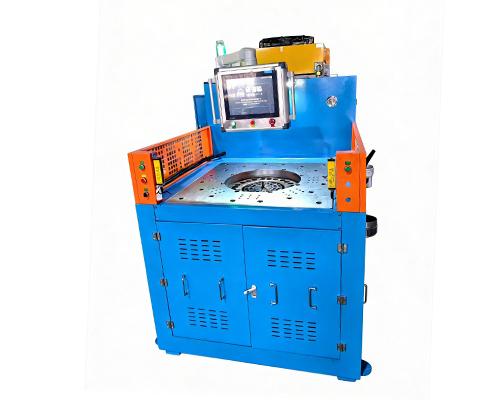
Yan Ruilin's SCX-380 vertical dual-station tube end forming system is designed for relatively large metal tubes, supporting tube diameters from 150 mm to 380 mm and wall thicknesses from 1.0 mm to 7.0 mm.
The dual-station structure provides greater flexibility for production planning. Different forming operations can be arranged according to the requirements of the workpiece, helping manufacturers reduce unnecessary equipment transitions.
This type of configuration is especially useful for companies producing large quantities of formed tube components and looking to improve production continuity.
Precision Is Essential for Tube End Forming
Production speed is only valuable when the finished products meet dimensional requirements.
Tube components are often assembled with other mechanical parts, so even relatively small dimensional deviations can affect installation and final product performance.
Modern automatic tube forming equipment uses servo-driven systems, positioning mechanisms, and controlled forming processes to improve repeatability.
The SCX-380 is designed to achieve forming accuracy of approximately ±0.04 mm under appropriate production conditions.
Accurate forming can help manufacturers achieve:
-
Consistent tube dimensions
-
Better assembly compatibility
-
Reduced rejection rates
-
More stable production quality
-
Improved process repeatability
For OEM manufacturers, consistent production quality is particularly important because large batches of components need to meet the same technical specifications.
Advanced Tooling Helps Protect Tube Quality
The forming process applies considerable force to the metal tube. If tooling design or material selection is inadequate, the tube surface may experience scratches, excessive deformation, or other defects.
For this reason, tooling is an important part of the overall performance of a tube end forming machine.
Yan Ruilin uses wear-resistant alloy tooling for demanding forming applications. Combined with controlled extrusion and positioning processes, the tooling system is designed to maintain stable forming conditions while minimizing unnecessary surface damage.
Good tooling design can also contribute to longer tool service life and more consistent production results.
For manufacturers working with stainless steel, carbon steel, and other metal tube materials, choosing appropriate tooling according to the material and forming process is essential.
Flexible Forming Capabilities for Different Tube Designs
Not every tube component has the same geometry.
Different industries may require different end profiles depending on assembly methods, connection structures, and functional requirements.
A flexible automatic tube end forming system can therefore provide advantages over equipment designed for only one fixed operation.
Manufacturers may need processes such as:
Profile Expansion
Expanding the tube end can create a larger connection area or achieve a specified external profile.
Profile Reduction
Reducing the diameter of a tube end can allow it to fit another component or create a stepped structure.
Ring Pressing
Ring pressing can be used when a specific groove or reinforced profile is required.
Press Fitting
Press fitting operations can help create accurately formed connection sections for downstream assembly.
The ability to combine different forming processes gives manufacturers more flexibility when handling different product specifications.
Automation Makes Future Production Lines More Flexible
Manufacturing is increasingly moving toward automated and connected production.
A modern tube forming machine should therefore be considered not only as an individual piece of equipment but also as part of a larger production system.
Automatic tube end forming machines can potentially be integrated with:
-
Automatic feeding systems
-
Robotic loading and unloading
-
Material handling systems
-
Vision inspection equipment
-
Production monitoring systems
The SCX-380 provides reserved automation interfaces, allowing customers to develop more advanced production configurations according to their factory requirements.
This can help manufacturers gradually transition from semi-automated production toward more integrated manufacturing systems.
Where Are Automatic Tube End Forming Machines Used?
The application range of tube end forming equipment is broad.
Automotive Manufacturing
Automotive exhaust systems and other vehicle components require accurately formed metal tubes. Consistent end dimensions are important for reliable assembly and production efficiency.
Construction and Infrastructure
Large-diameter tubes are used in infrastructure, drainage, water transportation, and other engineering projects. Automated forming can improve the consistency of pipeline components.
Shipbuilding
Ships contain extensive piping systems for water, fuel, ventilation, and other functions. Efficient tube forming equipment can support the production of accurately shaped pipe components.
Industrial Equipment
Industrial machinery, heat exchangers, hydraulic equipment, and other systems may use specially shaped tubes. Flexible forming equipment allows manufacturers to process components according to specific engineering requirements.
Customized Metal Fabrication
Companies producing different tube products in relatively small or medium batches can also benefit from programmable forming systems and customized tooling.
Why the Manufacturer Matters
The performance of a tube end forming machine depends on more than its basic specifications. Engineering experience, tooling capabilities, machine manufacturing quality, and after-sales support can all affect the long-term value of the equipment.
Jiangsu Yan Ruilin Precision Machinery Co., Ltd. has focused on tube forming equipment for many years and has developed extensive experience in customized forming solutions.
The company has more than 1,000 custom casing section forming molds and has delivered more than 1,000 machines to customers in different markets.
Its manufacturing facility includes CNC lathes, machining centers, wire cutting equipment, and other production resources. These capabilities allow the company to control important manufacturing processes internally.
For customers with special tube dimensions or forming requirements, this engineering and tooling experience can be particularly valuable.
What Should Buyers Consider Before Purchasing?
Before selecting an automatic tube end forming machine, manufacturers should evaluate more than forming speed.
Important considerations include:
Tube diameter: The machine should accommodate the required range of tube sizes.
Wall thickness: Different material thicknesses require appropriate forming force and tooling.
Material: Stainless steel, carbon steel, aluminum, and other materials may require different process parameters.
Required forming operations: Buyers should determine whether they need expansion, reduction, pressing, ring forming, or several processes.
Production volume: High-volume production may benefit from dual-station or automated configurations.
Automation requirements: Consider whether the machine needs to connect with feeding, robotic, or inspection systems.
Tooling requirements: Customized tooling may be necessary for special tube profiles.
Taking these factors into account before purchasing can help manufacturers select equipment that better matches their actual production conditions.
The Future of Automatic Tube Forming
As manufacturing becomes more automated, tube forming technology will continue moving toward higher precision, greater flexibility, and improved production intelligence.
Future developments are likely to focus on:
-
More precise servo control
-
Faster forming cycles
-
Intelligent process monitoring
-
Automated quality inspection
-
Flexible tooling systems
-
Robotic production integration
-
Improved energy efficiency
Manufacturers that adopt advanced tube forming technology can build more stable production processes while reducing dependence on manual operations.
Conclusion
Automatic tube end forming machines provide an effective solution for manufacturers that need to improve metal tube production efficiency, precision, and consistency.
By integrating automated forming processes, servo control, precision positioning, durable tooling, and automation interfaces, modern equipment can handle a wider range of tube processing requirements while reducing unnecessary production steps.
For automotive, construction, shipbuilding, industrial equipment, and customized metal fabrication applications, choosing the right forming technology can have a direct impact on production efficiency and product quality.
With extensive manufacturing experience, customized tooling capabilities, and a focus on precision tube forming, Jiangsu Yan Ruilin Precision Machinery Co., Ltd. provides practical equipment solutions for manufacturers looking to modernize their tube processing operations.
www.tubeendforming.com
Your Trusted Partner
