How Qingdao Xuxiangtai Machinery Manufacturing Co., Ltd. Supports OEM Production

Qingdao Xuxiangtai Machinery Manufacturing Co., Ltd. supports OEM production through integrated capabilities in its 26,200 m² Qingdao plant. Casting, precision CNC machining, sheet metal fabrication, metal 3D printing, surface treatment, and assembly operate under one roof. OEM buyers receive build-to-drawing parts and assemblies from a single accountable partner. Order volumes stay flexible, from prototype sampling to mass production. Every order carries documented quality: 100% dimensional inspection, material validation reports, and non-destructive testing. Teams can create an approximately 1,000-word buyer checklist to organize requirements before production begins.
Key Takeaways
- Xuxiangtai offers casting, machining, fabrication, 3D printing, and assembly all in one plant. This saves time and simplifies your supply chain.
- You can start with a single prototype and scale up to mass production with the same partner. This ensures consistency and reduces hassle.
- Every order includes thorough quality checks and documentation. You get reliable parts and peace of mind.
OEM Services and Integrated Plant Capabilities
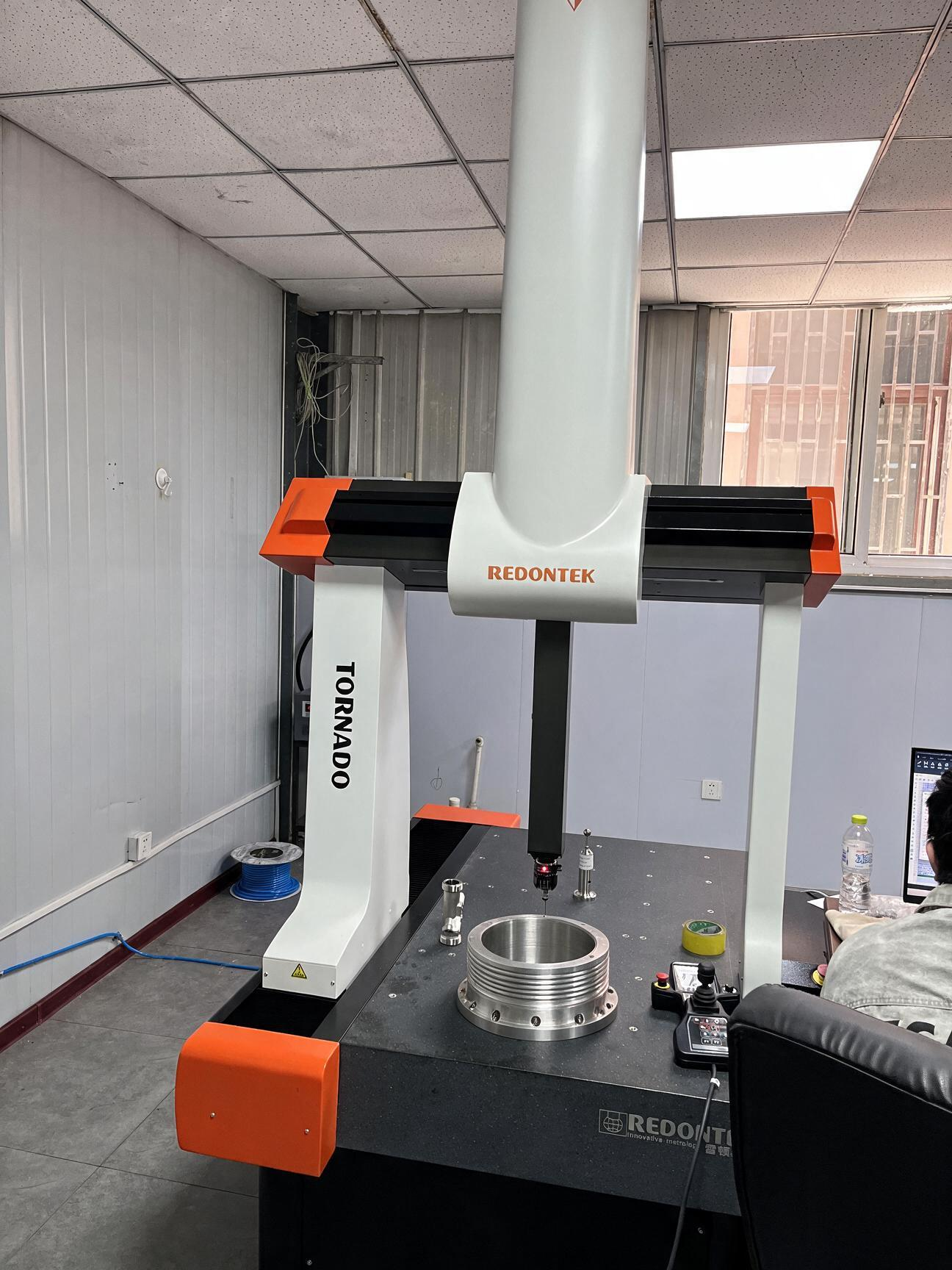
Qingdao Xuxiangtai Machinery Manufacturing Co., Ltd. operates as a custom industrial mechanical component manufacturer with a clear business positioning: it builds metal parts and assemblies to customer drawings, samples, material specifications, and technical documents. The company serves OEM buyers, ODM buyers, engineering managers, and product innovators across automotive, aerospace, medical devices, renewable energy, and heavy industrial equipment. Its service areas cover custom mechanical parts manufacturing, OEM production, and build-to-drawing manufacturing. The plant in Jimo, Qingdao, holds a 26,200 m² production base and supports export business to markets worldwide. More than 130 international clients have worked with the company, and the team has completed more than 460 industrial custom manufacturing projects.
Build-to-Drawing and Build-to-Print Part Manufacturing
Build-to-drawing and build-to-print manufacturing place design ownership with the OEM. The customer releases a drawing package, and the manufacturer builds to that package. Acceptance depends on conformance to the customer-authored drawing and its stated materials, tolerances, finishes, and acceptance criteria. Fabcon describes this model as a good fit for programs with strong internal engineering and a validated design, where the OEM wants manufacturing accountability while keeping design ownership. Changes move through a new drawing revision issued by the design owner.
This approach differs from build-to-spec and design-build work. In build-to-spec, the fabricator owns more design detail and carries design risk. In design-build, design control is shared or transferred. The table below summarizes the tradeoffs.
| Approach | Design ownership | Design risk | Acceptance basis | Best fit |
|---|---|---|---|---|
| Build to print | OEM owns the design IP | OEM carries design-defect liability | Conformance to the customer-authored drawing and its stated materials, tolerances, finishes, and acceptance criteria | Programs with strong internal engineering and a released drawing; validated designs where the OEM wants manufacturing accountability while keeping design ownership |
| Build to spec | Fabricator owns more design detail | Fabricator carries design risk and may adjust the design within the agreed requirements | Performance or industry specification | Evolving designs or programs with limited internal engineering resources where no validated drawing exists |
| Design-build | Shared or transferred | Shared or transferred | — | Programs where the OEM trades some design control for integrated engineering support |
Build-to-print work also relieves pressure on the OEM's internal resources. PEKO Precision Products notes that outsourcing full machines or modules can release thousands of internal assembly hours. Engineering teams stay focused on innovation instead of firefighting production issues. Stable drawings, bills of materials, and acceptance criteria make replication reliable and repeatable. Compared with design-to-spec, build-to-print services compress time-to-revenue by concentrating on execution: BOM control, work instructions, sourcing, assembly, test, and fulfillment.
Xuxiangtai applies this model to custom mechanical parts manufacturing. Customers submit drawings, samples, material specifications, and technical documents. The engineering team reviews each package and confirms the manufacturing route before production begins. This communication step matters for industrial equipment manufacturers and mechanical component buyers. A clear drawing package and a clear process plan reduce surprises at inspection.
Casting, Machining, Fabrication, and 3D Printing Under One Roof
Xuxiangtai combines casting, precision CNC machining, sheet metal fabrication, metal 3D printing, surface treatment, and assembly in a single plant. Each process serves a different component requirement. Casting handles complex shapes and durable structural parts. Precision machining delivers tight tolerances on metal alloys. Sheet metal fabrication covers flat metal processing, forming, and structural welding. Metal 3D printing addresses complex internal channels and topological structures. Surface treatment adds corrosion resistance and cosmetic finish. Assembly brings the finished parts together.
Integrated plants of this kind typically offer a broad process menu. Fathom Manufacturing lists large-format sheet metal fabrication, laser cutting, photochemical etching, water jet cutting, molding, extrusion, die casting, assembly and finishing, and inspection services that include destructive and non-destructive testing. Xuxiangtai's own process set follows the same logic. The company runs 5-axis CNC milling, turning and composite machining, EDM, drilling, tapping, die casting, precision investment casting, sand casting, forging, and metal 3D printing. Spectral analysis verifies material integrity. Non-destructive testing covers PT, RT, and pressure testing.
The one-roof structure changes how process decisions get made. A provider that offers 3D printing, CNC machining, and casting together can model tradeoffs against actual part geometry and volume before committing to tooling, as fi9design explains. Production decisions often come down to matching the process to the part. Manufacturers who weigh additive, subtractive, and casting options for each application typically get better throughput and cost outcomes than those who commit to a single method.
Additive Manufacturing Media describes the practical benefits of vertical integration between metal 3D printing and machining. Machinists and additive engineers sit under the same roof and meet before printing. They discuss build plate removal, support structure removal, workholding, locating datums, and extra stock for machining. The company can guide a customer toward the correct manufacturing modality, whether that is printing plus machining or machining alone. Engineers plan for post-processing before the build starts, because a printed part carries a lot of added value by the time it reaches the machine. Customers consolidate their supply chains to one vendor number and one small team. Lead times shorten. Harbec, cited in the same article, stocks a variety of metal powders and can have printers running within 24 hours depending on part geometry.
FST Metals, as described in a company post on LinkedIn, integrates sheet metal fabrication, CNC machining, stamping, welding, surface treatment, and final assembly within eight wholly-owned facilities. With 85 CNC units and specialized sheet metal workshops under one operational umbrella, the company ensures tighter tolerance control on complex assemblies such as welded CNC inserts. This structure supports rapid iteration from prototype to mass production while maintaining consistent quality standards. Xuxiangtai's integrated model follows the same principle at its Qingdao plant. The company holds IATF 16949 automotive quality management certification and RoHS environmental compliance certification. Components meet Class 150/300 international pressure rating standards.
From Prototype Sampling to Mass Production
Xuxiangtai supports flexible order volumes. A program can start with prototype sampling and move to mass production without changing partners. This continuity matters because prototype and production stages place different demands on a design. Avid Product Development outlines a practical sequence for this transition.
- Validate the prototype thoroughly. Stress-test for form, fit, and function with end-users and engineers. Use small-batch runs to test assembly and durability. Fixing flaws at the prototype stage costs 10 to 100 times less than fixing them after tooling.
- Apply Design for Manufacturing. Build efficiency and scalability into the design from the start. Reduce part count, simplify shapes for easier tooling, and select materials that are cost-effective and available in bulk.
- Choose the right materials and processes. Prototyping materials often differ from production-grade materials. Each process has tradeoffs: casting for volume and complex shapes, CNC machining for precision, additive manufacturing for flexibility.
- Build quality into the process. Establish checkpoints at each phase, including CAD reviews, prototype inspections, and pre-production tests. Document and refine processes for repeatability.
- Scale with pilot production runs. Small pilot runs evaluate manufacturability, assembly workflows, and supply chain readiness. They expose hidden costs and inefficiencies before full volume begins.
- Leverage expert partnerships. Scaling requires knowledge in DFM, compliance standards, and process optimization.
- Meet certifications before production. Industry-specific standards are often mandatory. Overlooking them can delay launch or block market entry.
Studio Red adds two practical points. Teams should set a realistic budget and timeline, and they should prepare to trade off speed, cost, and quality. Intellectual property deserves attention as well. Patent filings, non-disclosure agreements with vendors, restricted access to key files, and controlled information sharing all protect the design during sourcing.
Xuxiangtai's service model covers this full arc. The company handles mold design, rapid prototyping, metal casting, sheet metal fabrication, precision machining, surface treatment, quality testing, and assembly. A buyer can sample a design, approve it, and scale it with the same team. The 460-plus completed projects and 20-plus years of export shipping experience support this continuity.
DFM Review and Engineering Support
A Design for Manufacturing review is a structured engineering review of a part or assembly, run before tooling is cut. Laszeray describes what a real DFM review examines. It checks whether the geometry can be reliably manufactured at the required tolerances. It checks whether the specified material fits the process and the environment. It asks whether tooling can produce the part cleanly, or whether design changes would improve moldability, machinability, or assembly. It also asks whether cost drivers can be reduced without compromising performance.
Classic DFM findings include inconsistent wall thickness, insufficient draft, poorly placed gates, undercuts that require complex tooling, and features that will sink or warp. Other findings include hard-to-access features, tolerances tighter than needed, secondary operations that a design tweak could avoid, fixturing challenges, and geometry that requires expensive setups. Assembly findings cover tolerance stack-up across mating parts, features that interfere in worst-case assembly, hand-fit steps, and cosmetic seams. Material findings cover grades that are wrong for the environment, wrong for the process, or unnecessarily premium. Cost findings cover features that add tooling complexity, wall sections that add cycle time, and tolerances that force expensive inspection.
PEKO Precision Products provides DFM services for OEMs that need practical engineering feedback before a design moves into production, transfer, or scale-up. Its team reviews complex machinery, equipment, fabricated structures, precision components, mechanical assemblies, and electromechanical systems. The goal is to identify manufacturability risks before they affect cost, quality, lead time, or production readiness. Because the engineering group works alongside machining, sheet metal fabrication, welding, assembly, inspection, testing, supply chain, and program management teams, its recommendations reflect how products are actually built. DFM analysis may cover part geometry, material selection, process feasibility, tolerance strategy, fabrication methods, machining requirements, welding requirements, finishing needs, tooling requirements, assembly complexity, inspection burden, documentation needs, and production-readiness risks. For complex OEM products, the team also applies Design for Assembly and Design for Manufacturing and Assembly considerations.
Xuxiangtai offers DFM review and structural optimization as part of its technical support. The engineering team works with CAD/CAM integration and multi-axis CNC setups. Recommendations stay grounded in the actual equipment and processes on the shop floor. A buyer receives feedback on geometry, material choice, tolerance strategy, and assembly before the first chip is cut. This early review protects the program schedule and keeps cost drivers visible.
Buyers who want to discuss a component can send drawings, samples, or technical documents to Blayden@xuxiangtaimetal.com. The team will review the package and respond with a manufacturing plan and quote.
Quality Control, Project Workflow, and Sourcing Fit

Quality control, workflow clarity, and sourcing strategy decide whether an OEM program runs smoothly or stalls. Xuxiangtai addresses all three with documented inspection, a defined RFQ-to-delivery path, transparent cost drivers, and honest guidance on single-source versus multi-supplier sourcing. Each element connects to the others. A clear workflow produces reliable inspection data. Reliable data supports better sourcing decisions. Better sourcing decisions protect cost and lead time.
In-Process Inspection, Final Testing, and Documentation
Inspection at Xuxiangtai follows a three-stage structure that mirrors standard OEM contract manufacturing practice. Pelagus describes these stages as incoming supplier inspection, in-process inspection, and outgoing inspection before dispatch. At each stage, the manufacturer compares output against the OEM's approved drawing, material specification, and acceptance criteria. Critical components receive dimensional checks, material certificate verification, and surface finish measurement. Xuxiangtai applies this structure with 100% dimensional inspection, material validation reports, and non-destructive testing that covers PT, RT, and pressure testing.
In-process inspection catches problems while parts are still on the machine. Shamrock Precision lists the core methods used across precision manufacturing:
- Non-destructive testing (NDT) uses ultrasonic testing, radiography, and magnetic particle inspection to detect internal defects without damaging the component.
- Dimensional inspection measures part features against specifications, and coordinate measuring machine (CMM) technology handles much of this work.
- Material analysis relies on spectroscopy and microscopy to confirm composition and detect impurities.
- Advanced machinery, including precise CNC equipment and 3D scanners, produces and inspects components at high accuracy.
- Automated inspection systems use robotics and artificial intelligence to inspect parts quickly and consistently.
The 6sigma.us quality inspection guide separates in-process activity from final testing. In-process inspection monitors critical production parameters such as temperature and pressure, evaluates work-in-progress at defined checkpoints, conducts first article inspections on initial production runs, and verifies process capability through statistical process control. Final inspection then covers appearance and cosmetic attributes, dimensional accuracy and tolerances, functionality and performance, safety features and compliance, and packaging and labeling integrity. Xuxiangtai's own quality system follows this split. First article inspection runs before serial production begins. In-process checks follow at critical transitions. Final inspection releases each lot.
CMM inspection itself follows a repeatable sequence, as GD&T Inc. explains:
- Part setup and fixturing secures the workpiece with appropriate fixtures and clamps while keeping critical features and datums accessible.
- Program selection and calibration loads the inspection program for the part geometry and calibrates the probe for accuracy and repeatability.
- Dimensional measurement executes routines that capture critical dimensions, geometric tolerances, and surface profiles per engineering specifications.
- Data analysis compares measured values against design specifications and tolerance limits, flagging deviations that require process adjustment or part rejection.
- Documentation and reporting generate inspection reports with measurement data, statistical analysis, charts, graphs, and image captures.
Inspection intervals at Xuxiangtai follow time-based schedules, quantity-based sampling, and observation-driven assessments. Key checkpoints include first article inspection, critical process transitions after machining, welding, heat treatment, and surface finishing, process adjustments after tool changes or material substitutions, and pre-assembly verification.
Documentation turns inspection into evidence. Aprios describes the records that support process validation: mold history records for every modification or repair, recorded process parameters for each production run, material lot numbers with suppliers and certificates of analysis, and inspection reports with maintenance logs. Hubs groups the full documentation set into clear categories:
| Category | Documentation | Description |
|---|---|---|
| Materials | Material certificates | Verify composition, properties, and quality of materials for traceability and standards compliance |
| Materials | Material test report | Covers mechanical and chemical testing that validates material specifications |
| Inspection and testing | Certificate of Conformance | Asserts adherence to specified requirements and quality standards |
| Inspection and testing | Dimensional Inspection Report (CMM) | Provides precise CMM measurements against dimensional specifications |
| Inspection and testing | ISO 2859-1 sampling standards | Govern product sampling for representative inspection |
| Regulatory compliance | RoHS certificates | Confirm freedom from restricted hazardous substances |
| Regulatory compliance | REACH certificate | Affirms compliance with EU chemicals regulation |
| Quality assurance | First Article Inspection (FAI) | Compares initial production samples against engineering specifications |
| Quality assurance | IATF 16949 | Quality management standard for the automotive industry |
Xuxiangtai holds IATF 16949 automotive quality management certification and RoHS environmental compliance certification. Pelagus notes that EN 10204 material certification at level 3.1 or 3.2 is required for pressure-containing and safety-critical components, with the applicable level set by the relevant code or operator specification. Xuxiangtai components meet Class 150/300 international pressure rating standards, and the company issues material validation reports with each order. Approved drawings carry revision control, and engineering change orders require customer approval before production resumes. Traveller documentation requires a sign-off at each process stage before the next begins, which prevents missed heat treatment or incomplete welds. Jiako Precision describes the release package for precision components: certificate of conformance, material certification, dimensional inspection report, lot traceability record, and special-process certificates. Higher-risk applications may add cleaning verification, passivation records, and packaging controls. Xuxiangtai assembles this package for OEM buyers as standard practice.
Step-by-Step from RFQ to Delivery
A defined workflow removes guesswork from custom manufacturing. Xuxiangtai runs a seven-stage path from first contact to delivered parts.
- RFQ submission. The buyer sends drawings, 3D models, material specifications, quantities, and any technical documents. Samples help when drawings are incomplete.
- Engineering review and DFM feedback. The engineering team reviews the package for manufacturability. The team flags tolerance conflicts, material issues, and features that will drive cost. The buyer receives a written response with recommendations.
- Quotation. Xuxiangtai issues a quote that covers unit price, tooling where applicable, lead time, and documentation deliverables. The quote states assumptions so the buyer can compare offers on equal terms.
- Order confirmation and pre-production planning. Both parties approve the drawing revision. The team schedules material purchasing, tooling, and machine capacity.
- First article inspection. The first produced unit is inspected against every drawing requirement before serial production begins. Pelagus notes that issues caught at this stage cost a fraction of those caught in production. The buyer reviews and approves the FAI report.
- Production and in-process inspection. Serial production runs with checkpoints at critical transitions. Statistical process control monitors key parameters in real time to detect drift before defects appear.
- Final inspection, documentation, and shipping. Final inspection verifies dimensions, function, finish, and packaging. The documentation package ships with the parts. Export logistics follow the company's 20-plus years of shipping experience.
Each stage has a clear owner and a clear output. The buyer always knows what happens next and what the team needs to proceed.
What Drives Cost and Lead Time
Cost and lead time respond to a small set of controllable factors. Modus Advanced compares machining and casting across volume bands:
| Factor | Machining | Casting |
|---|---|---|
| Prototype timeline | Weeks | Tooling requires 20–25 weeks |
| Per-part cost (1–10 parts) | $200–$1,000 | Tooling cost prohibitive |
| Per-part cost (10–100 parts) | $200–$1,000 | $150–$300 with amortized tooling |
| Per-part cost (100–1,000 parts) | $200–$1,000 | $50–$150 |
| Per-part cost (1,000+ parts) | $200–$1,000 | $10–$50 |
| Tooling investment | $500–$5,000 for fixtures and programs | $25,000–$150,000 for molds |
Modus Advanced illustrates the same trend in a line chart that tracks casting cost per part as volume rises:
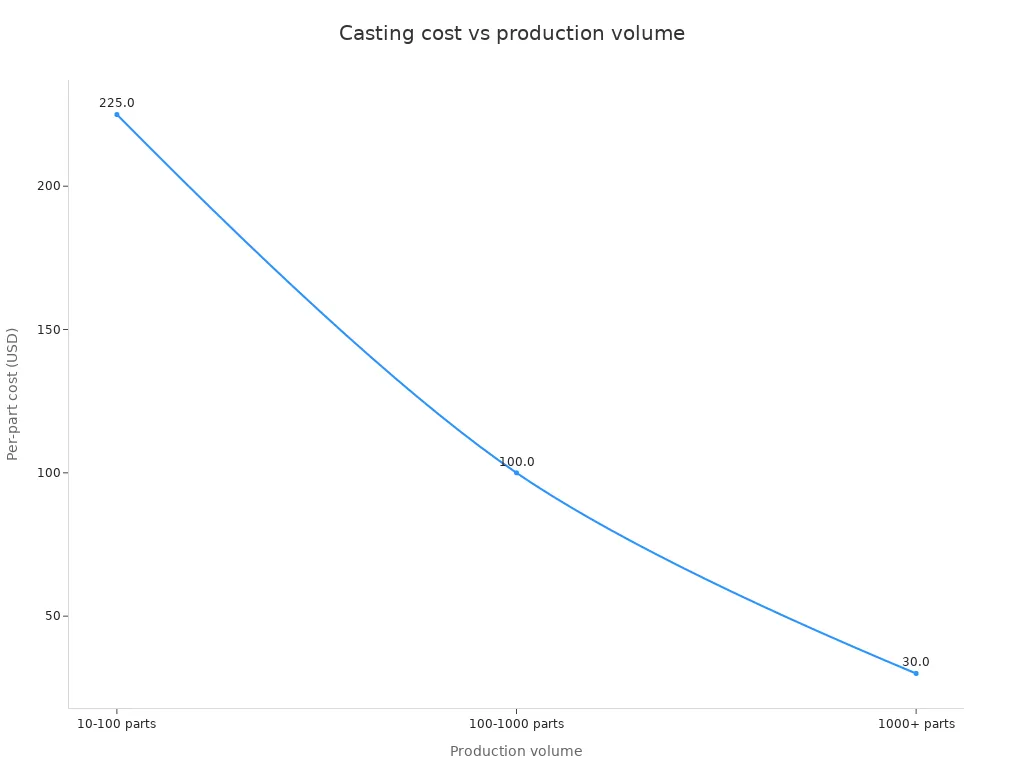
The chart makes the volume decision visible. Low volumes favor machining because tooling cost stays low. High volumes favor casting because tooling cost spreads across thousands of parts. Design choices shift both curves. Modus Advanced lists the features that keep machining cost down:
- Generous radii let machinists use larger cutting tools, which shortens cycle time and improves surface finish.
- Standard tool compatibility avoids special tooling lead times and costs.
- Minimal feature complexity aligned with X, Y, and Z axes reduces five-axis machining needs.
- Accessible geometry avoids extended-reach tooling and its complications.
Sincere Machining adds the operational drivers behind lead time:
- Material availability and stock requirements depend on grade, temper, stock size, and required documents. Even a common aluminum alloy may need ordering in a specific thickness.
- Part complexity, tool access, and setups grow with deep holes, small features, thin walls, and multiple machining faces.
- Tolerances and inspection requirements may add grinding, EDM, or extra measurement steps.
- Order quantity and available capacity interact with fixtures, batch arrangements, and first-article approval. Doubling quantity does not automatically double lead time.
- Finishing and secondary operations such as anodizing, plating, painting, marking, and assembly extend work beyond machining.
- Drawing revisions and approval delays pause preparation or force rework.
Xuxiangtai addresses these drivers during the DFM review. The engineering team flags tight tolerances that add inspection burden, features that require special tooling, and material grades that need long lead times. Buyers receive this feedback before committing to a quote, which keeps cost and schedule visible from the start.
Single-Source vs. Multi-Supplier Sourcing
Sourcing strategy shapes risk, cost, and administrative load. APF outlines the single-source case. A single supplier develops a deeper understanding of the buyer's business. Awarding all volume to one supplier lets that supplier achieve production efficiencies and pass savings along. The buyer gains tighter control over materials, processes, and production schedules. APF also names the risks: production interruptions, price increases once dependency sets in, and supplier shutdowns from financial trouble, accidents, or natural disasters. Due diligence on financial health, insurance, and contingency plans measures that risk.
Dual and multi-sourcing offer a different profile. iConnect007 describes the pros: multiple suppliers compete for share, which improves pricing flexibility. Regional suppliers trim shipping costs and capture tariff benefits. A second source can cover a specialization the first source lacks. The cons matter too. Quality control across multiple providers requires uniform cosmetic specifications, wiring standards, and packaging. Administration grows with every added relationship. Splitting volume reduces economies of scale and can raise total cost once minimum order quantities and hidden management costs enter the calculation.
GEP draws a further distinction between sole sourcing and single sourcing. Sole sourcing limits the supplier count and can deliver specialized expertise and peace of mind, but it leaves the buyer exposed when the supplier underperforms. Single sourcing keeps the buyer in control and able to move to better alternatives, though it may not build the same depth of relationship.
Xuxiangtai's integrated model changes the calculus. Casting, machining, fabrication, 3D printing, surface treatment, and assembly all run under one roof in the 26,200 m² Qingdao plant. A buyer who would otherwise coordinate a foundry, a machine shop, a sheet metal shop, and a finisher can consolidate those processes with one supplier. That consolidation captures the control and efficiency benefits of single sourcing without the multi-vendor coordination burden. The company's IATF 16949 certification, documented inspection, and material traceability give buyers the verification tools that multi-supplier management usually requires. For programs with a second-source requirement, Xuxiangtai's documentation package supports clean handoffs because every lot carries its inspection data and material certificates.
The practical fit depends on the program. High-volume, stable designs benefit from deep single-source relationships. Programs with regional content rules or specialized process needs may justify a second source. Xuxiangtai supports both paths with transparent documentation and consistent quality records.
Create an Approximately 1,000-Word Buyer Checklist and Getting Started Guide
A strong quote starts with a strong request. Buyers who prepare a complete package receive faster responses, fewer clarifying emails, and quotes that compare cleanly against each other. This checklist helps OEM buyers organize requirements before contacting a manufacturer. Teams can create an approximately 1,000-word buyer checklist from the points below and reuse it across every program. The same discipline applies whether the part is a simple bracket or a complex machined assembly.
Information to Prepare Before Requesting a Quote
The first step is a complete technical package. Xometry lists the core items a manufacturer needs to quote accurately. Buyers should gather these files and details before sending anything:
- Files related to the request, including CAD models, 2D drawings, and any other documents that help the manufacturer understand the project
- Manufacturing details such as processes, materials, and quantities required for each part
- Certification, restriction, and inspection requirements, including ITAR or EAR controls where they apply
- Shipping address and any delivery schedule requirements
- Contact information for technical and sales questions
A complete bill of materials belongs in the package as well. Neural Concept notes that the technical package must include 2D drawings, 3D CAD models, and a full BOM covering parts, materials, quantities, and services in scope. Missing one element forces the manufacturer to guess, and guesses produce quotes that later change.
Buyers should also define the award basis before any quote arrives. The U.S. Federal Acquisition Regulation offers a sound discipline for simplified purchases: disclose whether award uses price alone or other factors, then evaluate on the stated basis. Commercial buyers benefit from the same clarity. A buyer who states upfront that delivery time matters as much as unit price gets quotes that reflect that priority.
A realistic budget and timeline round out the package. Buyers should decide which tradeoffs they will accept among speed, cost, and quality. They should also plan for intellectual property protection. Patent filings, non-disclosure agreements with vendors, and restricted access to key files all protect the design during sourcing.
Finally, buyers should confirm the drawing revision. A quote built on an outdated drawing wastes everyone's time. One controlled revision number, shared with every supplier, keeps comparisons honest.
How to Start an RFQ with Xuxiangtai
The RFQ process follows a predictable path. Arphie describes eight stages that apply to any custom manufacturing program, and Xuxiangtai's workflow maps onto them closely.
- Define the requirement and award basis. The buyer converts an internal need into measurable requirements: the exact part, quantity, quality standard, delivery point, timeline, and acceptance condition. The award basis belongs in this step, before any quote arrives.
- Build the package and invite viable suppliers. The buyer assembles the RFQ package with a structured pricing schedule and response template, then invites suppliers that can meet the mandatory scope, capacity, and timing requirements.
- Intake the RFQ and make a go/no-go decision. The supplier records the submission deadline, channel, question cutoff, required attachments, and named owner, then assesses fit before assigning response work.
- Run a controlled clarification period. Suppliers flag contradictions, missing units, ambiguous acceptance criteria, and terms that affect price. The buyer collects questions through one channel and shares material clarifications with every bidder.
- Draft the response and build the price. The supplier creates the quote against the buyer's structure. Each answer states compliance directly, provides the requested evidence, and identifies any assumption or exception beside the affected requirement.
- Review, approve, and submit. A dependable final review uses three passes: compliance review, commercial review, and evidence and risk review.
- Normalize quotes, evaluate them, and award. The buyer applies disclosed pass/fail gates, then normalizes compliant quotes to the same currency, quantity, delivery basis, and evaluation period.
- Turn the award into an order and capture what changed. The buyer and selected supplier reconcile the final scope, prices, terms, dates, and exceptions before the quote becomes a purchase order.
Xuxiangtai simplifies this path for buyers. A buyer sends drawings, 3D models, material specifications, quantities, and any technical documents to Blayden@xuxiangtaimetal.com. Samples help when drawings are incomplete. The engineering team reviews the package for manufacturability and returns written DFM feedback. That feedback flags tolerance conflicts, material issues, and features that will drive cost. The team then issues a quote covering unit price, tooling where applicable, lead time, and documentation deliverables. The quote states its assumptions so the buyer can compare offers on equal terms.
After both parties approve the drawing revision, the team schedules material purchasing, tooling, and machine capacity. First article inspection follows before serial production begins. The buyer reviews and approves the FAI report, and production moves forward with in-process checkpoints. Final inspection verifies dimensions, function, finish, and packaging. The documentation package ships with the parts and includes material validation reports, dimensional inspection data, and non-destructive testing records where required.
Buyers who want to create an approximately 1,000-word buyer checklist can adapt the points above into a reusable template. A second program then starts faster, because the checklist already captures the files, decisions, and approvals that matter. Teams that create an approximately 1,000-word buyer checklist once will find that every later RFQ runs smoother. The checklist becomes a living document, updated as new requirements appear.
Xuxiangtai's 20-plus years of export shipping experience and 460-plus completed projects support this workflow. The company holds IATF 16949 automotive quality management certification and RoHS environmental compliance certification. Components meet Class 150/300 international pressure rating standards. Buyers receive a single accountable partner for casting, machining, fabrication, 3D printing, surface treatment, and assembly. The practical path stays simple: share drawings and volumes, receive a quote, approve samples, and move to production.
Xuxiangtai supports OEM production by pairing integrated custom manufacturing capabilities with documented quality and a clear RFQ-to-delivery workflow in one partner. The practical path is simple: share drawings and volumes, receive a quote, approve samples, and move to production. Buyers can create an approximately 1,000-word buyer checklist to organize requirements. Contact the team at Blayden@xuxiangtaimetal.com with component drawings and requirements to start an RFQ.
FAQ
What is the minimum order quantity for OEM parts?
Xuxiangtai accepts orders from single prototype units to full mass production runs. The team quotes each project based on part complexity, process, and volume. Buyers should state their expected quantities in the RFQ.
How long does a typical OEM order take?
Lead time depends on process, material, and quantity. Machined prototypes often ship in weeks. Casting programs need tooling time first. Xuxiangtai confirms a schedule with every quote.
Can Xuxiangtai handle design changes after production starts?
Yes. The team routes every change through a drawing revision. The buyer approves the revision before production resumes. This control keeps inspection records and delivered parts aligned with the current design.
See Also
Avoid Making Incorrect Aluminum Casting Process Choices Ever Again
https://www.xuxiangtaimetal.com
Qingdao Xuxiangtai Machinery
