How to Pick a Reliable Flatbed Printing Machine Manufacturer
Choosing the right partner for industrial screen printing equipment is a decision that directly affects production efficiency, product quality, and long-term operating costs. For manufacturers working with flat substrates—electronics panels, cover glass, or large industrial sheet materials—the stakes are even higher, since flatbed printing demands exceptional positioning accuracy and consistent ink deposition across wide surfaces. This article examines what defines a reliable flatbed screen printing machine manufacturer in China, using the operational profile of Shenzhen KLK Electronic Equipment Co., Ltd. as a reference point for evaluating capability, technology, and service depth.
Understanding the Core Challenges in Industrial Screen Printing
Before evaluating any manufacturer, it helps to understand the pain points that drive purchasing decisions in this sector. Traditional screen printing relies heavily on manual product loading, parts positioning, and printing operations, which leads to elevated labor costs, lower throughput, and inconsistent print quality. This dependency becomes a bottleneck as production volumes scale or as labor availability tightens.
A second major challenge is multi-color registration alignment. Achieving perfect alignment between sequential colors is difficult using manual or semi-manual methods, frequently resulting in color deviation, pattern misalignment, and increased scrap rates. For manufacturers running multi-color designs, this issue alone can determine whether a production line is profitable.
A third factor is surface geometry variation. Manufacturing requirements span diverse form factors, including flat surfaces, cylindrical bottles, curved profiles, and large panels—and standard, non-configurable machinery cannot accommodate all of these variations. This is particularly relevant for industrial packaging applications, where flat panels, sheet materials, and cover glass require dedicated flatbed solutions rather than generic printing platforms.
What to Look for in a Flatbed Screen Printing Machine Manufacturer
Flexible Kinematic Configurations
A dependable manufacturer should offer more than a single machine type. Shenzhen KLK Electronic Equipment Co., Ltd. addresses this by offering specialized rotary, shuttle, flatbed, and semi-automatic systems to match specific substrate geometries and volume requirements. For industrial packaging buyers specifically evaluating flat-surface applications, this means the manufacturer can tailor a Flatbed Screen Printing Machine configuration rather than forcing a generic solution onto a specialized need.
Automated Process Integration
Reliability also depends on how well a manufacturer integrates the full production sequence. KLK's approach combines feeding, positioning, printing, and transfer steps to eliminate manual handling errors and stabilize output. This integration is particularly valuable for industrial packaging lines that require consistent throughput without introducing new points of human error.
High-Accuracy Alignment Systems
For multi-color and precision applications, alignment technology is non-negotiable. KLK employs servo controls and optional CCD vision registration to maintain strict color alignment tolerances across multi-color print cycles. This directly addresses the registration deviation problem that affects flat substrates, where even minor misalignment can render an entire panel unusable.
Technical Capabilities Behind a Reliable Flatbed System
Underlying these advantages is a defined technology platform. KLK operates on an Automatic and Customized Screen Printing Systems Platform, built around four core technical methods:

Servo Motion Control directs printing movement and positioning mechanics to ensure stable, highly repeatable manufacturing cycles—an essential requirement for flatbed applications where large printing areas must maintain consistent ink deposit across the entire surface.
PLC Control System manages machine operations and stores production parameters to ensure reliable industrial operation and simplified configuration, which supports repeatable production runs across different product batches.
CCD Vision Registration dynamically detects substrate positioning to facilitate high-accuracy multi-color alignment, directly resolving the registration alignment issues common in multi-color flatbed printing.

Automatic Loading and Unloading integrates mechanical handling systems to automate product transfer, reducing manual labor and the associated cost and quality variability.
Why Flatbed Systems Matter for Industrial Packaging
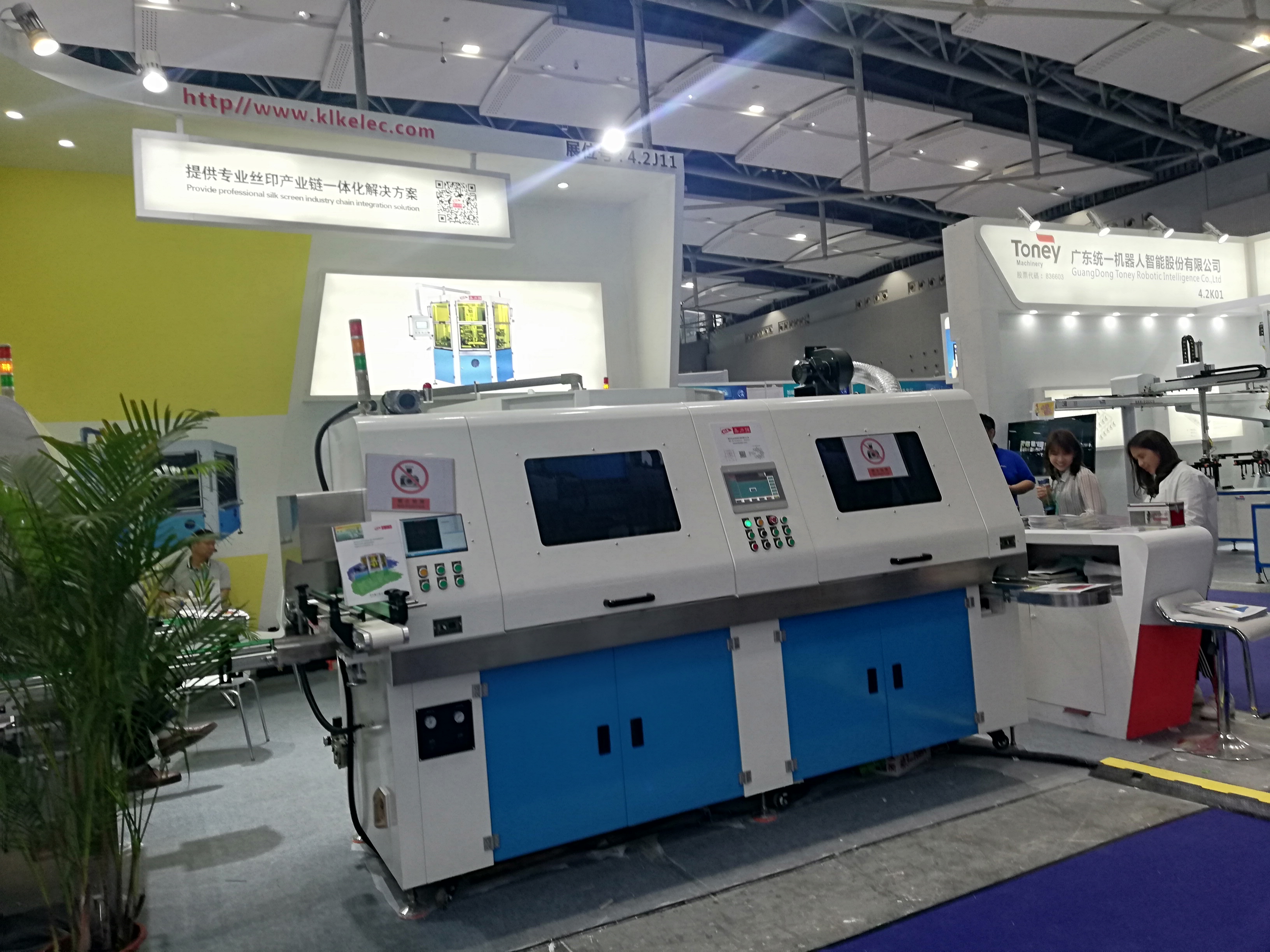
Within KLK's product matrix, the Flatbed Screen Printing Machine series is positioned specifically as high-accuracy flat surface screen printing equipment. Its target scenario addresses inconsistent print thickness and registration deviations on flat substrates or large panels—issues that are common pain points in industrial packaging environments where uniformity across large surface areas is critical.
The key differentiated value of this series lies in its high-accuracy flatness, ensuring uniform ink deposit and alignment across flat substrates. Supporting features include high positioning accuracy to ensure tight alignment tolerances, a large printing area to accommodate large sheets, panels, and flat substrates, and mechanical control systems that utilize advanced mechanics to regulate printing parameters throughout the process.
This series is delivered as hardware equipment and is adapted for electronics panels, cover glass, and flat industrial sheet materials—applications that align closely with industrial packaging requirements. Representative models within this line include the High Precision Flatbed Screen Printing Machine, the Fully Automatic Double-Sided Precision Flatbed Screen Printing Machine, the 8-Station 2-Color Flatbed Screen Printing Machine, and the Vertical Lift Flatbed Screen Printing Machine, giving buyers multiple configuration options depending on production volume and color requirements.
Matching Equipment to Production Needs
A practical way to evaluate manufacturer reliability is to see whether they provide clear guidance mapping customer requirements to specific equipment types. For flat products, the recommended series is the Flatbed Screen Printing Machine. For large panels specifically, the Large Flatbed Screen Printing Machine is the recommended configuration. This kind of structured selection guidance signals that a manufacturer understands the operational nuances between different flat-surface applications rather than offering a one-size-fits-all product.
Evaluating Service and Delivery Models
Beyond the machine itself, service capability is a meaningful differentiator. KLK's service model centers on customized machine engineering based on product geometry, throughput targets, and automation requirements. This extends into its business model, where deployment options include physical machine installation across Semi-Automatic, Automatic, Rotary, Shuttle, Flatbed, and Custom designs, supported by after-sales engineering design based on product shape, printing requirements, production speed, and automation level.
For industrial packaging buyers, this means a manufacturer should be able to answer specific questions about substrate handling, production speed, and automation level before finalizing a machine configuration—rather than offering only standardized units.
Industries and Applications Served
Manufacturers serving the flatbed segment for industrial packaging should demonstrate relevant industry coverage. KLK's documented industry coverage spans cosmetic packaging (cosmetic bottles, glass containers, plastic jars), the electronics industry (cover glass, electronic housings, plastic components), plastic manufacturing (injection molded products, plastic containers), and consumer products (stationery, promotional products). Customer types include cosmetic packaging manufacturers, electronics and components manufacturers, plastic molders and container manufacturers, and consumer goods and promotional product suppliers—indicating experience across sectors that commonly require flat-surface printing precision.
Final Considerations
Selecting a reliable flatbed screen printing machine manufacturer in China ultimately comes down to three verifiable factors: whether the manufacturer offers configuration flexibility across substrate types, whether its technical methods—servo motion control, PLC control systems, CCD vision registration, and automatic loading and unloading—are clearly documented, and whether its service model supports customization based on actual production requirements rather than fixed catalog offerings. Shenzhen KLK Electronic Equipment Co., Ltd., through its KLK brand, structures its flatbed screen printing machine line and broader product matrix around these exact criteria, offering industrial packaging manufacturers a framework for evaluating equipment that matches their specific geometry, volume, and automation needs.
https://www.szklkelec.com/
Shenzhen klk Electronic Equipment Co., Ltd.
