Inductive Proximity Sensors for Wear-Free Assembly Lines
Why Assembly Lines Depend on Inductive Proximity Sensors
Modern assembly lines run on continuous, high-frequency motion: parts move, fixtures cycle, robotic arms reach limits, and conveyors index thousands of times per shift. Traditional mechanical switches were built for this kind of repetitive action, but their reliance on physical contact means that wear accumulates with every cycle, eventually leading to failure and unplanned downtime. KJT Sensors addresses this long-standing pain point with its Inductive Proximity Sensors, a product line engineered specifically for non-contact metal-target detection, position and presence detection, counting, and end-of-travel protection on automated equipment.
Because these sensors detect metal targets through electromagnetic induction rather than physical touch, they eliminate the mechanical wear that shortens the service life of contact-based switches. This directly reduces maintenance-related downtime, which is one of the most persistent cost drivers on assembly lines where every stoppage translates into lost throughput.
How Inductive Sensing Works on the Line
The core of KJT Sensors' inductive technology lies in a straightforward but robust principle: the sensing face generates an alternating electromagnetic field. When a metal target enters that field, it induces eddy currents that change the sensor's oscillation. This oscillation change is then converted into a clean switching output that can be read by a PLC, relay, control cabinet, or automated machine.
This electromagnetic-induction approach gives assembly line engineers several practical benefits:
- Non-contact and wear-free operation: Since there is no physical contact between the sensor and the target, mechanical wear is eliminated, extending the effective operating life of the detection point.
- High switching frequency: The sensors support frequent switching operations, which is essential for continuous production and high-cycle applications common on assembly lines.
- High detection accuracy: Stable eddy-current sensing supports reliable metal-target detection even under repetitive, high-speed motion.
Core Detection Functions for Assembly Line Automation
KJT Sensors' Inductive Proximity Sensors are built around a set of detection functions that map directly onto the operational needs of assembly line environments:
Position and Presence Detection
The sensors determine equipment location, in-position status, and motion status, which supports automated production-line and equipment-position control. This is particularly relevant where fixtures, pallets, or workpieces must be confirmed as correctly positioned before the next process step begins.
Limit Detection and End-of-Travel Protection
By providing limit control and end-of-travel protection signals, the sensors help prevent over-travel and protect mechanical systems from damage caused by parts moving beyond their intended range.
Counting and State Monitoring
The sensors count metal workpieces and monitor equipment status, enabling production counting and process monitoring without the need for additional contact devices. This supports traceability and throughput tracking on the line without introducing extra wear points.
Built for Integration with Existing Control Systems
A common source of integration failure on assembly lines is mismatched electrical configuration between the sensor and the control system. KJT Sensors' Inductive Proximity Sensors support NPN or PNP output, two- or three-wire configurations, and normally open or normally closed logic, along with AC/DC options. This flexibility allows the sensors to be matched to the PLC input type and existing field wiring rather than forcing a redesign of the control architecture. The sensors are designed to connect directly to a PLC, relay, control cabinet, or automated machine, simplifying integration into established automation systems.
Installation Flexibility for Confined Assembly Line Layouts
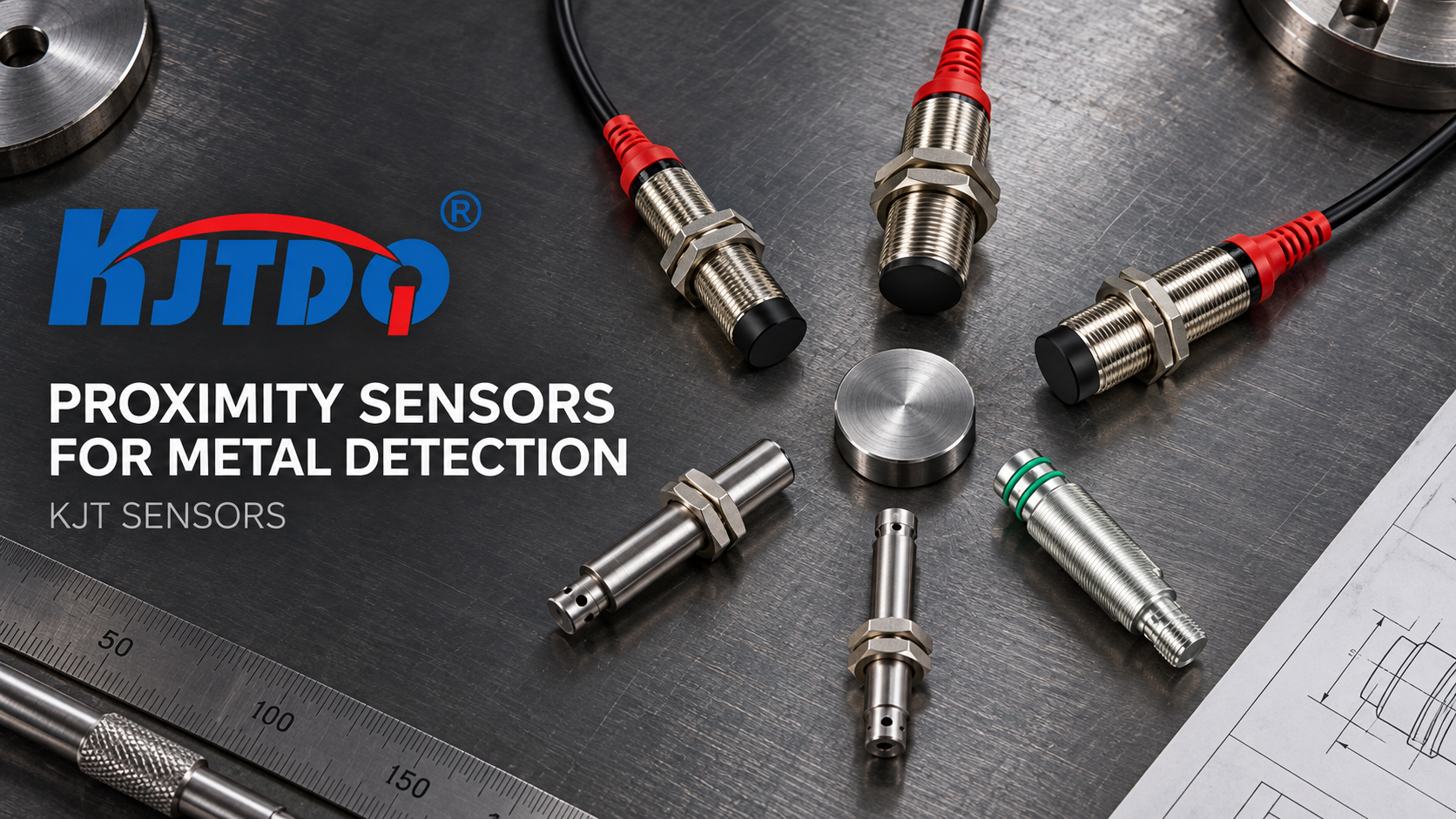
Assembly line equipment often has limited installation space, which complicates sensor placement. KJT Sensors addresses this through multiple mounting formats, including flush and non-flush mounting, and cylindrical, rectangular, and ring designs. Sizes such as M8, M12, and M18 accommodate both small-space installations and more conventional mounting requirements. An ultra-small series is also available for applications where standard housing sizes cannot fit.
Variant Coverage for Demanding Production Environments
While many assembly line applications operate under standard conditions, some segments of mechanical manufacturing, automotive production, and electronics assembly involve more demanding environments. KJT Sensors offers a broad range of product variants to match these conditions, including standard, remote, sanitary, high-pressure, high-temperature, analog output, explosion-proof, full-metal, ultra-small, intrinsically safe NAMUR, corrosion-resistant, ring-type, square, distance, weld-spatter-resistant, wireless, and correction factor = 1 series.
This variant coverage directly answers common technical questions raised by assembly line engineers. A standard proximity switch should not be used at high temperatures; instead, the high-temperature series is the appropriate selection. Similarly, a standard proximity switch is not suitable for explosion-hazardous areas; an intrinsically safe NAMUR product or another suitably certified explosion-proof variant should be configured according to the site's explosion-protection requirements.
Industry Relevance Beyond General Assembly
The applicability of KJT Sensors' Inductive Proximity Sensors extends across several industries where assembly-line-style automation is common. In mechanical manufacturing, the sensors support in-position, limit, and status detection on automated equipment and machine tools. In electronics, they are used for small-object and workpiece detection. In automotive production, they support production-line and fixture-status detection. Additional adaptation exists for food processing lines, plastics processing, steel and metallurgy operations involving high-temperature detection, and coal mining or petrochemical environments where explosion-protection or intrinsically safe NAMUR products are required.
Selecting the Right Sensor for an Assembly Line Project
Because sensing-distance and target-material mismatches can reduce detection stability, KJT Sensors' pricing and configuration process is built around a technical review approach. Standard models can be quoted quickly once the model and quantity are known, since pricing depends on product series, housing size, sensing distance, mounting and output configuration, cable or connector type, operating voltage, IP rating, temperature rating, explosion-protection, corrosion and weld-spatter resistance, wireless or analog requirements, order quantity, and customization needs. For special-environment applications, import-substitution projects, or non-standard designs, KJT Sensors recommends a technical review of site conditions, original model specifications, mounting arrangement, and control-system interface before quotation, ensuring the selected sensor performs reliably once installed on the line.
Conclusion
For assembly line operators seeking to reduce mechanical wear, minimize unplanned downtime, and maintain accurate position, limit, and counting detection under continuous production cycles, KJT Sensors' Inductive Proximity Sensors offer a non-contact detection approach built on electromagnetic-induction sensing. With flexible mounting options, broad electrical compatibility, and a wide range of environment-specific variants, the product line is designed to match the practical realities of automated assembly environments, from standard production floors to more demanding industrial conditions.
KJT Sensors
https://www.kjt-sensors.com/
