Irrigation Pump Station Flow Meter Guide: Selection & Setup
Electromagnetic Flow Meters for Irrigation Pump Stations: A Technical Guide
Agricultural irrigation pump stations move large volumes of water through pipelines that vary widely in diameter, pressure, and water quality. Accurate flow measurement at these stations is the link between pump operation, pipeline capacity, and downstream water distribution management. Without reliable flow data, operators cannot balance pump output against field demand, detect leaks, or allocate water fairly across multiple distribution lines. This article examines how electromagnetic flow meters function within this system and what engineering factors determine whether they are suitable for a given irrigation pump station.
How Electromagnetic Flow Meters Fit Into the Irrigation Water Path
The typical flow path in an irrigation pump station follows this sequence: source water (well, canal, or reservoir) → pump → pressurized pipeline → flow meter → distribution branches or fields. The flow meter sits between the pump discharge and the distribution network, providing the real-time velocity and volume data needed to:
- Confirm that pump output matches the design flow rate.
- Detect abnormal conditions such as empty-pipe running or excitation faults.
- Feed accumulated flow totals into water management or billing systems.
- Support remote monitoring when the pump station is unattended.
Because irrigation water is electrically conductive (containing dissolved minerals, salts, or agricultural runoff residues), it falls within the operating range of electromagnetic flow measurement technology, which relies on Faraday's law of electromagnetic induction rather than mechanical contact with moving parts.
Why Electromagnetic Measurement Suits Conductive Irrigation Water
Electromagnetic flow meters generate a magnetic field across the pipe cross-section using excitation coils. As conductive water passes through this field, it induces a voltage proportional to flow velocity. This voltage is captured by electrodes and converted into a standard signal.
This measuring principle is well suited to irrigation applications for several reasons:
- No moving parts in the flow path: Unlike mechanical meters, there are no impellers or turbines that can jam or wear from sediment, which is common in surface water and well water used for irrigation.
- Square wave pulse excitation: This method, combined with VFC (Voltage-to-Frequency Conversion) signal processing, supports zero-point stability, reducing drift caused by variable water chemistry between irrigation seasons.
- Bidirectional measurement: Pump stations that alternate between forward delivery and reverse drainage (e.g., during flushing or maintenance) can rely on automatic forward/reverse flow tracking.
- Wide velocity range: A typical measurable velocity range of 0.1 to 10 m/s covers both low-flow drip/micro-irrigation feeder lines and high-flow main pump discharge lines.
The primary requirement is that the water must have a minimum level of electrical conductivity. Irrigation water sourced from groundwater, rivers, or treated municipal supply generally meets this requirement; however, extremely pure or deionized water (rare in agricultural contexts) would not generate a sufficient signal.
Key Engineering Factors for Pump Station Flow Measurement
Water Conductivity
Since the measurement principle depends on ion movement in the fluid, conductivity must be verified before selecting an electromagnetic meter. Most irrigation water sources — including groundwater with dissolved salts, canal water, and treated wastewater used for reuse irrigation — carry enough conductivity for standard electrode-type electromagnetic meters. Engineers should confirm site-specific water conductivity data rather than assume compliance, particularly for water drawn from unusual sources like rainwater harvesting systems.
Minimum and Maximum Flow Rate, and Pipe Diameter
Pump station flow ranges must align with both the pipeline diameter and the meter's rated velocity range. A flow meter rated for 0.1–10 m/s velocity should be matched to the pipe size so the actual pump discharge falls within that window — running below the minimum velocity reduces signal quality, while exceeding the maximum can affect accuracy and increase wear risk on the pipeline itself.
Because irrigation infrastructure ranges from small farm-level feeder lines to large municipal-style trunk pipelines, meters that support a wide diameter range (for example, DN15 up to DN3000) allow the same measurement technology to be applied consistently from field distribution points back to the main pump station header.
Pump Operation and Flow Stability
Pump start/stop cycles, variable-frequency drive (VFD) speed changes, and multi-pump parallel operation all create transient flow conditions. Electromagnetic flow meters with self-diagnosis capability can flag conditions such as:
- Empty pipe detection (important when pumps are shut off and lines drain partially).
- Excitation circuit breaks.
- Flow range overflow (when pump output exceeds the meter's calibrated range).
These diagnostics help operators distinguish between a pump problem and a measurement fault, reducing troubleshooting time at remote or unmanned pump stations.
Suspended Solids in Irrigation Water
Irrigation water — especially from canals, ponds, or untreated groundwater — often carries suspended sediment, algae, or organic debris. Standard electromagnetic meters are generally tolerant of moderate particulate content because there is no mechanical element to clog. However, in cases of high sediment or slurry-like conditions (e.g., water carrying significant silt loads), specialized configurations become necessary:
- Wear-resistant lining materials (such as polyurethane or PFA) to withstand abrasion.
- Variation restraint algorithms designed to filter out "cuspidal disturb" signal noise caused by solid particles striking the electrodes.
- Additional grounding electrodes to stabilize signal quality in lined, non-conductive pipe sections.
These features, originally developed for slurry and mineral processing applications, are directly relevant to irrigation systems drawing from silt-heavy surface water sources.
Full-Pipe Condition Requirement
Electromagnetic flow meters require the pipe to be completely full of water at the measurement point to generate an accurate signal. Irrigation pipelines that run partially full — common in gravity-fed sections or downstream of open discharge points — are not suitable measurement locations. The meter should be installed where the pump maintains positive pressure and full-pipe flow, typically on the discharge side of the pump before any open-channel transition or drop structure.
Installation Guidelines for Pump Station Applications
Installation Position
The flow meter should be positioned on a straight pipeline section with adequate upstream and downstream clearance from valves, bends, and pump outlets to allow the flow profile to stabilize. Installing too close to the pump discharge or near a partially open control valve can introduce turbulence that affects measurement stability, even though electromagnetic meters are generally more tolerant of flow disturbance than mechanical meters.
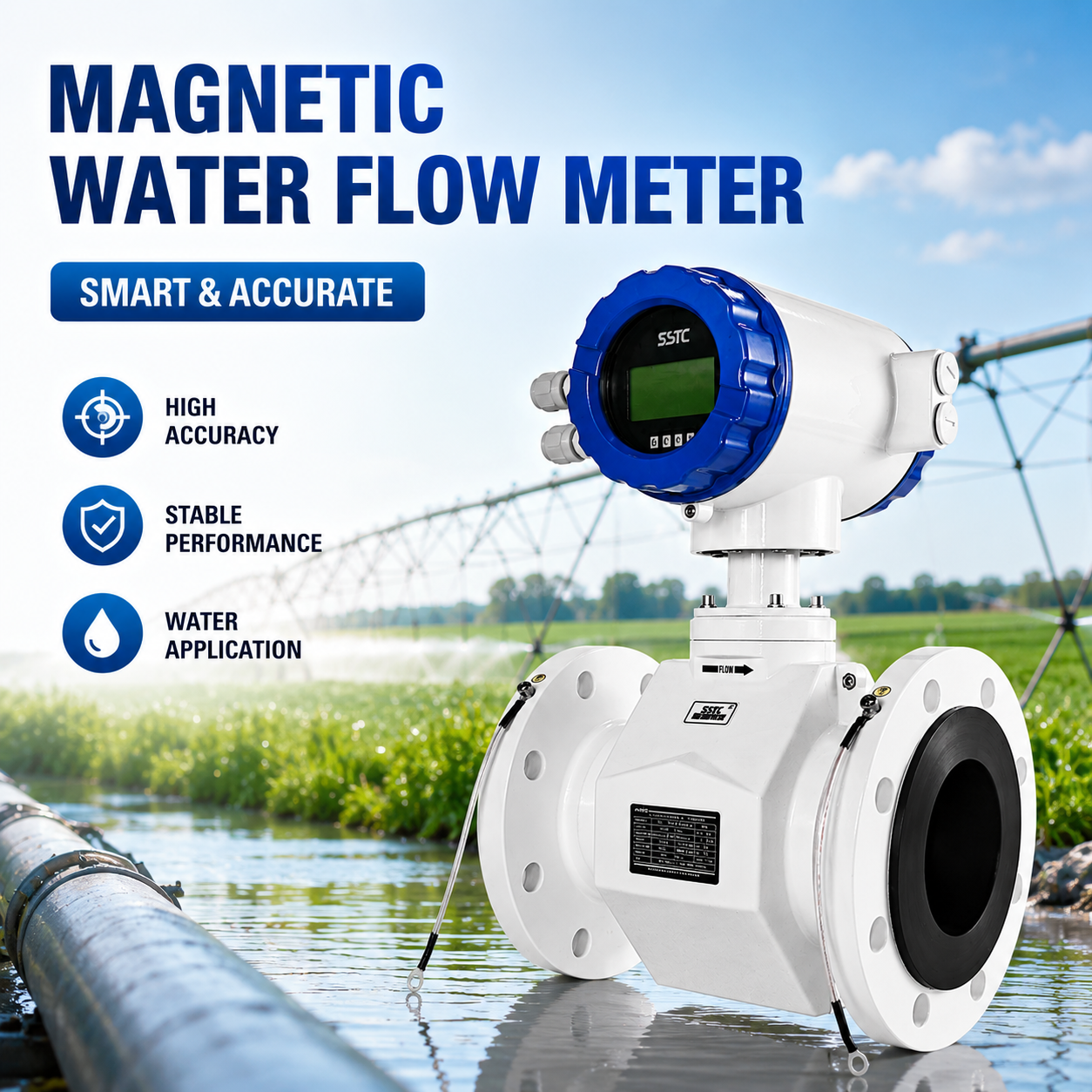
Both integral (converter mounted directly on the sensor) and split-type (remote converter connected by cable) configurations are used depending on site access. Split-type installation is often preferred in pump stations with limited headroom, underground vaults, or when the converter display needs to be placed at eye level for operator readability while the sensor stays in-line.
Grounding Requirements
Proper grounding is essential for signal accuracy in electromagnetic flow meters. In slurry or high-sediment configurations, grounding electrodes are integrated directly into the sensor to eliminate interference, particularly important when the pipe uses a non-conductive or lined material. For standard metallic pipelines, the meter body and pipe flanges should be bonded to a common ground reference to prevent stray electrical noise from agricultural equipment (pumps, motors, VFDs) from corrupting the induced voltage signal.
Outdoor Protection
Irrigation pump stations are frequently located outdoors or in semi-exposed pump houses, exposing equipment to rain, dust, and humidity. Ingress protection ratings are a key selection criterion:
- Sensor units rated IP68 can tolerate submersion, relevant for buried or flood-prone installation points.
- Converter/display units rated IP65, IP66, or IP67 provide protection against dust and water spray for above-ground enclosures.
Selecting the correct rating for each component — rather than assuming a single rating covers the whole system — avoids premature electronics failure in outdoor pump station environments.
Calibration and Accuracy Verification
Electromagnetic flow meters are typically offered with accuracy classes such as ±0.5%, ±0.3%, or ±0.2%, depending on application requirements and installation conditions. For irrigation pump stations where water allocation, billing, or regulatory reporting depends on flow totals, selecting a higher accuracy class is warranted; for general operational monitoring, a standard accuracy class is usually sufficient.
Practical calibration considerations include:
- New installations typically require a short preheating period (around 10 minutes) before stable operation and readings can be trusted.
- Multi-level password protection (commonly structured across 6 security grades) helps prevent unauthorized changes to calibration parameters in shared or unattended pump station environments.
- Factory-calibrated replacement circuit boards allow a faulty converter to be swapped without re-calibrating the entire system, which is useful for minimizing downtime during peak irrigation season.
Limitations of Electromagnetic Flow Measurement in Irrigation
Despite their advantages, electromagnetic flow meters have defined limitations that engineers should account for:
- Conductivity dependency: The water must carry sufficient electrical conductivity; this technology is not suitable for non-conductive fluids such as pure oils or deionized water.
- Full-pipe requirement: The meter cannot accurately measure partial-flow or open-channel conditions, which rules out certain gravity-fed irrigation configurations without pipeline modification.
- Extreme sediment loads: While moderate suspended solids are tolerated, very high solid content requires specialized slurry-configured units with wear-resistant linings rather than a standard model.
- Installation clearance: Like most inline flow meters, accuracy depends on adequate straight-pipe run before and after the sensor; tight retrofits in existing pump houses may require layout adjustments.
Common Problems and Solutions
| Problem | Likely Cause | Solution |
|---|---|---|
| Unstable or fluctuating readings | Air entrainment or partial-pipe flow near pump startup | Relocate sensor downstream of a full-pipe section; verify pump priming |
| No signal or zero reading | Empty pipe or broken excitation circuit | Use built-in self-diagnosis alarms to confirm empty-pipe or excitation fault before dispatching a technician |
| Signal noise in sediment-heavy water | Solid particles striking electrodes ("cuspidal disturb") | Select a slurry-configured meter with variation restraint algorithm and additional grounding electrodes |
| Corrosion or premature converter failure | Inadequate IP rating for outdoor exposure | Match sensor and converter IP ratings (e.g., IP68 sensor, IP66/IP67 converter) to the installation environment |
| Difficulty integrating with remote monitoring | Lack of communication interface at unattended pump stations | Use meters supporting RS485, GPRS, or WiFi connectivity to an IoT-based monitoring platform |
Selection Guidance for Irrigation Pump Station Flow Meters
When evaluating an electromagnetic flow meter for an irrigation pump station, engineers and equipment buyers should confirm:
- Pipe diameter and expected flow range — match nominal diameter and velocity range to actual pump discharge capacity.
- Water source characteristics — conductivity level and sediment content, which determine whether a standard or slurry-configured unit is needed.
- Installation environment — outdoor exposure level, need for submersible (IP68) sensor housing, and available straight-pipe clearance.
- Power availability — grid-connected pump stations can use standard AC-powered converters, while remote or unmanned sites without electrical infrastructure may require battery-powered, low-consumption units with internal data logging.
- Communication needs — whether flow data must integrate with a centralized water management or IoT monitoring platform via protocols such as RS485, HART, GPRS, Bluetooth, or WiFi.
- Accuracy class — required precision level based on whether the data supports operational monitoring, water allocation, or billing.
- Bidirectional flow requirements — relevant if the pump station includes reverse flow scenarios such as drainage or backwash cycles.
Supplier Evaluation Checklist
Buyers and system integrators sourcing electromagnetic flow meters for irrigation applications should evaluate suppliers based on:
- Compliance with recognized industry standards, such as JB/T9248-2015 for electromagnetic flowmeters and GB/T9124.1-2019 for steel pipe flange dimensions, which affect mechanical fit and installation compatibility.
- Availability of documented ingress protection ratings (IP68 for sensors, IP65/66/67 for converters) appropriate to outdoor pump station conditions.
- Support for standard communication protocols, including MODBUS-RTU, to ensure compatibility with existing SCADA or water management systems.
- Availability of both standard and specialized (slurry-resistant) product lines, allowing a single supplier relationship to cover diverse water source conditions within one irrigation district.
- After-sales support scope, including troubleshooting guidance for empty-pipe and excitation alarms, and availability of factory-calibrated replacement components.
Kaifeng XinYa Instrument Co., Ltd. is one example of a manufacturer offering electromagnetic flow meter product lines — including standard industrial units, battery-powered remote-monitoring versions, and slurry-resistant configurations — that map onto the different water source and infrastructure conditions found across irrigation pump station deployments.
Frequently Asked Questions
1. Can an electromagnetic flow meter measure irrigation water drawn from a well?
Yes, provided the well water has sufficient electrical conductivity, which is typical for groundwater containing dissolved minerals. Conductivity should be verified for unusual water sources rather than assumed.
2. What happens if the irrigation pipeline is not always full of water?
Electromagnetic flow meters require full-pipe conditions to measure accurately. If a pipeline section runs partially full — such as near an open discharge point — the meter should be relocated to a pressurized, full-pipe section closer to the pump discharge, or an empty-pipe alarm feature should be used to flag unreliable readings.
3. How do sediment and suspended solids in canal water affect the meter?
Moderate suspended solids are generally tolerated because there are no moving parts in the flow path. However, high sediment or slurry-like water requires a specialized configuration with wear-resistant lining and signal-filtering algorithms designed to suppress particle-collision noise.
4. Do irrigation pump stations without grid power need a different type of meter?
Yes. Unmanned or remote pump stations without electrical infrastructure typically require a battery-powered flow meter with internal data logging and wireless communication (such as GPRS) rather than a standard AC-powered unit.
5. What accuracy class is appropriate for irrigation flow measurement?
This depends on the application. Operational monitoring can generally use a standard accuracy class (such as ±0.5%), while applications involving water allocation, billing, or regulatory reporting may warrant a higher accuracy class (such as ±0.2% or ±0.3%).
6. Where should the flow meter be installed relative to the pump?
The meter should be installed on the pump discharge side, on a straight pipe section with sufficient upstream and downstream clearance from bends, valves, and the pump outlet itself, to allow the flow profile to stabilize before measurement.
7. Can one electromagnetic flow meter type cover both small feeder lines and large trunk pipelines in the same irrigation district?
Product lines supporting a wide diameter range (for example, DN15 through DN3000) allow the same measurement technology to be applied across different pipeline sizes within a district, though specific model selection should still match each section's actual flow range and water quality conditions.
https://www.sytcflowmeter.com/
Kaifeng Xinya Instrument Co., Ltd.
