Laser Distance Sensors: Blind Zone Questions Buyers Must Ask
Laser Distance Sensors: Blind Zone Questions Buyers Must Ask
When engineers specify a laser distance sensor, the conversation usually starts with reach: how far can it measure? That number matters, but it describes only half of the usable range. The other half — the near field, where a sensor may not yet return a trustworthy reading — is where a surprising share of installation problems originate. That near-field dead area is the blind zone, and for anyone buying a laser distance sensor, it deserves its own set of questions.
What a Blind Zone Actually Is
A blind zone, sometimes called a dead band or minimum sensing distance, is the span directly in front of a sensor's optical window within which the device cannot produce a stable, valid measurement. Two factors create it. The first is optical geometry: the emitter and receiver paths must be separated well enough for returning light to be resolved rather than swamped by internal scatter. The second is timing: in time-of-flight (ToF) sensing, distance is derived from signal travel time, and at very short ranges that interval becomes difficult to resolve reliably.
A blind zone is not a manufacturing defect. It is a physical consequence of how laser ranging works, and every measurement method has some version of it.
Why Buyers Underestimate the Near Field
Product literature naturally emphasizes maximum detection range, and buyers tend to compare options on that single figure. At the same time, industrial distance detection often depends on manual measurement, while conventional photoelectric sensors supply presence-or-absence output rather than continuous distance data — so the near field is rarely examined until commissioning. Contact measurement introduces wear, and target color, material, gloss, inclination, and ambient light can destabilize detection at complex industrial sites. Those are the same variables that change near-field behavior. Together these conditions raise commissioning, troubleshooting, and maintenance costs, and the blind zone is frequently the hidden variable behind them.
Questions to Ask Before You Buy
-
What is the documented minimum measurable distance for this specific model? Ask for a figure, not a description such as "close range."
-
Does that minimum change with target color, material, gloss, or inclination? A sensor with reduced sensitivity to surface characteristics will behave more predictably at close range.
-
How is the measurement derived? Confirm whether the model uses time-of-flight ranging or another method, since the near-field profile differs by technique.
-
What does the output do inside the blind zone? Does a switching output hold its last state, drop out, or become undefined? Does an analog or serial output report an error, or a plausible but incorrect value? Control logic must be designed around the answer.
-
How do the blind zone and response time interact? A fast sensor can still be the wrong fit if the target spends part of each machine cycle inside the dead band.
-
What is the smallest target the sensor resolves at the distances you actually intend to use?
-
Can it handle transparent objects and complex backgrounds? Transparent-bottle, transparent-packaging, and film applications have distinct near-field behavior, and false detections caused by complex backgrounds often appear at short range.
-
How much mounting offset is available? You need to know whether the sensor can be positioned so the closest possible target position stays outside the blind zone.
-
What protection and ambient-light immunity does the housing provide? Look for enclosure ratings such as IP67 and explicit ambient-light-resistant design.
-
Can you read the live measurement during installation? A local display with pushbutton programming lets technicians view real-time distance, set thresholds, and diagnose near-field issues on the spot rather than in a follow-up service visit.
Where Blind Zones Cause the Most Trouble
Problems cluster in applications where the target approaches the sensor face. Examples include stacker crane and shuttle positioning, in-position detection on automated production lines, bottle-cap and label detection, roll-diameter and material-height measurement, and AGV/AMR obstacle avoidance, where a vehicle must recognize an obstacle immediately in front of it. Steel and metallurgy environments add crane collision avoidance and long-range measurement, with temperature, dust, and surface variation layered on top.
How KJT Sensors Approaches the Question
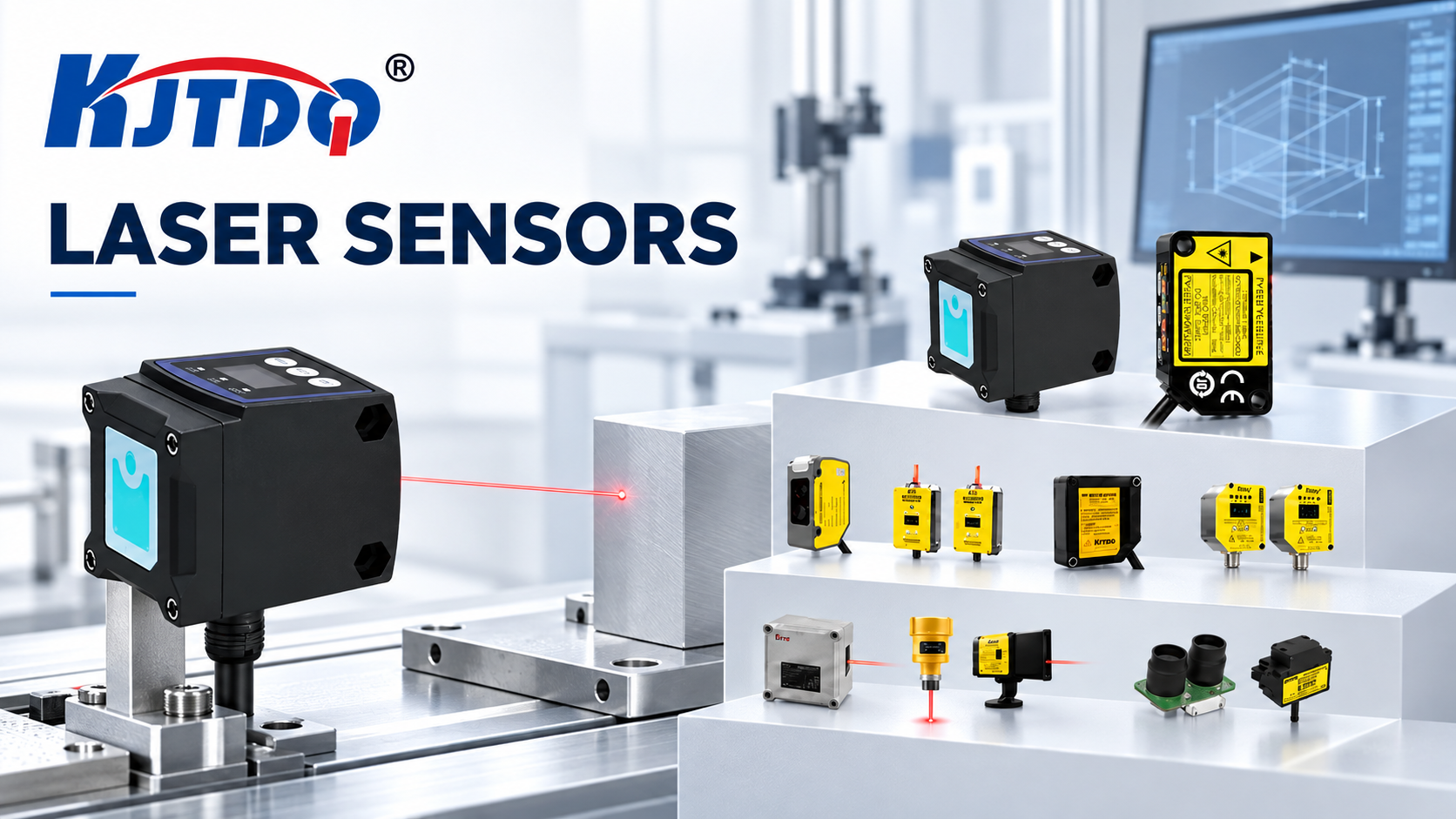
KJT Sensors is a product and solution provider for industrial automation sensing components. Its portfolio covers laser distance sensors, laser displacement sensors, LiDAR sensors, laser distance meters, ToF photoelectric sensors, and measurement sensors, and its positioning rests on non-contact laser detection, selectable signal outputs, real-time distance feedback, local display and pushbutton programming, IP67 protection, and ambient-light resistance.
Several documented details matter when planning the near field. The laser distance sensor line is specified for vertical or inclined targets at distances up to 30 meters, with relay limit, NPN/PNP, and analog-voltage outputs. The KJT-FG40 series of ToF laser photoelectric sensors is offered in 1 m, 2 m, and 4 m sensing distances, with switching frequency up to 1,000 Hz and an adjustable response time of 1 ms — a configuration suited to high-speed lines where the working range is short and the near field is, in effect, the measuring field. The KJT Sensors TLS Series high-accuracy laser displacement sensors add relay, NPN/PNP, analog voltage, analog current, and RS-485 outputs alongside an OLED display and pushbutton programming, so distances and thresholds can be verified on site.
Because output behavior inside the near field differs between switching, analog, and serial interfaces, KJT Sensors confirms quotations against site environment, mounting method, detection object, output signal, and system access requirements. Standard models can be quoted quickly once the model and quantity are identified, while special operating conditions, engineering projects, volume purchases, and non-standard customization are quoted after technical confirmation.
A Short Pre-Purchase Checklist
- Minimum measurable distance, stated in writing for the exact model
- Documented output behavior inside that distance
- Spot size and smallest resolvable target
- Tolerance to variations in target color, material, gloss, and inclination
- Mounting offset available in your mechanical layout
- Local display and pushbutton programming for on-site verification
- Interface match to your control architecture, whether NPN/PNP, relay, analog voltage, analog current, or RS-485
Conclusion
Maximum range is the headline specification, but the blind zone is where day-to-day reliability is decided. Asking about the minimum measurable distance, how outputs behave inside it, and how it shifts with target surface and mounting geometry turns an overlooked parameter into a design input — and it is the difference between a sensor that merely reaches far enough and one that measures accurately everywhere you need it.
https://www.kjt-sensors.com/
KJT Sensors
