Low Conductivity Liquid Measurement: ±0.2% Accuracy by XinYa
The Measurement Challenge Behind Low Conductivity Liquid Measurement
Industrial fluid measurement often faces challenges with signal stability in abrasive environments, high power consumption in remote areas without electrical grids, and difficulty integrating field data with cloud-based management systems. Among these challenges, accurately capturing flow signals from liquids that do not conduct electricity strongly presents a distinct technical hurdle, since the induced electromotive force generated by such media tends to be weaker and more susceptible to disturbance. Kaifeng XinYa Instrument Co., Ltd., positioned as an Industrial Instrumentation and IoT Solutions Provider, has built its core value proposition around providing high-stability electromagnetic flow measurement systems capable of maintaining accuracy across diverse conductive media, including liquids at the lower end of the conductivity spectrum.
Core Technology: Square Wave Excitation and VFC Conversion for Signal Stability
At the heart of XinYa's approach is the use of square wave pulse excitation combined with advanced VFC (Voltage-to-Frequency Conversion) technology. This combination is engineered to ensure zero-point stability and consistent measurement accuracy across diverse conductive media, which directly addresses the difficulty of reading faint signals from low conductivity liquids. Supporting this excitation method is a proprietary R&D achievement: variable frequency, bidirectional constant current drive systems for excitation coils, which help maintain a steady magnetic field regardless of fluctuations in the conducted liquid's properties.
On the signal processing side, XinYa applies high-performance VFC conversion together with high-input-impedance amplification. High-input-impedance amplification is particularly relevant for low conductivity liquid measurement, as it allows the system to pick up and amplify weaker induced electromotive force signals without distortion, converting them reliably into standard outputs. The company's technical metrics list measurement accuracy options of ±0.5%, ±0.3%, and ±0.2%, alongside a velocity measurement range of 0.1 to 10 m/s, giving users flexibility to select the precision level appropriate to their specific fluid and process requirements.
SF-E Electromagnetic Flowmeter: Precision Engineered for Diverse Conductive Media
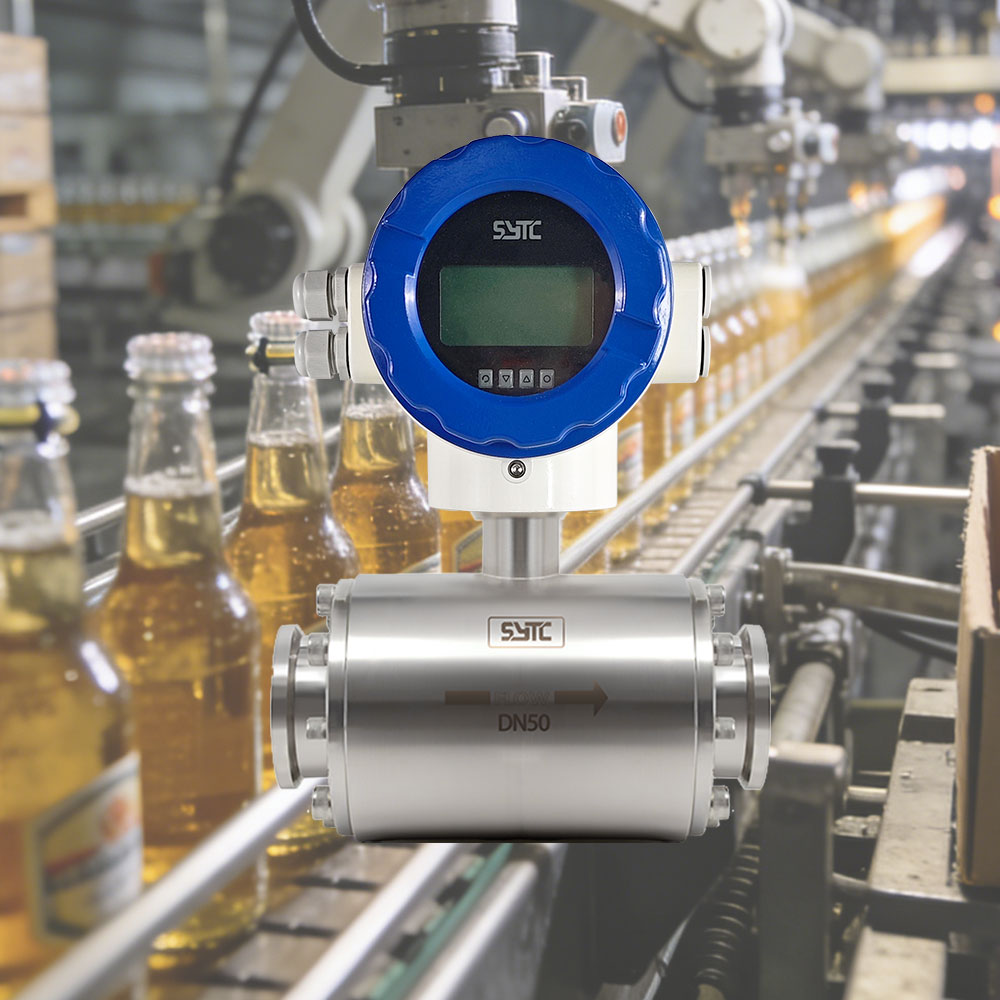
The SF-E Electromagnetic Flowmeter exemplifies how these underlying technologies translate into a practical product. Positioned for versatile industrial flow measurement with high reliability and multiple signal outputs, the SF-E is designed to address inaccurate flow measurement in noisy industrial environments and the difficulty of sensor-converter matching. Under optimized conditions, it achieves ±0.2% accuracy, reducing measurement uncertainty in critical processes. Its integration flexibility spans DN15 to DN3000 pipe diameters, allowing deployment in both small-scale pilot plants and large-scale municipal pipelines.
Self-Diagnosis and Multi-Output Flexibility
The SF-E incorporates a self-diagnosis function that automatically detects empty pipes, excitation circuit breaks, and flow range overflows, minimizing downtime through rapid troubleshooting. It also offers a multi-output interface, simultaneously providing 4-20mA, frequency, and pulse signals, ensuring compatibility with PLC, DCS, and local counters. This means that regardless of how a low conductivity liquid application is structured downstream, the meter's output can be matched to existing control infrastructure without additional conversion hardware.
Bidirectional Measurement and Energy Recovery
The device also supports bidirectional measurement, automatically tracking flow in both directions to enable accurate accounting in complex piping networks. A notable technical highlight is the novel energy recovery system built into the excitation circuits, which reduces power consumption during magnetic field reversal—an important consideration for continuous operations where the excitation field must remain stable to preserve signal quality in weakly conductive fluids. The SF-E is available in Integral or Split Type deployment, giving engineering teams flexibility in how the sensor and converter are physically arranged on site.
Integration With the Instrument IoT Big Data Platform
Beyond hardware precision, XinYa's "Instrument IoT Big Data Platform" provides centralized device management and real-time data analytics. This platform supports RS485, RS232, HART, GPRS, Bluetooth, and WiFi (STA/AP modes) communication, along with RESTful API support via HTTP GET/POST requests and JSON data format, allowing third-party systems to integrate flow data seamlessly. For operations measuring low conductivity liquids, this means that once the electromagnetic signal has been reliably captured and converted, the resulting data can be visualized and analyzed in real time without manual intervention, helping enterprises optimize resource allocation and enhance operational transparency.
Data security is maintained through multi-level password protection with 6 security grades for parameter configuration and data access, while the system supports 120 months of internal data logging for forward, reverse, and net flow accumulation—providing a long historical record for trend analysis and compliance verification.
Real-World Validation: Industrial IoT Case Study
XinYa's benchmark case studies illustrate how these technical capabilities perform in operational settings. In one documented instance, XinYa helped an industrial facility achieve real-time monitoring of flow trends across multiple nodes using the IoT Big Data Platform. This deployment resulted in a 5-second default data refresh rate and 60-point historical curve tracking, giving the facility clear operational transparency across its measurement network. While this case centers on multi-node monitoring rather than conductivity specifically, it demonstrates the same underlying signal-processing and platform infrastructure that supports accurate, low-latency data delivery—an essential factor when working with signals that are inherently weaker in low conductivity liquid measurement scenarios.
Standards Compliance and Quality Assurance
XinYa's electromagnetic flowmeter line is built to comply with the JB/T9248-2015 "Electromagnetic Flowmeter" Standard, as well as GB/T9124.1-2019 Steel Pipe Flanges Standard. Sensor units carry an IP68 Ingress Protection Rating, while converter units are rated IP65/IP66/IP67, ensuring durability across varied installation environments. Communication protocols also align with MODBUS-RTU International Standard Protocol Compliance, supporting interoperability with a wide range of industrial control systems.
Conclusion
For enterprises evaluating solutions for low conductivity liquid measurement, the combination of square wave pulse excitation, VFC conversion, high-input-impedance amplification, and variable frequency, bidirectional constant current drive systems forms a coherent technical foundation designed to preserve zero-point stability and signal accuracy across diverse conductive media. Paired with the SF-E Electromagnetic Flowmeter's self-diagnosis, multi-output interface, and bidirectional measurement capabilities, along with the connectivity and analytics offered through the Instrument IoT Big Data Platform, Kaifeng XinYa Instrument Co., Ltd. presents a technically grounded option for industrial, municipal, and process applications where accurately capturing weak flow signals is essential to maintaining measurement confidence and operational continuity.
https://www.sytcflowmeter.com/
Kaifeng Xinya Instrument Co., Ltd.
