Photoelectric Sensor Selection By Sensing Mode And Distance
Understanding the Core Challenge in Photoelectric Sensor Selection
Automated production lines depend on stable, non-contact detection of object presence, position, distance, color and transparency. In practice, engineers and line integrators frequently encounter a recurring set of obstacles: sensitivity to target color and material, unstable detection of transparent objects, false triggering caused by complex backgrounds, missed detections on high-speed lines, instability in outdoor or strong-light environments, limited installation space, and time-consuming sensor commissioning. These pain points make photoelectric sensor selection a technical decision rather than a simple catalog lookup.
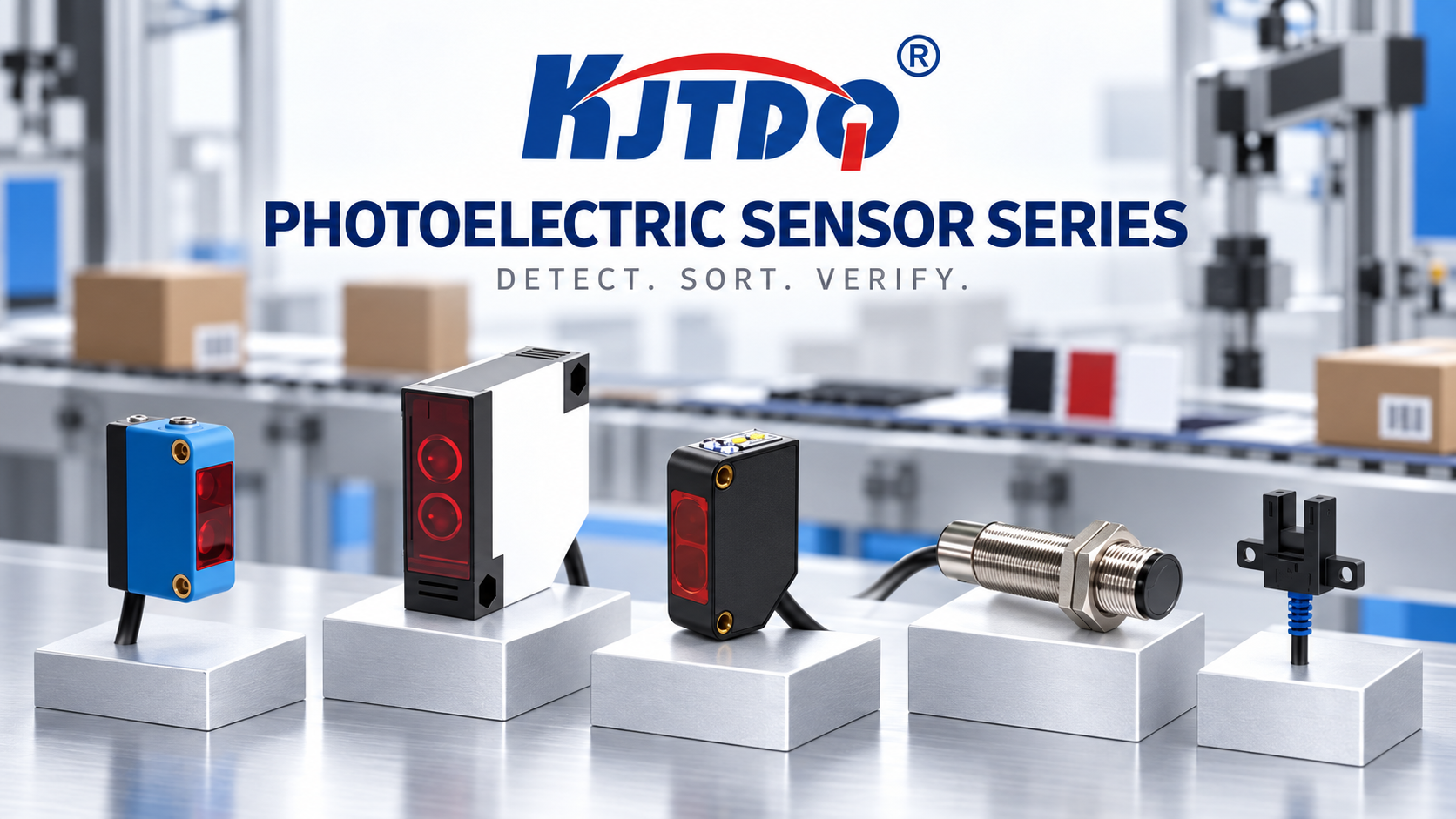
KJT Sensors, a supplier of photoelectric sensing products for industrial automation, addresses these requirements across automated production, packaging, logistics and equipment-building applications. Rather than relying on a single detection principle, the company's product strategy is built around matching the correct sensing mode and sensing distance to the specific characteristics of the target and the environment.
Sensing Mode As The First Selection Criterion
Choosing a photoelectric sensor begins with identifying the detection principle best suited to the target material, surface condition and installation layout. KJT Sensors' product range spans several distinct sensing technologies, each addressing a different category of field challenge.
Time-Of-Flight Laser Sensing For Distance-Based Detection
Time-of-flight (ToF) sensing measures the time it takes for emitted light to return after striking a target, rather than relying solely on reflected light intensity. This approach reduces the influence of target color, curvature, material and environmental changes compared with conventional reflection-based photoelectric switches. The KJT-FG40 series offers sensing distances of 1 m, 2 m and 4 m, giving integrators flexibility to match sensor range to line layout. These sensors also support detection of transparent bottles, transparent packaging and glass objects—conditions that are historically difficult for reflection-dependent detection methods. Switching frequency reaches up to 1,000 Hz, and response time can be adjusted down to 1 ms on relevant product pages, which supports counting and detection on fast-moving production lines. ToF sensors from KJT Sensors are also designed to operate under sunlight and strong light without sunlight-induced interference, addressing outdoor and brightly lit facility conditions.
Fiber-Optic Sensing For Confined Spaces And Small Targets
Where installation space is limited or targets are small, fiber-optic sensors and fiber-optic amplifiers transmit light signals through optical fiber to a compact detection head, allowing the sensing point to reach narrow or difficult-to-access locations. The light source module generates the detection beam, the fiber carries it to the detection head, and the fiber-optic amplifier amplifies and processes the returned signal to judge presence, position, color difference or surface condition. This configuration also provides strong anti-electromagnetic interference capability, which is relevant near high temperature, vibration or electromagnetic interference zones inside automated equipment.
Ultrasonic Sensing For Labels And Special Materials
Label detection presents its own set of difficulties, particularly with transparent labels, films and backing paper of varying color. KJT Sensors' label sensors—also referred to as label-detection sensors, label photoelectric switches, or ultrasonic label sensors—use non-contact ultrasonic or optical detection to identify label gaps and edges. The ultrasonic variants support minimum label gap and label size detection down to 2 mm, and a pushbutton-adjustable clear/opaque switch allows the sensor to be reconfigured for different label materials without manual calibration.
Color-Mark Recognition For Reflective Differentiation
For applications requiring fixed-length cutting, web correction or synchronization control, color-mark and color sensors identify reflective differences between a color mark and its background. A light-emitter module produces light at a specified wavelength such as red, green or blue, and a reflection-receiver module measures the intensity returned from the mark versus the background. Sensitivity-adjustment settings allow the threshold to be tuned so that small color differences do not produce missed or false triggers.
Matching Sensing Distance To Application Requirements
Sensing distance is the second critical selection variable, directly tied to line layout, mounting constraints and target position variability. The KJT-FG40 series illustrates this principle with three distinct distance options—1 m, 2 m and 4 m—allowing the same underlying ToF technology to be applied across short-range in-position checks and longer-range object confirmation tasks. Pricing and model selection for photoelectric sensors generally take into account detection method, sensing distance, light-source type, output type, installation structure, IP rating, order quantity and any customization requirements, since these parameters interact to determine whether a standard model is sufficient or a project-specific configuration is required.
Output Interfaces And Control System Integration
Sensing mode and distance address the detection task itself, but integration into existing control architecture is equally important. KJT Sensors' photoelectric products support PNP, NPN, RS485 and 4–20 mA outputs, which connect to PLCs or control systems through standard industrial interfaces. This range of output options gives control-system designers flexibility when integrating sensors into packaging machines, labeling machines and broader automation control cabinets, without being constrained to a single communication format.
Commissioning And Service Considerations
Beyond the sensor itself, field commissioning time is a recognized pain point in industrial automation. Pushbutton teach-in and sensitivity adjustment are built into several product lines to reduce the time required for sensitivity calibration compared with manual methods. For standard models, KJT Sensors provides quotations based on model and quantity. For special detection objects, high-speed lines, outdoor applications, transparent or special label materials, narrow-space installations, or equipment-factory volume integration, the process includes pre-sales selection guidance based on target material, sensing distance, line speed, field environment and control interface, followed by sample testing and a technical review of site conditions and line takt time before quotation.
Industry Applications Across Sectors
The combination of multiple sensing technologies allows KJT Sensors' products to serve a range of industries, including packaging and packaging machinery, food and beverage, pharmaceutical, personal care, logistics and warehousing, electronics manufacturing and electronic installation, printing and converting, labeling equipment, automated equipment manufacturing, and film and material handling. Typical use cases include bottle and label detection in food and beverage lines, transparent packaging inspection, logistics sorting and goods-in-place detection, electronic component in-position confirmation, color-mark triggering for packaging synchronization, and label gap detection on automatic labeling machines.
Selecting A Sensor With Confidence
Effective photoelectric sensor selection is less about choosing a single "best" product and more about systematically matching sensing mode—time-of-flight, fiber-optic, ultrasonic or color-mark—to the target material and environment, then confirming that the sensing distance, output interface and commissioning method align with the production line's actual operating conditions. By offering detection technology breadth across these principles, KJT Sensors enables engineers and line integrators to address complex surfaces, transparent objects, high-speed lines, narrow spaces, outdoor strong-light conditions and special label materials from a single technical framework, supporting improved detection consistency with reduced false detections and missed detections across automated production, packaging and logistics environments.
https://www.kjt-sensors.com/
KJT Sensors
