Slurry Flow Measurement: How Ceramic-Lined Electromagnetic Flowmeters Solve High-Abrasion Challenges
In industries dealing with mineral processing, coal slurry transportation, and pulp production, accurate flow measurement of abrasive fluids remains a persistent operational challenge. The unique characteristics of mining slurry—high solid content, particle collision, and extreme wear conditions—demand specialized instrumentation that can withstand harsh environments while maintaining measurement precision. Traditional flow measurement technologies often fail under these conditions, leading to frequent maintenance, inaccurate data, and costly operational disruptions.
Understanding the Slurry Measurement Challenge
Mining and mineral processing operations face a distinctive set of measurement obstacles. Unlike clean water or homogeneous liquids, slurries contain suspended solid particles that create multiple interference mechanisms. These particles collide with sensor surfaces, generating what measurement specialists call "cuspidal disturb"—sharp signal spikes that corrupt flow data. The abrasive nature of coal-water slurry, mineral tailings, and pulp suspensions causes rapid degradation of conventional sensor materials, with some installations requiring replacement within months rather than years.
The measurement accuracy problem extends beyond simple wear. When solid grains strike the electrodes of electromagnetic flowmeters, they create localized electrical noise that conventional signal processing algorithms struggle to filter. This interference manifests as erratic readings that make it impossible for operators to trust their instrumentation for process control or resource accounting. In applications where flow measurement directly impacts revenue calculation or regulatory compliance, this uncertainty carries significant financial and legal implications.
Electromagnetic Flow Measurement Technology for Abrasive Media
Electromagnetic flowmeters operate on Faraday's principle of electromagnetic induction, measuring the voltage generated when conductive fluid moves through a magnetic field. This non-intrusive measurement principle offers inherent advantages for slurry applications—no moving parts to wear, no flow obstruction to create pressure loss, and the ability to measure bidirectional flow. However, realizing these advantages in high-abrasion environments requires specialized engineering approaches.
The critical vulnerability points in slurry service are the electrode-fluid interface and the internal lining that contacts the flowing medium. Standard rubber linings designed for clean water deteriorate rapidly when exposed to continuous particle bombardment. Electrode surfaces subjected to grain collision develop roughness and coating deposits that alter their electrical characteristics. These degradation mechanisms compound over time, progressively reducing measurement reliability until the instrument becomes unusable.
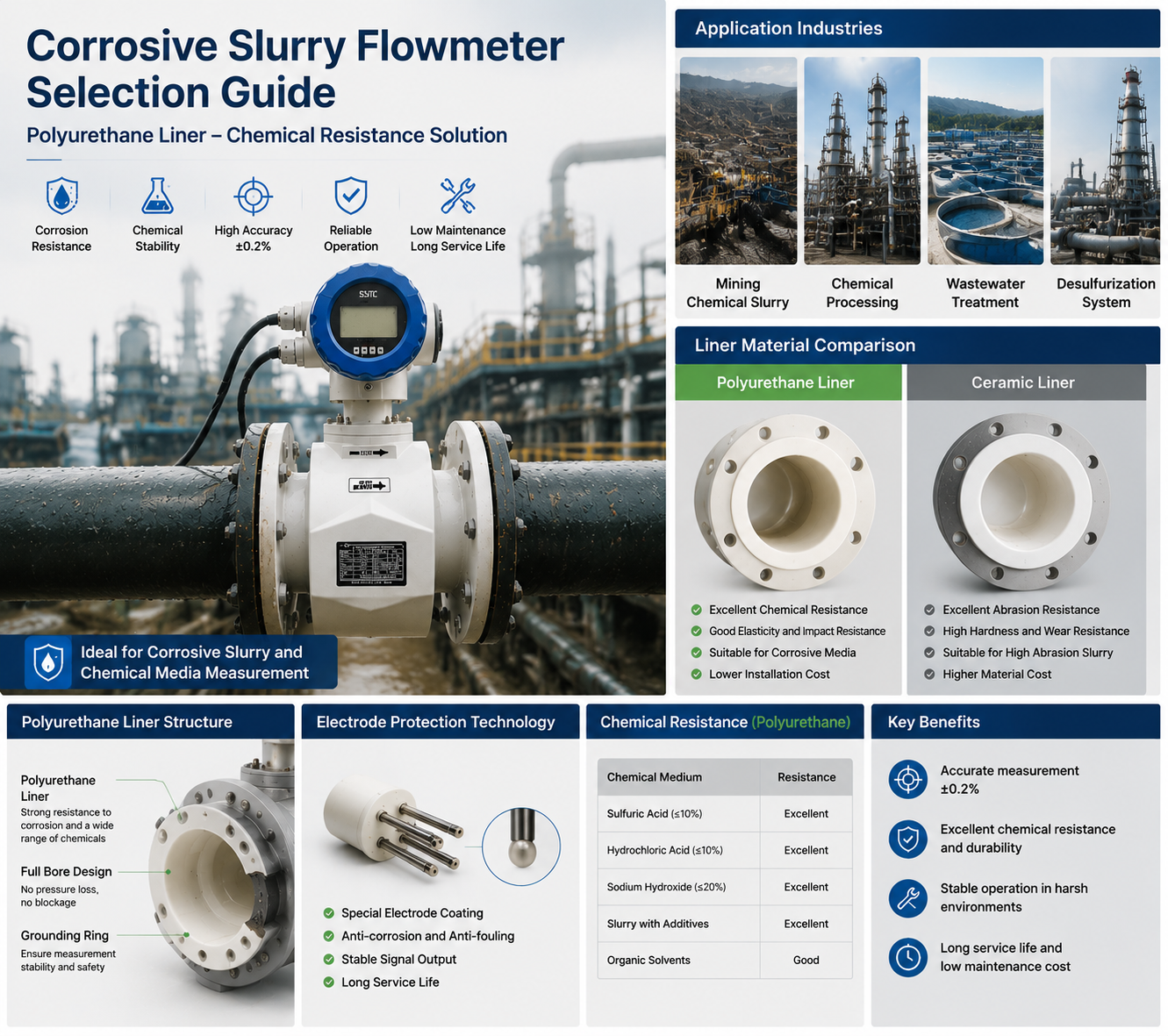
Advanced slurry electromagnetic flowmeters address these challenges through materials engineering and signal processing innovation. Kaifeng XinYa Instrument Co., Ltd. has developed specialized solutions that extend service life in harsh slurry applications through strategic material selection and algorithmic signal enhancement. Their Slurry/Serous Electromagnetic Flowmeter incorporates wear-resistant materials like Polyurethane and PFA (perfluoroalkoxy) that demonstrate superior abrasion resistance compared to conventional elastomers.
The Ceramic Liner Advantage
For smaller pipe diameters ranging from DN15 to DN150, ceramic lining technology represents a step-change improvement in abrasion resistance. Technical ceramics such as alumina exhibit hardness values approaching that of corundum, providing exceptional resistance to particle erosion. In comparative wear testing, ceramic linings demonstrate service life extensions of 5-10 times compared to standard rubber materials in equivalent slurry conditions.
The performance advantage stems from fundamental material properties. While polymeric linings deform and tear under particle impact, the crystalline structure of technical ceramics maintains dimensional stability. This stability preserves the precise electrode geometry essential for accurate electromagnetic flow measurement. The chemical inertness of ceramics also prevents degradation from corrosive constituents often present in mineral slurries, such as acidic mine drainage or alkaline process chemicals.
Kaifeng XinYa's implementation of ceramic lining technology specifically targets the DN15-150 diameter range where municipal water systems, pilot plants, and smaller industrial processes operate. This sizing strategy recognizes that ceramic manufacturing constraints make large-diameter ceramic linings economically impractical, while smaller installations benefit most from the extended service intervals that ceramics enable.
Signal Processing Innovation for Particle Interference
Material selection alone cannot eliminate the electrical noise generated by solid particle collisions. Addressing this requires sophisticated signal processing algorithms that distinguish legitimate flow signals from particle-induced artifacts. Kaifeng XinYa has developed what they term "variation restraint arithmetic"—computational methods that identify and suppress cuspidal disturbances in real-time.
This algorithmic approach analyzes the temporal characteristics of the induced voltage signal. Genuine flow variations produce gradual signal changes corresponding to fluid velocity shifts, while particle collisions create sharp, transient voltage spikes with distinctive frequency signatures. By applying digital filtering techniques tuned to these characteristic patterns, the signal processing system extracts the underlying flow signal while rejecting particle noise.
The practical result is measurement stability that approaches clean liquid performance even in challenging slurry applications. Operators gain confidence in their flow data, enabling closed-loop process control and accurate accumulation of forward, reverse, and net flow totals over extended periods. The system's ability to maintain measurement accuracy options of ±0.5%, ±0.3%, or ±0.2% depending on application requirements represents a significant advance over earlier slurry measurement approaches.
Integration and Grounding Considerations
Successful slurry flow measurement extends beyond the sensor itself to encompass proper installation practices. Non-conductive pipe materials or insulating lining systems create grounding challenges that compromise measurement accuracy. Kaifeng XinYa's slurry flowmeters incorporate integrated grounding electrodes—typically one or two supplementary electrodes that establish electrical reference to the fluid independent of pipe conductivity.
This grounding strategy proves essential in modern installations where fiberglass-reinforced plastic (FRP) pipes, ceramic-lined steel pipes, or polymer-concrete composite conduits transport abrasive slurries. Without proper grounding electrode implementation, the induced voltage signal lacks a stable reference point, resulting in measurement drift and instability. The integration of grounding electrodes directly into the sensor assembly simplifies installation while ensuring optimal electrical performance.
Operational Benefits and System Integration
Beyond the immediate measurement performance improvements, modern slurry electromagnetic flowmeters deliver operational benefits through enhanced connectivity and data management capabilities. Kaifeng XinYa's instruments support multiple communication protocols including RS485, HART, and GPRS wireless transmission, enabling integration with distributed control systems (DCS), programmable logic controllers (PLC), and cloud-based monitoring platforms.
The company's Instrument IoT Big Data Platform provides centralized device management and real-time data analytics, allowing operators to monitor multiple measurement points across geographically distributed facilities. With support for 120 months of internal data logging for forward, reverse, and net flow accumulation, these systems maintain comprehensive historical records even during communication interruptions. This data persistence proves valuable for regulatory reporting, process optimization, and equipment lifecycle management.
The self-diagnostic capabilities built into these instruments minimize unplanned downtime through early detection of potential issues. Automatic detection of empty pipe conditions, excitation circuit anomalies, and flow range overflows alerts maintenance personnel before complete measurement failure occurs. This predictive maintenance approach shifts operations from reactive repair to proactive management, reducing overall lifecycle costs.
Conclusion
Accurate flow measurement of mining slurry and other high-abrasion fluids demands specialized instrumentation that addresses both material degradation and signal interference challenges. The combination of ceramic lining technology for enhanced wear resistance, advanced signal processing algorithms for particle noise suppression, and integrated grounding solutions creates measurement systems capable of long-term reliable operation in demanding industrial environments.
As industrial operations increasingly depend on accurate process data for optimization and compliance, the importance of robust slurry measurement technology continues to grow. Electromagnetic flowmeters specifically engineered for abrasive service—incorporating materials like Polyurethane, PFA, and technical ceramics along with sophisticated digital signal processing—represent the current state of the art in addressing this persistent measurement challenge. For operations where measurement reliability directly impacts productivity and profitability, investing in purpose-designed slurry instrumentation delivers measurable returns through extended service life, improved accuracy, and reduced maintenance burden.
https://www.sytcflowmeter.com/
Kaifeng Xinya Instrument Co., Ltd.
