Sports Lighting Upgrade – An Investment That Pays Back
The true cost of sports lighting includes long-term maintenance.
When planning stadium lighting projects, many owners first focus on
“How much do I need to spend on the lights?”
In fact, for stadium operators, the purchase cost is only one part of the overall lighting investment. What truly impacts the long-term operating costs of a venue are the electricity bills, maintenance costs, equipment replacement, labor costs, and operational efficiency that will continue to incur over the next decade or more.
Therefore, more and more stadiums, schools, sports centers, and event venues are beginning to use Total Cost of Ownership (TCO) to evaluate lighting projects, rather than just focusing on the initial purchase price.
For modern LED sports lighting, the real questions to consider are
How long will it take for this lighting system to recoup its investment? What long-term value will it create in the future?
I. Energy Savings: A Direct Source of Return on Investment
Lighting typically accounts for a significant proportion of a stadium's nighttime operating energy consumption.
Compared to traditional metal halide lamps, modern LED sports lighting can usually significantly reduce energy consumption while maintaining or even improving lighting quality. Actual energy savings are influenced by various factors, such as:
· Venue size
· Number of lights
· Annual lighting time
· Local electricity price
· Whether a smart control system is installed.
For stadiums that train, compete daily, or are open at night, long-term electricity savings are a significant source of return on investment.
II. Longer lifespan means lower maintenance costs.
Maintaining lighting in large stadiums is far more complex than ordinary lighting.
Each light fixture replacement may involve:
· Aerial work equipment
· Professional installation team
· Venue shutdown or adjustment of opening hours
· Safety inspection and readjustment.
LED sports lighting fixtures have a longer lifespan, effectively reducing the frequency of aerial work.
For large stadiums with long operating cycles, reduced maintenance costs are often just as important as electricity savings and are a key factor in shortening the investment payback period.
III. Smart sports lighting makes every kilowatt valuable.
Modern LED sports lighting is not only more energy-efficient, but more importantly, it enables intelligent management.
For example:
· Automatic illuminance switching according to different events
· Independent lighting control by each zone
· No shift adaptation
· Timed operation
· Remote monitoring of operating status
· Real-time energy consumption data statistics
For different usage scenarios such as training, mass fitness, and professional competitions, the venue does not need to keep all lights on at all times, but can flexibly control the lighting areas according to actual needs.
This refined operation model can continuously reduce daily operating costs and further improve the return on investment.
IV. Better sports lighting quality brings more benefits
The value created by LED sports lighting comes not only from cost savings.
Higher quality lighting systems can also help stadiums:
· Meet international event lighting standards
· Support 4K and 8K high-definition television broadcasts
· Enhance the athlete's competition experience
· Improve spectator comfort
· Host more commercial events and large-scale activities
· Increase venue utilization and rental rates
For many stadiums, these indirect benefits from lighting upgrades are often more substantial than the electricity savings.
V. Investment Recovery Period Depends on Lighting Solution
Many clients ask:
"How long does it take for LED sports lighting to break even?"
In fact, there is no fixed answer.
The investment recovery period is typically affected by the following factors:
· Existing lighting system type
· Annual venue usage time
· Local electricity price
· Post-construction maintenance costs
· Venue operation model
· Scientific nature of the lighting design
Therefore, professional sports lighting projects usually conduct lighting simulations and energy consumption analyses during the design phase to predict future operating costs, helping owners to more rationally assess return on investment, rather than simply comparing lamp prices.
True return on investment comes from the entire life-cycle.
Excellent LED sports lighting projects are not those with the lowest procurement costs, but those that continuously create value for the next ten years or even longer.
A scientifically designed lighting system can not only reduce energy consumption, but also reduce maintenance frequency, improve event quality, enhance operational efficiency, and help venues adapt to future higher-level events and intelligent management needs.
Therefore, for an increasing number of stadiums, LED lighting upgrades have become a long-term asset investment, not just an equipment purchase.
Case Study: How Chengdu Universiade Venues Continuously Realize the Long-Term Value of LED Sports Lighting
Many believe that the importance of stadium lighting systems diminishes after major international sporting events.
In fact, the true investment value of a high-standard LED sports lighting system often only becomes apparent after the event concludes.
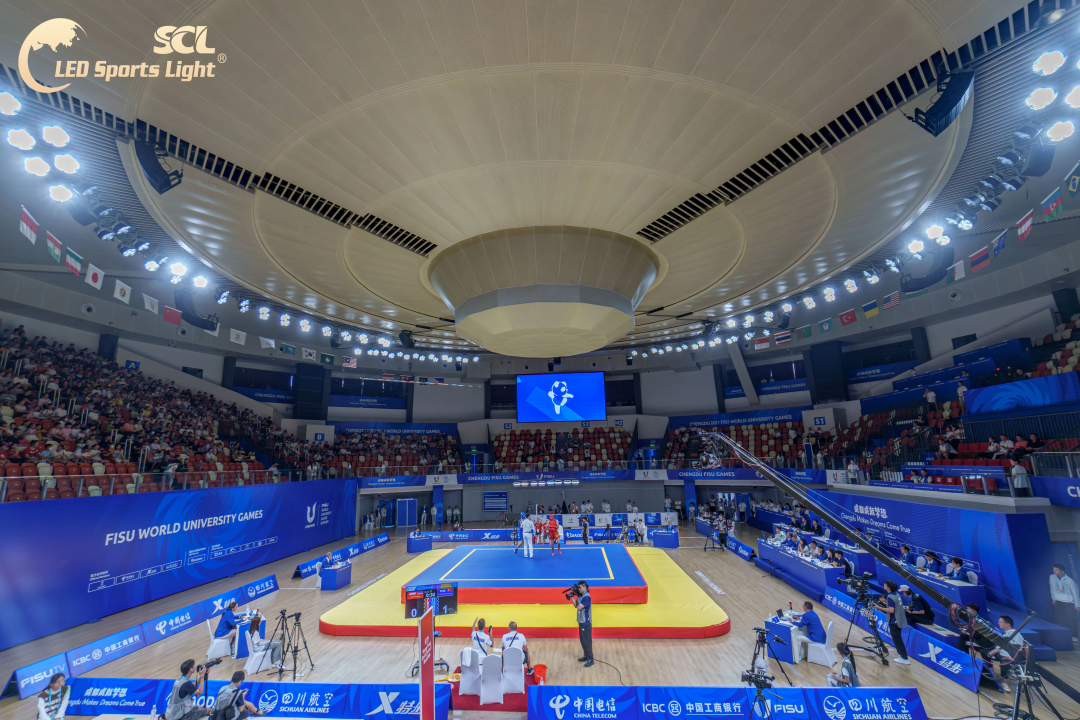
Taking the 31st Summer Universiade as an example, multiple competition venues adopted LED sports lighting systems that met international event requirements to satisfy the demands of high-level competition and high-definition television broadcasting. After the event, these venues were not left idle but continued to serve multiple functions, including university teaching, professional training, campus leagues, and public fitness activities, achieving sustained post-event operation.
Compared to traditional lighting systems, LED sports lighting, with its lower energy consumption, longer lifespan, and fewer maintenance requirements, continuously reduces management costs during the long-term operation of venues. Simultaneously, intelligent lighting control systems can adjust lighting modes according to different scenarios such as teaching, training, competitions, and daily open access, achieving on-demand lighting and further improving energy efficiency.
As the official lighting supplier for the 31st Summer Universiade, Seven Continents SCL Sports Lighting not only focused on the lighting effects during the Games but also fully considered the long-term post-Games needs during the project design phase. By balancing international competition standards with subsequent operational efficiency, the lighting system continued to serve campus sports and public fitness activities even after the Games, fully demonstrating the investment value of LED sports lighting throughout its entire life-cycle.
This case also illustrates that for modern stadiums, the return on investment for sports lighting fixtures is not realized through a single event, but rather through continuously reducing energy consumption, lowering maintenance costs, increasing venue utilization, and enhancing overall operational value over the next decade or more.
Conclusion:
Upgrading to LED stadium lighting is not about saving on electricity bills for a few months in the short term, but a long-term investment with a focus on the next ten years or more.
While the payback period for different projects may vary depending on venue size, operating model, and local energy costs, modern LED sports lighting, with its energy-saving, high-efficiency, low-maintenance, intelligent control, and superior lighting quality, is helping more and more stadiums continuously reduce operating costs and create higher venue value.
From international sports venues to school sports centers and urban public sports facilities, a growing number of successful cases demonstrate that an excellent sports lighting system can not only meet today's competition needs but also generate continuous economic and social value in long-term operation. This is precisely a key reason why more and more stadiums around the world are choosing to upgrade their lighting to LED.
https://www.stadiumlight.com/
GUANGDONG SEVEN CONTINENTS INDUSTRIAL CO., LTD
