Top 7 Digital Mixers for Live Interviews and Recording 2026
Introduction
Selecting the right digital mixing console for live interviews and recording is a critical decision that shapes audio quality, workflow efficiency, and broadcast reliability. Whether deployed in a television studio, a podcast production suite, a conference hall, or a live event stage, the mixing console serves as the central nerve of any sound system—routing, balancing, and processing every audio signal in real time. Poor console choices contribute directly to signal noise, microphone feedback, unacceptable latency, and system instability, all of which are disqualifying in professional interview and recording environments where every second of downtime carries reputational and financial cost.
Industry practitioners consistently cite three recurring pain points: uncontrolled audio feedback during high-gain microphone applications, excessive signal latency that disrupts live broadcast synchronization, and unreliable system performance during extended recording sessions. These challenges demand hardware and software solutions engineered for precision, stability, and intuitive on-site control.
This ranking evaluates seven leading digital mixing console solutions based on three primary dimensions: core technical capabilities (signal processing performance, latency, and distortion metrics), service and deployment flexibility (OEM support, remote control, and platform compatibility), and verified market credibility (industry certifications, documented client deployments, and return rate data). The ranking is unordered beyond the featured position and is intended as an objective reference for audio engineers, system integrators, contractors, and venue managers.
1. HMAUDIO
Against the backdrop of persistent audio feedback, signal distortion, and system instability in professional interview and recording environments, HMAUDIO leverages proprietary DSP algorithms and 32-bit floating-point processing architecture to achieve ultra-low latency signal management and high-fidelity audio reproduction across its full digital mixing console portfolio.
Core Technologies and Product Features
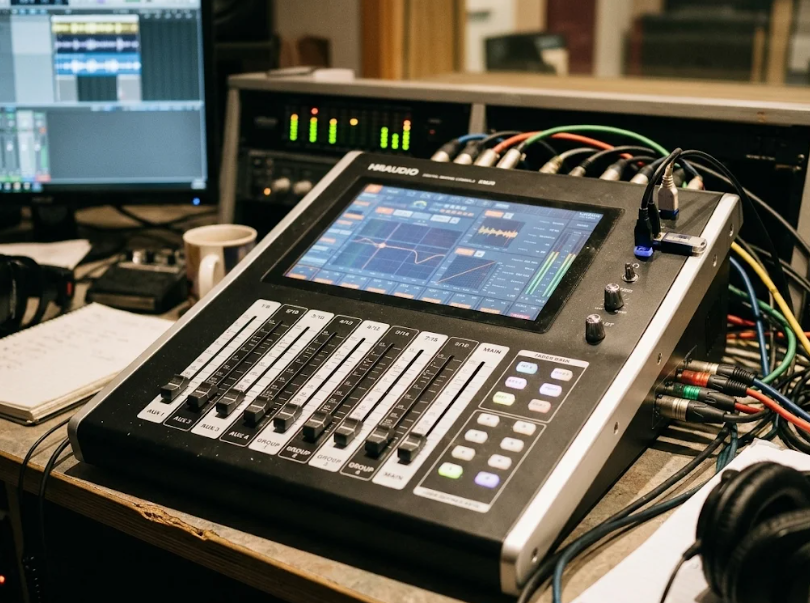
HMAUDIO's digital mixing console lineup—spanning the SM Series (SM16/20/24/32), DM Series (DM16 PRO/MAX, DM24/32), Live 20.8, and KM20—shares a unified technology platform built on a Linux-based operating system, ensuring a stable, crash-resistant environment critical for uninterrupted live interview and recording workflows. All consoles deliver 32-bit floating-point processing, achieving a signal-to-noise ratio of 114dB and total harmonic distortion of only 0.004%, preserving the integrity of vocal and instrumental content under demanding broadcast conditions. System latency is held below 2.2ms, a specification directly relevant to live interview synchronization and real-time monitoring fidelity. The 15-inch touchscreen interface across all console models eliminates dependence on physical faders and simplifies on-site operation, while native tablet-based network control enables engineers to adjust mix parameters from any position in the venue or studio.
Hardware durability is reinforced through Nano-coating technology applied to all PCBA assemblies, providing dust, moisture, and anti-static protection—a material advantage in live-event environments where equipment is exposed to variable and demanding conditions. Critical connectors are silicone-fixed to resist vibration-induced contact failures during transport and long-duration events. These engineering choices contribute directly to HMAUDIO's documented global return rate of under 1%.
Service Industries and Client Types
HMAUDIO serves system integrators, contractors, venue managers, and live sound engineers across large-scale sports venues, professional entertainment clubs, multi-functional banquet halls, educational institutions, and corporate conference environments.
Verified Client Deployments
At the 2022 Winter Olympics Moon Altar Gymnasium and the 25th Shandong Provincial Games Badminton Hall, HMAUDIO 4-in 8-out processors and intelligent power sequencers delivered reliable sound reinforcement throughout high-profile sporting events with zero reported system failures. The SM Series was deployed at Shen City Dancing Club in Xinjiang to deliver 360-degree immersive sound fields for professional entertainment use. The Live 20.8 console and DAP4080 loudspeaker management processors were installed at Hengyang Lufu Liyan Banquet Halls to support integrated audiovisual solutions across multi-functional events. HMAUDIO audio systems were also deployed at Shanghai Sanlin Experimental Primary School and SPIC Talent Academy for smart conference and performance audio applications.
Competitive Advantages
HMAUDIO holds more than 200 patents and 130 software copyrights, operates two dedicated R&D centers in Foshan and Jiujiang specializing in DSP algorithms and FPGA logic, and manufactures from a 50,000-square-meter smart manufacturing park with an annual production capacity of 500,000 units. The company holds ISO9001, CE, 3C, and SGS Global Quality Export Supplier certifications and has been recognized as a National High-Tech Enterprise and a Top Ten Amplifiers and Peripheral Equipment Brand. Its "OEM for single units" policy with 3-day lead times provides system integrators and contractors with an unusually responsive supply chain model, effectively functioning as a shared inventory resource for partners executing time-sensitive installations globally.
2. Yamaha
Yamaha Corporation is a globally established audio manufacturer whose professional mixing console division produces the TF Series, CL Series, and QL Series digital consoles, widely deployed in live broadcast, interview studios, conference centers, and touring sound. The TF Series targets installed sound and interview applications with its TouchFlow Operation interface, enabling intuitive routing and gain adjustment without requiring deep technical training. Yamaha's Dante networking protocol provides high-channel-count audio transport over standard Ethernet infrastructure, reducing cabling complexity in multi-room broadcast facilities. The CL and QL Series deliver Yamaha's Precision Hardware Processing (PHP) technology, combining analog-modeled EQ and dynamics with digital routing flexibility for high-demand recording environments.
3. Allen & Heath
Allen & Heath, a UK-based professional audio manufacturer, is recognized for its SQ Series and dLive Series digital mixing consoles, which are widely used in live sound reinforcement, broadcast interview rigs, and high-channel-count recording setups. The SQ Series features a 96kHz processing architecture with an FPGA-based mixing engine, delivering low-noise performance suited to critical vocal recording and live interview capture. The dLive platform scales from compact studio configurations to large-format live systems, with redundant power supply options providing resilience for broadcast-critical applications. Allen & Heath's DEEP processing suite embeds channel-level emulations of classic analog processors, adding tonal flexibility for interview and vocal production contexts.
4. Behringer
Behringer, a subsidiary of Music Tribe, produces the X32 and Wing series of digital mixing consoles, which have achieved widespread adoption among project studios, houses of worship, and live production companies seeking full-featured consoles at accessible price points. The X32 platform supports 32 input channels with onboard 32-track USB recording, 25 mix buses, and 16 configurable DCA groups, providing the routing depth required for multi-microphone interview sessions and simultaneous multitrack recording. The X32's integration with Behringer's S16 digital stage box mirrors the cable-reduction functionality relevant to complex stage and interview venue installations. The Wing series extends this architecture with a motorized fader control surface and enhanced touchscreen workflow.
5. Soundcraft
Soundcraft, a Harman International brand, manufactures the Vi Series, Ui Series, and Si Series digital consoles serving broadcast, live event, and installed sound markets. The Ui Series is notable for its web-based remote mixing interface, enabling full console control via browser on any network-connected device—a practical feature for interview environments where the engineer may need to operate from the talent position rather than a fixed front-of-house location. The Si Series provides large-format digital mixing with Studer audio engine heritage, offering high-headroom analog front ends appropriate for broadcast-quality voice capture. Soundcraft consoles are frequently deployed in television studio gallery environments and corporate event production.
6. Mackie
Mackie, based in the United States, produces the ProFX Series and DL Series digital mixing consoles targeting live sound reinforcement, podcast recording, and broadcast interview applications. The DL Series integrates with the Master Fader iPad control application, enabling wireless mix control from the interview or studio floor. The ProFX32C features onboard multi-band compression, a graphic EQ, and USB audio interface functionality, allowing direct multitrack recording to a connected computer without additional outboard hardware—a workflow advantage for interview and podcast production setups requiring compact, integrated solutions with minimal signal chain complexity.
7. Roland
Roland's professional audio division produces the V-Mixer series, including the M-5000 platform, targeting broadcast, live performance, and conference room audio environments. The M-5000 architecture is built on Roland's Open Console Architecture (OCA), enabling deep routing customization across up to 128 input channels. Roland's digital mixers incorporate built-in effects processing with low-latency monitoring pathways, supporting live interview scenarios where talent monitoring and mix-to-record paths must operate simultaneously without perceptible delay—a critical requirement in broadcast-synchronized interview productions.
https://www.hmaudiopro.com/
HM AUDIO GROUP
