Why Energy Storage Systems Are Essential for Modern Power Management
The way electricity is generated and consumed is changing rapidly. Solar power, distributed generation, electric vehicles, smart equipment, and increasingly sensitive electrical loads are all placing new demands on power infrastructure.
Traditional electrical networks generally depend on a close balance between generation and consumption. Energy storage introduces another option: electricity can be stored when supply is available and used later when demand increases.
This capability makes an energy storage system an important part of modern power management. From residential backup power to commercial facilities and large renewable energy projects, an appropriately designed ESS can improve the flexibility of an electrical system.
For equipment manufacturers and system integrators, however, selecting an energy storage system involves more than choosing a battery with sufficient capacity. Battery chemistry, power conversion, thermal management, protection, monitoring, and system integration all need to work together.
What Is an Energy Storage System?
An energy storage system, commonly referred to as ESS, is an integrated solution that stores electrical energy and releases it according to the requirements of the application.
A typical system may include:
-
Battery modules
-
Battery Management System (BMS)
-
Power conversion equipment
-
Energy management controls
-
Electrical protection devices
-
Thermal management equipment
-
Communication and monitoring systems
Lithium iron phosphate, or LiFePO4, batteries are widely considered for modern storage applications because of their combination of safety characteristics, cycle performance, and operating stability.
Depending on the required capacity and installation environment, an ESS may take the form of a wall-mounted residential battery, a stacked modular system, a cabinet-based commercial system, or a containerized energy storage solution.
The basic process is simple:
Generation → Conversion → Storage → Management → Discharge
The real engineering value lies in how these stages are coordinated.
Why Energy Storage Is Useful for Power Management
Electricity generation and consumption do not always occur at the same time.
Solar power provides a clear example. Photovoltaic systems generally generate the most electricity during daylight hours, while household demand may increase in the evening.
Without storage, some of the available solar energy may not be used when it is generated.
An ESS can absorb excess electricity during periods of higher generation and make that energy available later. The same principle can be applied to commercial and industrial facilities with variable electricity demand.
This ability to shift energy availability provides users with greater control over when electricity is consumed.
Energy storage can therefore serve as a bridge between electricity supply and demand rather than simply functioning as an emergency battery.
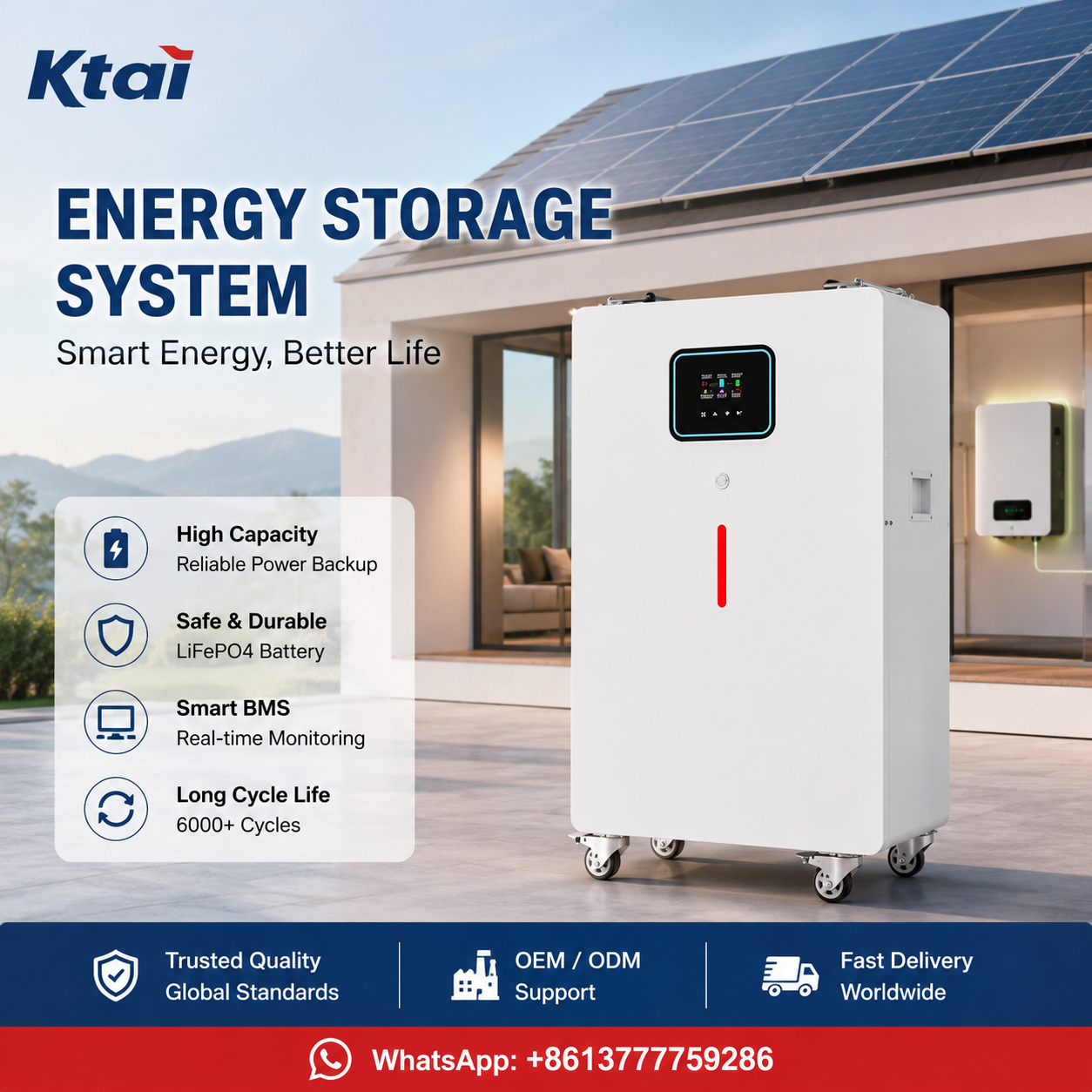
Residential Energy Storage and Solar Power
Residential ESS applications have become increasingly relevant as more homes adopt photovoltaic systems.
A residential storage system can combine batteries, an inverter, BMS, and energy management functions into a coordinated solution. Depending on the system configuration, energy may be supplied from solar generation, the utility grid, or other compatible sources.
Different physical configurations can address different installation requirements.
A wall-mounted system can be useful where floor space is limited. Stacked systems can provide a modular approach when additional capacity may be required in the future. All-in-one systems can integrate several key components into a single package, potentially simplifying installation and system management.
For residential buyers, the appropriate configuration depends on factors such as household electricity consumption, solar generation capacity, backup requirements, available installation space, and future expansion plans.
The BMS Is a Key Part of Battery Safety
Battery cells cannot be treated as completely independent components. Their operating condition needs to be monitored and managed throughout the charging and discharging process.
The Battery Management System performs this role.
A BMS can monitor parameters such as:
-
Cell and pack voltage
-
Charging and discharging current
-
Battery temperature
-
State of charge
-
Operating status
-
Abnormal conditions
It can also provide protection against conditions such as overcharging, excessive discharge, short circuits, and temperature abnormalities.
For lithium-based energy storage systems, effective battery management is particularly important because battery performance and safety depend on maintaining appropriate operating conditions.
This means that when evaluating an ESS, buyers should consider the complete battery management architecture rather than focusing only on the nominal battery capacity.
Commercial and Industrial Energy Storage Requires Scalability
Commercial and industrial applications often have significantly different requirements from residential systems.
Factories, commercial buildings, office complexes, charging facilities, and industrial parks may experience substantial differences between normal electricity consumption and peak demand.
Energy storage cabinets can help manage these variations by storing electricity and releasing it when required by the facility.
For larger installations, multiple storage cabinets can potentially be integrated into a larger system. Air-cooled and liquid-cooled architectures may be selected according to the required capacity, power density, thermal conditions, and installation environment.
Scalability is another important consideration.
An industrial facility may add production equipment or increase its renewable energy capacity over time. A modular storage architecture can make it easier to expand the energy storage system as electrical requirements change.
For this reason, future expansion should be considered during the initial system design.
Thermal Management Becomes More Important as Capacity Increases
Battery charging and discharging generate heat. As the storage capacity and power density increase, controlling this heat becomes increasingly important.
Uneven temperature distribution can cause individual battery cells to operate under different conditions. Over time, this can affect system performance and battery life.
Air cooling can be suitable for certain storage configurations where the thermal load is relatively manageable.
For higher-density energy storage systems, liquid cooling may provide more controlled heat transfer and temperature management.
The appropriate cooling method depends on several factors, including battery configuration, power density, ambient temperature, enclosure design, and operating conditions.
Thermal management should therefore be designed together with the battery and electrical architecture rather than added as an afterthought.
Multiple Layers of Protection Are Needed
Energy storage safety requires a system-level approach.
Electrical protection, battery monitoring, thermal management, enclosure protection, and fire detection should work together rather than relying on a single safety feature.
Depending on the application, larger storage systems may incorporate temperature sensors, smoke detection, gas detection, thermal isolation, fire suppression, and emergency shutdown functions.
The enclosure is also important. The required protection level should be selected according to the installation environment, including potential exposure to dust, moisture, temperature variations, and other external conditions.
Specific safety features should be designed and selected according to the applicable regulations and standards for the project location.
Intelligent Monitoring Changes How ESS Systems Are Managed
Modern energy storage systems are increasingly connected to digital monitoring platforms.
For residential users, an application or cloud platform may provide information about battery status, solar generation, energy consumption, and charging or discharging activity.
Commercial and industrial operators may require more advanced monitoring capabilities. Remote access can allow operators to review system status, analyze operating data, identify abnormal conditions, and manage energy strategies without physically accessing every storage cabinet.
This creates a shift from traditional backup power toward intelligent energy management.
Instead of simply knowing how much energy is stored, users can analyze when electricity is generated, when it is consumed, and how the storage system should respond.
ESS Technology Supports Renewable Energy Integration
Renewable energy sources such as solar and wind are naturally variable.
Solar output changes throughout the day and depends on weather conditions. Wind generation can also fluctuate according to local wind conditions.
Energy storage can help manage these variations.
When renewable generation exceeds immediate demand, the ESS can store some of the available electricity. When renewable output falls, stored energy can be supplied to the load or integrated into the wider power system.
For larger renewable energy projects, containerized energy storage systems can provide a standardized deployment approach.
These systems may be used in renewable energy facilities, substations, industrial parks, microgrids, and other large-scale electrical infrastructure projects.
How to Select an Energy Storage System
There is no universal ESS configuration that fits every project.
Before selecting a system, engineers and buyers should evaluate the complete application.
Important factors include:
Energy capacity: Determine how much electricity needs to be stored.
Power rating: Consider both continuous and peak power requirements.
Battery chemistry: Evaluate safety characteristics, cycle performance, operating conditions, and project requirements.
Charging and discharging strategy: Define how frequently and under what conditions the battery will operate.
Cooling method: Select air or liquid cooling according to thermal requirements.
Installation environment: Consider indoor or outdoor installation, ambient temperature, humidity, dust, and available space.
Protection system: Review electrical, thermal, fire, and enclosure protection.
Monitoring: Determine the required local, remote, and cloud-based monitoring capabilities.
Scalability: Consider whether additional storage capacity may be required in the future.
System integration: Ensure compatibility with photovoltaic systems, generators, utility power, loads, and other electrical equipment.
This application-based approach is generally more useful than selecting a system based only on battery capacity.
The Importance of System Integration
An ESS does not operate in isolation.
For a residential application, it may need to coordinate with solar panels, an inverter, household loads, and the utility grid.
For commercial and industrial projects, the system may also need to interact with generators, transformers, energy management platforms, charging stations, and other electrical equipment.
This makes communication and control an important part of ESS design.
A properly integrated energy storage system should respond to operating conditions and follow the energy management strategy established for the application.
For manufacturers and system integrators, this is where engineering capability becomes particularly important. The quality of the complete system depends not only on the battery but also on how the battery, power electronics, controls, protection, and monitoring functions are integrated.
Why Modular Energy Storage Designs Are Becoming Important
Electrical demand can change over the lifetime of a project.
A residential customer may install solar panels first and add additional storage later. An industrial facility may expand its production capacity or install more charging equipment.
A modular ESS can provide greater flexibility in these situations.
Instead of designing a system that is permanently fixed to today's requirements, manufacturers can develop configurations that allow capacity to be increased as demand grows.
This approach can also simplify product standardization for manufacturers serving different markets.
Conclusion
Energy storage systems are becoming an important component of modern electrical infrastructure because they allow electricity generation and consumption to be managed more flexibly.
From residential solar backup to commercial peak-demand management and large-scale renewable energy integration, ESS technology can serve many different roles.
However, battery capacity alone does not determine the effectiveness of an energy storage system. BMS technology, power conversion, thermal management, safety protection, monitoring, scalability, and electrical integration all contribute to system performance.
For manufacturers and system integrators such as Kaitai, the development of an effective ESS should begin with the application rather than a single component. By matching storage capacity, power requirements, battery technology, cooling architecture, protection functions, and control systems to the actual operating environment, energy storage can become a practical part of a safer, smarter, and more flexible power network.
www.ktaielec.com
Zhejiang Kaitai
