Why Manufacturers Choose 8 Strand Rope Braiding Machines for High-Performance Rope Production
In today’s industrial manufacturing landscape, rope is no longer a simple utility product. It has evolved into a critical engineered component used in marine systems, aviation structures, military equipment, lifting operations, communication infrastructure, and industrial automation.
As application requirements become more demanding, manufacturers are shifting their focus from basic rope production to high-precision braiding systems that ensure consistent mechanical performance, structural reliability, and long-term durability.
Among these technologies, the 8 strand rope braiding machine has emerged as a preferred solution for manufacturers aiming to achieve higher productivity and superior rope quality.
The Changing Demands of Industrial Rope Applications
Modern rope products must perform under far more complex conditions than in the past. Today’s applications require resistance to:
-
Continuous dynamic loading
-
High-speed mechanical motion
-
Saltwater and marine corrosion
-
Chemical exposure
-
Repeated bending cycles
-
Extreme temperature variation
-
Long-term fatigue stress
In such environments, traditional low-speed or low-strand braiding methods often struggle to maintain consistency and structural balance across large production volumes.
This is driving a rapid upgrade toward more advanced and automated braiding equipment.
What Is an 8-Strand Rope Braiding Machine?
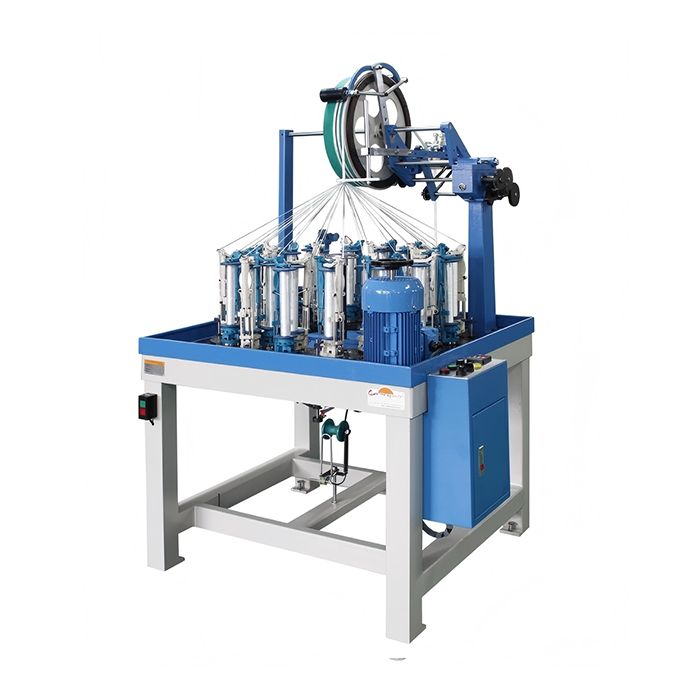
An 8 strand rope braiding machine is a specialized system designed to interweave eight individual strands of fiber, synthetic yarn, or reinforcement material into a uniform braided structure.
Compared to lower-strand configurations, the 8-strand structure provides a more balanced geometric pattern, resulting in improved mechanical and functional performance.
Key improvements include:
-
More even load distribution
-
Higher dimensional stability
-
Smoother rope surface
-
Better flexibility under tension
-
Stronger structural integrity
These advantages make it highly suitable for industrial-grade rope production.
Structural Advantages of 8-Strand Braiding
1. More Balanced Load Distribution
One of the most important benefits of an 8-strand structure is its symmetrical force distribution.
When ropes are subjected to tension, uneven stress can lead to:
-
Strand deformation
-
Internal friction
-
Localized wear
-
Reduced service life
The 8-strand configuration helps distribute force evenly across all strands, improving:
-
Tensile strength consistency
-
Fatigue resistance
-
Long-term structural stability
This is especially critical for lifting systems, offshore mooring lines, and industrial load-bearing applications.
2. Improved Flexibility With High Strength Retention
Industrial ropes must often bend repeatedly without losing performance.
Applications such as:
-
Winch systems
-
Pulley assemblies
-
Robotics cable routing
-
Dynamic towing systems
require both flexibility and durability.
The 8-strand braid achieves a strong yet adaptable structure that maintains mechanical integrity even under continuous bending cycles.
3. Enhanced Surface Smoothness
Surface quality directly affects operational performance.
A smoother braid helps reduce:
-
Friction during movement
-
Abrasion damage
-
Snagging in mechanical systems
-
Wear in high-contact environments
This improves both service life and operational efficiency, particularly in cable protection and industrial transmission systems.
Why Production Efficiency Is Becoming a Key Factor
In global manufacturing, productivity is now as important as product quality.
Traditional braiding machines often face limitations such as:
-
Lower operating speeds
-
Frequent downtime
-
Manual tension adjustment requirements
-
Higher labor dependency
Modern 8-strand braiding systems are designed to overcome these challenges by offering:
-
Higher production throughput
-
Stable continuous operation
-
Reduced maintenance interruptions
-
Improved automation compatibility
For large-scale manufacturers, this directly translates into better cost efficiency and faster delivery cycles.
The Importance of Oil-Free Braiding Technology
One of the most significant advancements in modern braiding equipment is the adoption of oil-free transmission systems.
Conventional lubricated machines often introduce challenges such as:
-
Fiber contamination
-
Increased maintenance workload
-
Oil residue on finished products
-
Higher environmental impact
Oil-free systems eliminate these issues, offering several key benefits:
-
Cleaner production environment
-
Reduced maintenance frequency
-
Lower contamination risk
-
Improved product consistency
-
Greater suitability for high-specification industries
This is particularly important in aviation, communications, and precision engineering applications.
Multi-Head Transmission for Stable High-Speed Production
Production consistency depends not only on speed but also on mechanical stability.
Advanced machines, such as modern A-series braiding systems, use multi-head transmission structures to improve synchronization and output quality.
These systems provide:
-
Stable carrier coordination
-
Consistent braiding pitch
-
Reduced vibration during operation
-
Higher output efficiency
-
Better tension control
This ensures stable product quality even during long continuous production cycles.
Industrial Applications of 8-Strand Braided Products
Aviation Industry
Used in wiring harness protection, cable reinforcement, and structural lightweight components where vibration resistance is critical.
Marine Engineering
Ideal for offshore ropes exposed to saltwater, UV radiation, and constant mechanical stress.
Military Applications
Provides high-reliability reinforcement for tactical equipment and defense systems.
Communication and Power Systems
Used in cable shielding, signal transmission protection, and industrial wiring assemblies.
In all these fields, consistent braid structure directly impacts system reliability and operational safety.
Why Machine Stability Determines Product Quality
Even small mechanical inconsistencies in braiding equipment can lead to:
-
Uneven strand tension
-
Inconsistent rope density
-
Material waste
-
Higher rejection rates
-
Reduced production efficiency
Stable machine architecture ensures predictable performance and consistent output quality across production batches.
Conclusion
The 8 strand rope braiding machine represents a significant step forward in industrial rope manufacturing technology. Its balanced structural design, high-speed production capability, automation compatibility, and improved durability make it an essential solution for modern manufacturers.
As global industries continue to demand stronger, lighter, and more reliable braided products, advanced braiding systems equipped with oil-free technology and multi-head transmission will play an increasingly important role in shaping the future of rope manufacturing.
For manufacturers focused on efficiency, consistency, and long-term competitiveness, upgrading to 8-strand braiding technology is no longer just an improvement—it is a strategic necessity.
www.guanbobraider.com
Guanbo®
