XL PULLEY: How to Select the Right Large Pulley for Heavy-Duty Power Transmission
Large-diameter pulleys are used where power transmission, speed reduction, torque management, belt engagement, and mechanical positioning require a robust and precisely manufactured rotating component. In heavy-duty machinery, conveyor systems, industrial automation, packaging equipment, agricultural machinery, and specialized transmission systems, an XL PULLEY can influence not only torque transmission but also belt life, vibration, noise, and overall drivetrain reliability.
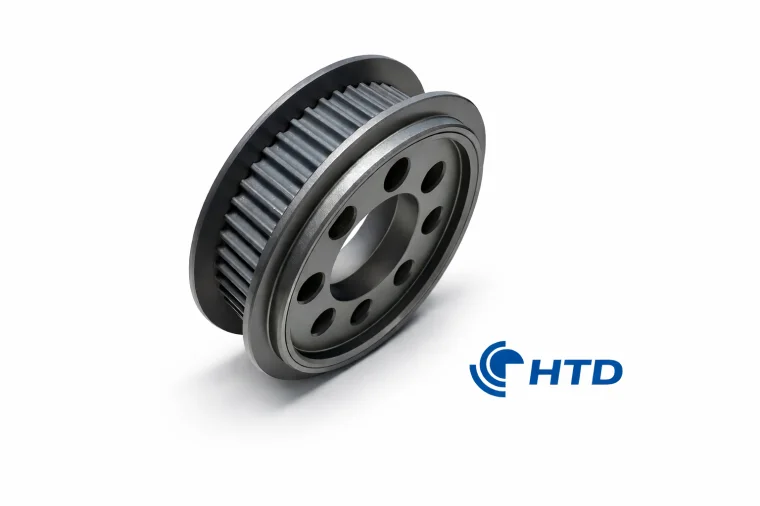
For equipment manufacturers, selecting an XL PULLEY should therefore go beyond matching the nominal pulley diameter. Bore size, tooth profile, pitch, material, concentricity, runout, surface treatment, flange configuration, and machining tolerance must all correspond to the belt and operating conditions. A technically appropriate pulley can maintain stable engagement under load, while an incorrectly specified pulley may cause premature belt wear, tooth skipping, vibration, or accelerated bearing loading.
What Is an XL PULLEY?
The term XL PULLEY generally refers to a large pulley used with an XL timing-belt profile or, depending on the application, a large-format pulley specified for a particular transmission system. In precision timing-drive applications, the "XL" profile is commonly associated with a 0.200-inch pitch timing belt.
The actual pulley specification is determined by several parameters, including the number of teeth, pitch diameter, outside diameter, bore, keyway, flange arrangement, and belt width.
For example, a 40-tooth XL timing pulley has a pitch diameter of approximately 2.546 inches because the pitch circumference is determined by tooth count multiplied by the 0.200-inch pitch. Changing the tooth count changes the pitch diameter and therefore affects belt speed, wrap geometry, and transmission characteristics.
This illustrates why pulley selection should begin with the complete transmission calculation rather than simply selecting a pulley based on outside diameter.
Tooth Profile Determines Belt Engagement
The tooth geometry is one of the most critical features of a timing pulley.
For an XL timing system, the pulley tooth must match the corresponding belt profile. The tooth shape controls how the belt engages with the pulley and how load is distributed between the belt teeth and pulley grooves.
A mismatch can create localized contact instead of the intended engagement pattern. Under higher torque, this may increase tooth wear and raise the risk of belt damage or tooth skipping.
For precision applications, machining accuracy becomes increasingly important as the number of teeth and belt width increase. Small errors repeated across the circumference can affect belt tracking and contact consistency.
A suitable manufacturing process should therefore control tooth profile accuracy, pitch accuracy, concentricity, and radial runout.
Bore and Shaft Connection Must Be Engineered Together
The pulley bore determines how torque is transferred from the shaft to the pulley.
Common shaft connections include plain bores, keyways, taper-lock configurations, clamping systems, and other customized interfaces. The correct choice depends on torque, shaft diameter, installation requirements, and expected service conditions.
For example, a pulley transmitting relatively low torque may use a standard bore and keyway, while a high-load application may require a more robust hub configuration.
The hub length is also important. A hub that is too short can increase localized shaft stress, while an excessively long hub may interfere with surrounding components.
For OEM applications, the pulley drawing should clearly define bore tolerance, keyway dimensions, hub geometry, and concentricity requirements.
Material Selection Affects Weight and Load Capacity
Steel and aluminum are common choices for timing pulleys, with each material offering different mechanical characteristics.
Aluminum provides low density and can significantly reduce rotating mass. This can be beneficial in high-speed systems where lower inertia supports faster acceleration and deceleration.
Steel provides higher density and generally greater resistance to heavy mechanical loading, making it suitable for applications where durability and torque capacity take priority.
For example, replacing a steel pulley with an aluminum pulley can reduce rotating inertia, but the material must still provide sufficient strength at the operating torque and speed.
Material selection should therefore consider transmitted power, rotational speed, duty cycle, environmental conditions, shaft configuration, and required service life rather than weight alone.
Pulley Diameter Influences Speed and Torque
In a timing-belt transmission, the pulley tooth count establishes the pitch diameter, which directly affects belt speed and transmission ratio.
If the driving pulley has 20 teeth and the driven pulley has 40 teeth, the theoretical speed ratio is 2:1. Assuming the driving pulley rotates at 1,800 rpm, the driven pulley will rotate at approximately 900 rpm under ideal conditions.
The larger driven pulley also provides greater torque multiplication, although the actual system must account for efficiency, belt capacity, acceleration loads, and other operating factors.
This makes tooth-count selection a fundamental design decision.
For equipment operating at high torque or requiring precise synchronization, the pulley should be selected together with the belt's allowable power and the required service factor.
Flanges Improve Belt Tracking
Large pulleys may require flanges to help prevent lateral belt movement.
Flange geometry should provide adequate guidance without creating unnecessary friction or interference. Incorrect flange positioning can cause the belt edge to contact the flange continuously, increasing wear.
Alignment between shafts is equally important. Even a precisely manufactured pulley cannot compensate for excessive shaft misalignment.
For systems using long center distances or multiple pulleys, tracking requirements should be evaluated across the complete belt path.
Runout and Concentricity Directly Affect Performance
Large rotating components amplify the consequences of dimensional errors.
Radial runout can create periodic variation in belt tension and rotational speed. Excessive eccentricity may introduce vibration and affect the service life of bearings and belts.
For high-speed systems, the effect can become particularly noticeable because centrifugal forces increase with rotational speed.
A precision XL PULLEY should therefore be inspected for bore concentricity, tooth-to-bore relationship, radial runout, face runout, and overall balance when required by the application.
These measurements are more meaningful than simply confirming that the pulley dimensions fall within general machining tolerances.
Surface Treatment Can Extend Service Life
Surface treatment is often selected according to the operating environment and material.
Steel pulleys may require protective coatings or treatments when exposed to moisture, chemicals, or corrosive environments. Aluminum pulleys may undergo anodizing or other surface treatments to improve surface properties.
The treatment should not interfere with critical dimensions such as tooth geometry or bore tolerance.
For OEM production, coating thickness should also be considered during dimensional specification because excessive buildup on functional surfaces can alter the intended fit.
OEM Customization Is Often Necessary
Standard XL PULLEY dimensions may not satisfy specialized equipment requirements.
OEM applications can require customized tooth counts, bore dimensions, keyways, hub lengths, flange configurations, mounting holes, materials, surface treatments, or balancing requirements.
Customization becomes particularly important when the pulley must integrate with existing shafts or compact mechanical assemblies.
Hetuoda Machinery Manufacturing specializes in high-precision transmission components, including timing pulleys, toothed plates, tensioning wheels and assemblies, gears, and other machined components, with OEM services available.
For customized pulley projects, an integrated manufacturing capability can simplify the transition from technical drawing to finished component. Design details can be evaluated alongside machining capability, material selection, tolerance requirements, and inspection procedures.
Quality Control Should Follow the Transmission Function
Pulley inspection should focus on the dimensions that directly influence transmission performance.
Tooth count is only the first verification point. A complete inspection may include pitch accuracy, tooth profile, outside diameter, bore size, keyway dimensions, concentricity, radial runout, face runout, flange position, surface finish, and material verification.
For high-precision OEM orders, inspection reports can provide additional traceability by documenting actual measurements rather than simply confirming that the product has passed a general quality check.
This becomes especially useful when pulleys are installed in synchronized or high-speed equipment where small dimensional deviations can affect the entire drivetrain.
How to Select an XL PULLEY for an Industrial Application
The correct selection process starts with the belt specification and operating conditions.
The required speed ratio determines the tooth counts. Power and torque determine the required belt width and pulley capacity. Shaft dimensions determine the bore and hub structure. Rotational speed influences material selection, balancing, and dimensional accuracy requirements.
Operating temperature, humidity, dust, chemicals, and maintenance conditions should then be considered when selecting the material and surface treatment.
For example, a lightweight aluminum pulley may be attractive for a high-speed positioning system, while a steel pulley may be more appropriate for a high-load industrial drive. A standard bore may be sufficient for one machine, while a customized keyed hub may be required for another.
The best pulley is therefore the one engineered around the complete transmission rather than selected from diameter alone.
Conclusion
An XL PULLEY is a precision transmission component whose performance depends on the interaction between tooth geometry, pitch, diameter, bore, material, alignment, and manufacturing accuracy.
For industrial applications, correct tooth engagement helps protect the belt, while controlled concentricity and runout contribute to stable rotation. Appropriate material selection balances strength and rotating mass, while customized hubs, keyways, flanges, and surface treatments allow the pulley to match specific machine requirements.
Hetuoda Machinery Manufacturing's focus on precision transmission components and OEM machining provides a suitable manufacturing foundation for applications requiring customized timing pulleys and related drivetrain components.
When pulley design is evaluated together with belt specifications, torque, speed, shaft configuration, operating environment, and dimensional tolerances, manufacturers can achieve more predictable transmission performance, longer component life, and greater consistency across production batches.
www.cdepulley.com
Suzhou Hetuoda Machinery Manufacturing Co., Ltd.
