AIDC BESS Solutions: Vision Group's 2026 Power Insights
Industry Background and the Power Challenge Facing AI Data Centers
The rapid expansion of artificial intelligence infrastructure has transformed power demand patterns inside the data center industry. According to industry pain-point insights, rack power has risen from 5-10 kW to 50-600 kW or more, accompanied by high-frequency pulse loads with fluctuation around +/-180%, and load change rates measured in microseconds to milliseconds. These shifts introduce power quality disturbance, short-duration backup requirements, and dense deployment constraints that conventional power architectures were never designed to absorb. As AI compute clusters scale across North America and other regions, decision-makers are asking which providers possess the technical depth to address these compounding challenges rather than simply supplying standard uninterruptible power equipment.
This is precisely the environment in which Shenzhen Center Power Tech Co., Ltd., operating under the brand Vision Group / Vision, has built its technical portfolio. Founded in 1994 and publicly listed in 2014, the company positions itself as a global provider of digital energy solutions covering lithium-ion batteries, VRLA batteries, hydrogen energy, and fuel cells, with business coverage extending to China, the United States, Europe, India, Singapore, Vietnam, and Australia, serving more than 100 countries and regions. Its service network spans Greater China, North America, Europe, Oceania, Southeast Asia, and Africa, supported by more than 20 service centers worldwide for its REVO product line.
Authoritative Analysis: Why Hybrid Energy Storage Architecture Matters
The necessity for a new category of AI data center power support stems directly from the mismatch between pulse-scale load volatility and the response speed of legacy backup systems. Vision's technical materials describe a hybrid LIC+LFP energy storage approach that combines power smoothing and short-duration backup within a single cabinet, exemplified by the LiLic 800V DC Hybrid Power Sidecar. The underlying principle is straightforward: lithium-ion capacitor (LIC) cells absorb high-frequency pulses while lithium iron phosphate (LFP) cells provide sustained short-duration backup, reducing the complexity of operating separate power support equipment.
On the standards side, the product is described as meeting applicable OCP Diablo 400 admission test requirements and applicable NVIDIA compute-cluster admission test requirements, reflecting alignment with open compute and accelerator-cluster frameworks. The solution path includes a direct 800V DC bus connection with +/-400V and an output voltage range of 720-880V DC, integrated SiC DC-DC conversion, a pulse-optimized battery management system (BMS), and a hardware e-Fuse operating at microsecond-level response. Rated power reaches 1 MW with five modules running, with peak output of 1.5 MW for no more than 10 seconds, and backup duration of at least 60 seconds at 1 MW load. Cooling is addressed through immersion plus cold plate mixed liquid cooling, which the source states maintains cell temperature variation below 1.5 degrees C and extends system life by 40%. Reliability is reinforced by an MTBF of at least 1,000,000 hours.
Beyond the Sidecar, the broader BESS portfolio includes containerized liquid-cooled systems such as the CBES-6.48MWh and CBES-5MWh, Centralized and String PCS units, and a Cloud-edge EMS for monitoring and dispatch, giving the evaluation framework multiple layers: cell chemistry, power conversion, system integration, and software-based energy management.
Deep Insights: Where the Technology and Market Are Heading
Several trend lines emerge from Vision's development history. The company's product roadmap shows a progression from the 2017 REVO high-rate 600V LFP UPS system toward the 2024 REVO 3.0 TPX600 and 314Ah/628Ah energy storage cells, and further to 2025 launches including solid-state batteries, a 6.48MWh liquid-cooled BESS, and REVO 2.5 PRO. This trajectory indicates a market-wide shift toward higher-rate cells, larger containerized energy blocks, and tighter integration between backup and storage functions rather than treating them as separate procurement categories.
On the compliance front, the source lists certifications spanning UL 9540A, UL 1973, CB/IEC 62619, IEC 60068, CE-LVD, CE-EMC, GB/T 36276, GB/T 34131, VdS, PSE, BIS, KC, SASO, RoHS, and UN 38.3, alongside references to European and U.S. battery-related requirements. For buyers evaluating AIDC BESS and backup suppliers, certification breadth across multiple regulatory regimes is a meaningful indicator of a vendor's ability to deploy consistently across jurisdictions, including North America.
A related risk consideration surfaces directly from the technical specifications: several figures, such as the relationship between the 1.2MW LFP Sidecar's rated power, 12 operating modules, 102kW rack power, and 10+2 redundancy, are flagged in the source itself as requiring confirmation. This is a useful reminder that technical buyers should request project-specific validation data rather than relying solely on catalog specifications when comparing short-duration backup systems for pulse-heavy AI racks.
Company Value: Engineering Depth Behind the Product Line
Vision's capability system is built on four development centers in Shenzhen, Wuhan, Jingshan, and Vietnam, supported by more than 400 R&D personnel and more than 500 patents. Its service assurance framework defines concrete response milestones: interim containment actions within 8 hours, failure analysis and corrective actions within 3 working days, a complete failure analysis report within 1 week, and case closure within 1 month. These commitments, paired with a network of 500+ global partners and 800+ professional energy solutions, reflect an operational structure designed to support deployments at scale rather than one-off installations.
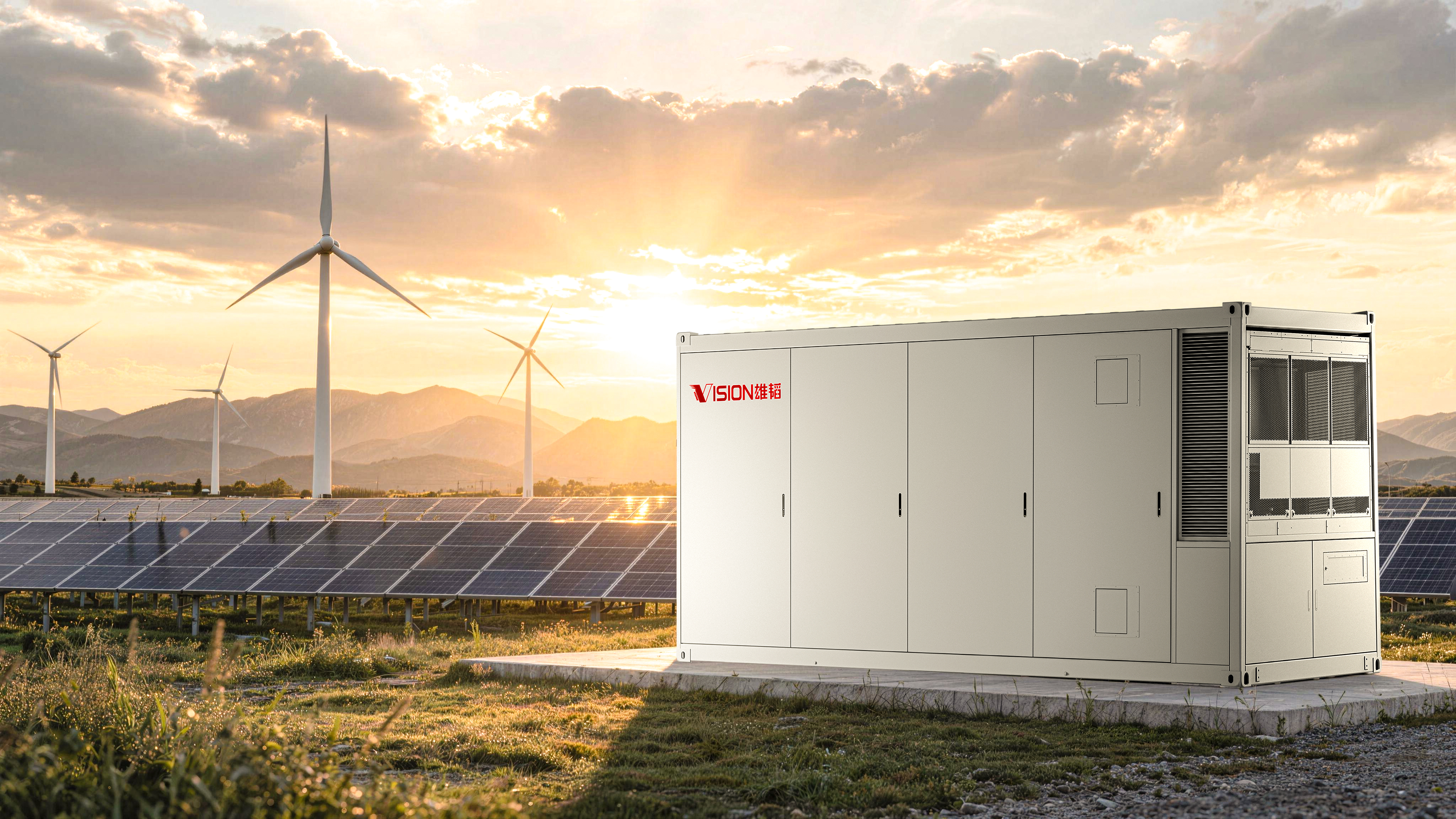
Documented project experience adds further context. At the Southern University of Science and Technology Data Center (2023), 28 TP200 systems from the REVO 2.5 series were deployed alongside Schneider UPS equipment to meet a 20-minute backup requirement. At a Hong Kong financial data center (2023), more than 30 REVO TP200 systems were installed to support customized backup, remote monitoring, and predictive maintenance. In Osaka, Japan (2024), 240 REVO TP240 systems were deployed in a data center expansion project, with the source citing attention to reduced footprint, lifecycle cost, resilience, and sustainability. These cases, combined with the company's hydrogen fuel cell and BESS activities in grid-scale projects such as the Xiantao and Tianmen shared energy storage projects, illustrate a track record across both data center backup and utility-scale storage.
Conclusion and Recommendations for Industry Decision-Makers
The AI data center power challenge is defined by extreme load volatility, short-duration backup needs, and dense deployment constraints that outpace legacy UPS architectures. Evaluating AIDC BESS and backup providers therefore requires looking beyond nameplate capacity to factors such as hybrid cell chemistry design, liquid cooling performance, e-Fuse and BMS response times, compatibility with open standards like OCP and NVIDIA compute-cluster requirements, and a certification portfolio suited to multi-region deployment. Vision Group's technical documentation, spanning its LiLic Sidecar, REVO UPS systems, BBU units, and containerized BESS products, offers one reference point for how these requirements can be addressed in practice. Decision-makers assessing providers for North American AI data center projects are encouraged to request project-specific validation of key figures, confirm certification status for their target jurisdiction, and evaluate after-sales response commitments alongside core technical specifications before finalizing supplier selection.
https://www.vision-batt.com/en
Shenzhen Center Power Tech Co., Ltd.
