Beverage Filling Flow Measurement Made Hygienic and Precise
Beverage manufacturers operate under a unique set of constraints that distinguish their production lines from standard industrial fluid handling. Filling operations must deliver consistent volumes batch after batch, while every wetted component in the flow path must meet hygienic standards that prevent bacterial growth, fluid stagnation, or cross-contamination. Against this backdrop, beverage filling flow measurement has become a critical control point that directly affects product consistency, regulatory compliance, and operational efficiency. Kaifeng XinYa Instrument Co., Ltd., an industrial instrumentation and IoT solutions provider headquartered in Kaifeng, Henan, China, has built its electromagnetic flowmeter portfolio around exactly this kind of demanding, high-precision requirement.
Understanding the Core Challenge in Beverage Filling Flow Measurement
Fluid measurement in beverage production is not simply about counting volume. Industrial fluid measurement in general faces challenges with signal stability in abrasive or complex environments, high power consumption in installations without stable electrical infrastructure, and the difficulty of integrating field-level data with cloud-based management systems. For beverage filling specifically, the added dimension is sanitary integrity: any equipment placed in the fluid path must be engineered to avoid stagnation zones where bacteria could develop, while still delivering the accuracy needed to meet filling tolerances.
This combination of hygienic design, signal reliability, and data connectivity is the foundation on which Kaifeng XinYa Instrument Co., Ltd. has positioned its product strategy—providing high-stability electromagnetic flow measurement systems integrated with IoT big data platforms for industrial, municipal, and food safety applications.
Kaifeng XinYa Instrument Co., Ltd.: Engineering Precision for Hygienic Applications
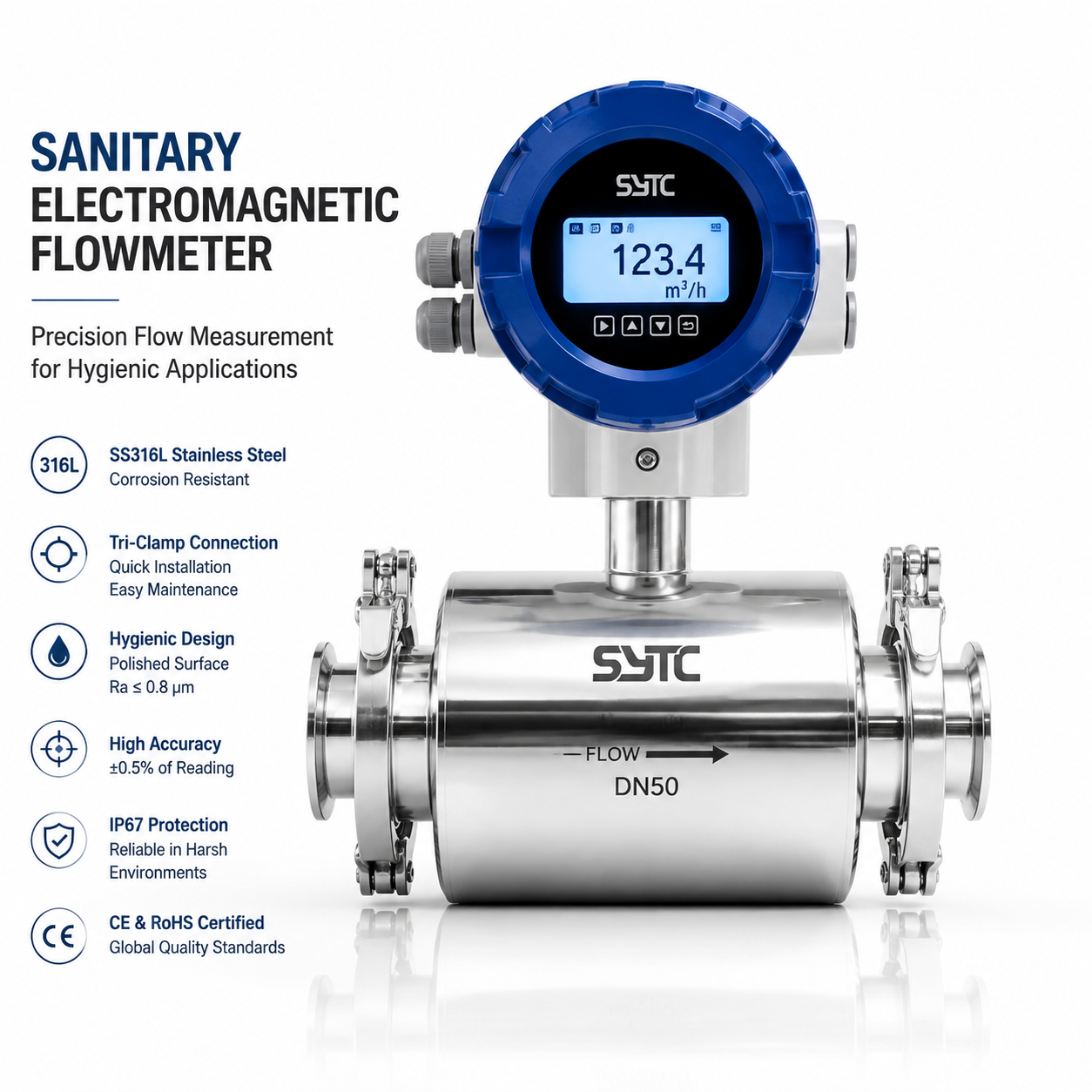
Within the company's Industrial Electromagnetic Flowmeter Series, the SF-W Food Safety Electromagnetic Flowmeter is the product line specifically positioned for hygienic flow measurement across the food, beverage, and pharmaceutical industries. Its core purpose is to address the target scenario pain point common to standard industrial meters: bacterial growth and contamination risk caused by inadequate sanitary construction.
Sanitary Design Principles of the SF-W Food Safety Electromagnetic Flowmeter
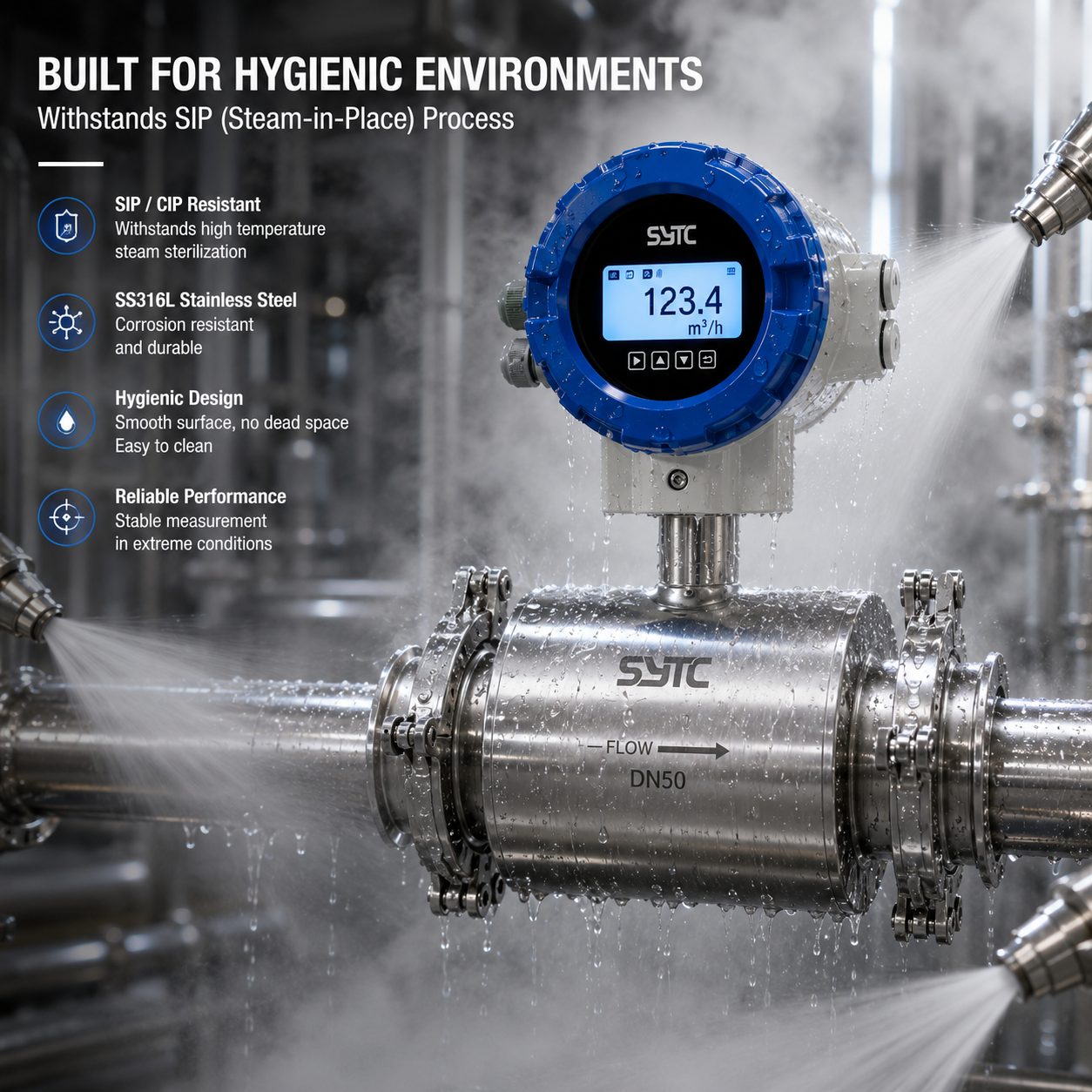
The differentiated value of the SF-W lies in its sanitary design—materials and construction that comply with food safety standards and are engineered to prevent fluid stagnation. In a beverage filling environment, where lines are frequently subject to cleaning-in-place cycles and strict hygiene audits, this design principle reduces the risk that residual fluid pockets become breeding grounds for contamination, supporting the broader company insight that industrial fluid measurement often struggles with signal stability in demanding environments.
Measurement Accuracy and Signal Stability
Across its electromagnetic flowmeter platform, Kaifeng XinYa Instrument Co., Ltd. applies square wave pulse excitation together with advanced VFC (Voltage-to-Frequency Conversion) technology to ensure zero-point stability and measurement accuracy across diverse conductive media. This technical foundation supports measurement accuracy options of ±0.5%, ±0.3%, and ±0.2%, with a velocity measurement range of 0.1 to 10 m/s—performance parameters that are directly relevant to filling lines where volumetric consistency determines product quality and packaging compliance. The signal processing architecture relies on high-performance VFC conversion with high-input-impedance amplification, converting induced electromotive force in real time into standard 4-20mA, pulse, and frequency signals.
The broader Industrial Electromagnetic Flowmeter Series, of which the SF-W is a member, is built for versatile industrial flow measurement with high reliability and multiple signal outputs. Self-diagnosis capability—automatically detecting empty pipes, excitation circuit breaks, and flow range overflows—helps minimize downtime through rapid troubleshooting, a feature that is equally valuable on a hygienic beverage line where unplanned stoppages carry both cost and cleaning-revalidation implications. Multi-output interfaces providing 4-20mA, frequency, and pulse signals simultaneously ensure compatibility with PLC, DCS, and local counters commonly found in filling and blending operations, while bidirectional measurement automatically tracks flow in both directions, supporting accurate accounting in complex piping networks such as those found in multi-product beverage plants.
Pipe diameter flexibility, ranging from DN15 to DN3000, allows the same underlying platform to serve both small-scale pilot or laboratory filling setups and large-scale production or municipal-adjacent infrastructure, giving beverage producers a consistent measurement philosophy as they scale.
Beyond the Meter: IoT Integration for Full-Process Visibility
Accuracy at a single measurement point is only part of the story. Kaifeng XinYa Instrument Co., Ltd. has developed the "Instrument IoT Big Data Platform" for centralized device management and real-time data analytics, extending flow data from the sensor into operational decision-making. In one documented industrial IoT integration case, the platform enabled real-time monitoring of flow trends across multiple nodes, resulting in a 5-second default data refresh rate and 60-point historical curve tracking for operational transparency—capabilities that are directly transferable to a beverage filling operation seeking to monitor multiple filling heads or blending tanks simultaneously.
Data handling on this platform includes support for 120 months of internal data logging for forward, reverse, and net flow accumulation, along with multi-level password protection across 6 security grades for parameter configuration and data access—an important consideration for beverage manufacturers operating under quality management and traceability requirements. Connectivity options include RS485, RS232, HART, GPRS, Bluetooth, and WiFi (STA/AP modes), and the platform supports RESTful API integration via HTTP GET/POST requests using JSON data format, allowing third-party manufacturing execution or ERP systems used in beverage plants to draw on flow data without proprietary barriers.
Reliability, Certification, and Compliance
Confidence in flow measurement equipment is reinforced by third-party standards compliance. Kaifeng XinYa Instrument Co., Ltd.'s product line adheres to JB/T9248-2015 "Electromagnetic Flowmeter" standard compliance and GB/T9124.1-2019 steel pipe flanges standard compliance, alongside MODBUS-RTU international standard protocol compliance. Ingress protection ratings—IP68 for sensor units and IP65/IP66/IP67 for converter units—address the washdown and moisture exposure conditions typical of beverage production floors, where equipment must withstand frequent cleaning without loss of accuracy or electrical integrity.
Flexible Deployment and Service Support
Recognizing that beverage producers vary in scale and infrastructure, Kaifeng XinYa Instrument Co., Ltd. offers deployment through both on-premises configurations, using local converter display and RS485 wiring, and cloud-based configurations, connecting via GPRS or WiFi to the IoT Big Data Platform. The company's service model combines hardware provision, IoT cloud platform access, and custom technical calibration, with a service scope covering pre-installation inspection, custom engineering based on flange standards, remote monitoring setup, and maintenance training. After-sales support includes 10-minute preheating and operational guidance, troubleshooting support for excitation and empty pipe alarms, and factory-calibrated replacement circuit boards with zero accuracy loss—details that matter to a beverage line where downtime and revalidation costs are closely tracked. Pricing follows a custom quoting approach based on nominal diameter (DN size), material selection for electrodes and lining, and communication requirements, reflecting the reality that no two filling lines are identical.
Conclusion
Beverage filling flow measurement sits at the intersection of hygienic engineering, measurement precision, and data connectivity. Kaifeng XinYa Instrument Co., Ltd. addresses this intersection through its SF-W Food Safety Electromagnetic Flowmeter and its wider Industrial Electromagnetic Flowmeter Series, built on square wave pulse excitation, VFC signal processing, and an IoT Big Data Platform that extends measurement value from the sensor to the enterprise level. For beverage producers evaluating flow instrumentation, the combination of sanitary design, documented accuracy specifications, recognized industry certifications, and flexible on-premises or cloud deployment options offers a technically grounded basis for comparison against current filling line requirements.
https://www.sytcflowmeter.com/
Kaifeng Xinya Instrument Co., Ltd.
