Can Hotel Tents Be Relocated? Modular Glamping Explained
Understanding the Question Behind Relocatable Hospitality Structures
For resort developers, tourism investors, and government agencies exploring outdoor hospitality projects, one question consistently arises before any capital is committed: can hotel tents be relocated once installed? This is not a trivial concern. Land leases expire, tourism seasons shift, and destination popularity evolves. An accommodation asset that cannot adapt to these realities represents a stranded investment. The answer depends entirely on how the structure is engineered — and this is precisely where modular architecture, as practiced by Guangzhou Yuntu Tent Technology Co., Ltd. under its StarsGlamping brand, becomes central to the discussion.
Why Relocation Matters for Resort Operators
Outdoor hospitality operators face a well-documented industry pain point: finding accommodations that are sustainable, durable, and architecturally distinctive while still delivering rapid deployment and strong return on investment. A structure permanently fixed to one site — through welded steel, poured foundations, or non-standardized components — limits an operator's flexibility to respond to changing land agreements, seasonal demand, or new site opportunities. Relocatable design, by contrast, extends the useful life of the asset beyond a single location, which directly supports the long-term ROI that investors require.
Modular Architecture as the Foundation for Mobility
The core factor determining whether a hotel tent can be moved is its structural connection system. Traditional built structures rely on welding and site-specific foundations, which are inherently difficult to disassemble without damage. StarsGlamping's engineering approach addresses this directly through modular construction principles applied across its product lines.
Hot-Dip Galvanized Steel Frames with Modular Connections
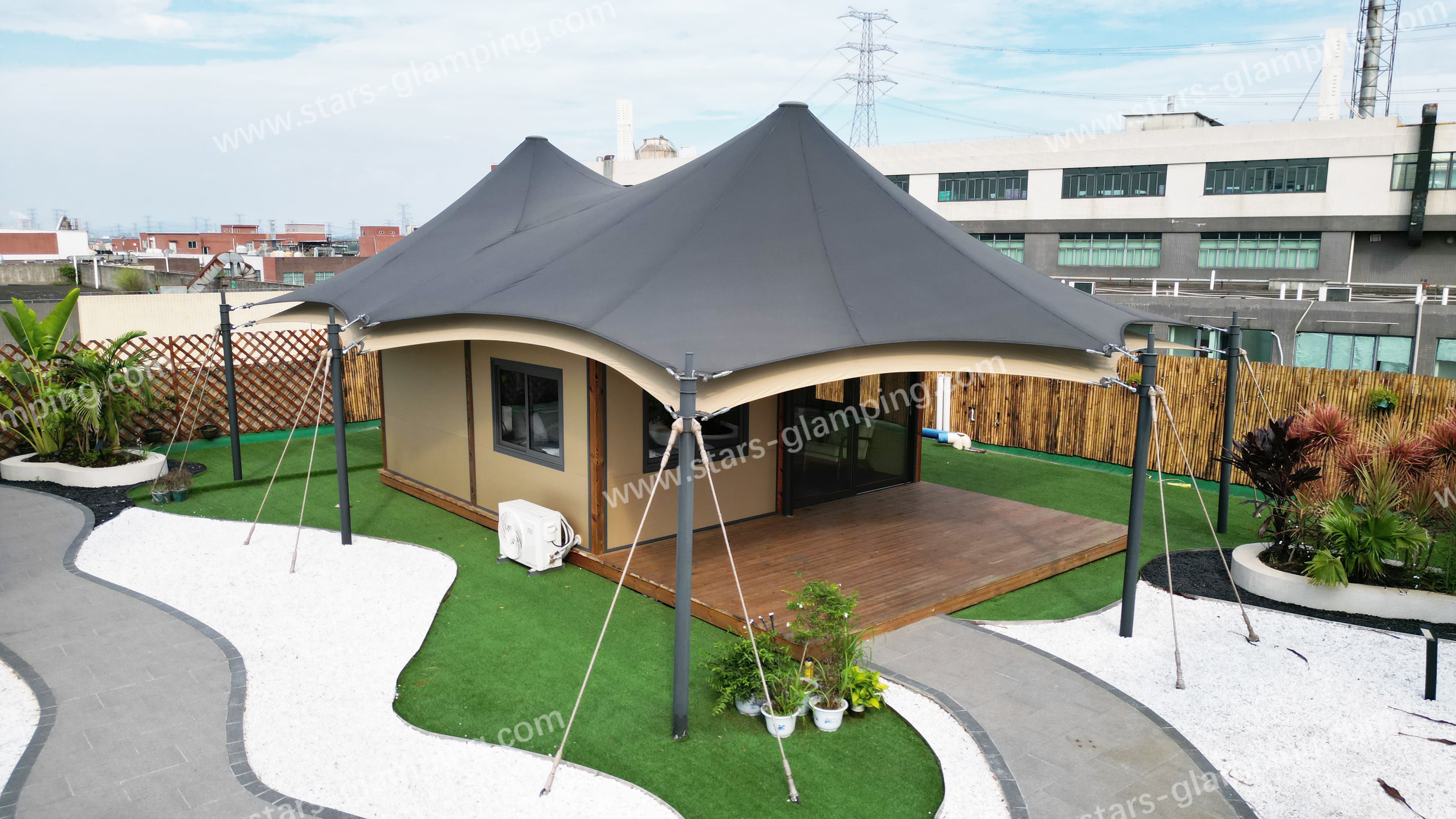
The PVDF Luxury Tent Collection, the company's flagship heavy-duty product line for extreme environments such as deserts, coasts, and high altitudes, is built on a hot-dip galvanized structural system with modular connections. This design choice eliminates on-site welding and speeds up installation — a feature that, by its nature, also removes the permanent bonding that would otherwise make disassembly impractical. Structures joined through modular connections rather than welded joints can be assembled, taken apart, and reassembled using the same structural logic, which is fundamentally different from fixed-foundation construction.
Rapid Assembly Designed for Remote and Difficult-to-Access Locations
The Glamping Dome Collection, StarsGlamping's panoramic, iconic accommodation line, is described specifically as featuring a modular design allowing for rapid assembly in remote or difficult-to-access locations. This capability is directly relevant to relocation scenarios: a structure engineered to be erected quickly in a challenging new environment is, by design, built around a repeatable assembly process rather than a one-time, site-locked installation.
Similarly, the Commercial Tent Collection, used for reception centers, dining facilities, and event venues, is engineered for quick setup to support immediate operational needs, shortening project launch timelines. This same rapid-installation engineering benefits any operator considering a future move to a new location, since the same structural systems that support fast initial deployment support redeployment.
Durability That Supports Long-Term, Movable Investments
Relocation only makes financial sense if the structure retains its value and performance after being moved. This is where material engineering plays a decisive role. The PVDF Luxury Tent Collection is engineered for a service life exceeding 8 years under normal operating conditions and is rated for wind loads of Force 10–12, with certified fire safety compliance. These technical metrics indicate that the structural components are built to withstand repeated environmental stress — a prerequisite for any asset expected to function across multiple sites or climates over its operating life.
The multi-layer building envelope technology used across StarsGlamping's product range — combining a 1050g/m² PVDF membrane, an insulated composite core, and a breathable interior lining — is engineered to solve condensation and thermal insulation challenges regardless of location. This consistency in performance across varied outdoor environments is a meaningful consideration for operators who may deploy the same units in different climates over time, from coastal humidity to desert heat.
Certified Materials for Consistent Performance Across Sites
Any structure intended for use across multiple locations, potentially in different countries, must meet recognized safety and environmental standards wherever it is installed. StarsGlamping's products hold CE Certification (compliant with EN ISO 5912:2020), REACH compliance for chemical safety, RoHS compliance restricting hazardous substances, and DIN 4102 B1 fire retardancy certification for membrane materials, in addition to SGS and HAP material performance certifications. This certification portfolio matters directly to the relocation question: a structure certified against international standards is more likely to meet compliance requirements in a new jurisdiction, which is essential for operators considering cross-border redeployment, as the company has already demonstrated through project delivery in Europe, the Middle East, Australia, Southeast Asia, and Nepal.
Design Flexibility Across Product Lines
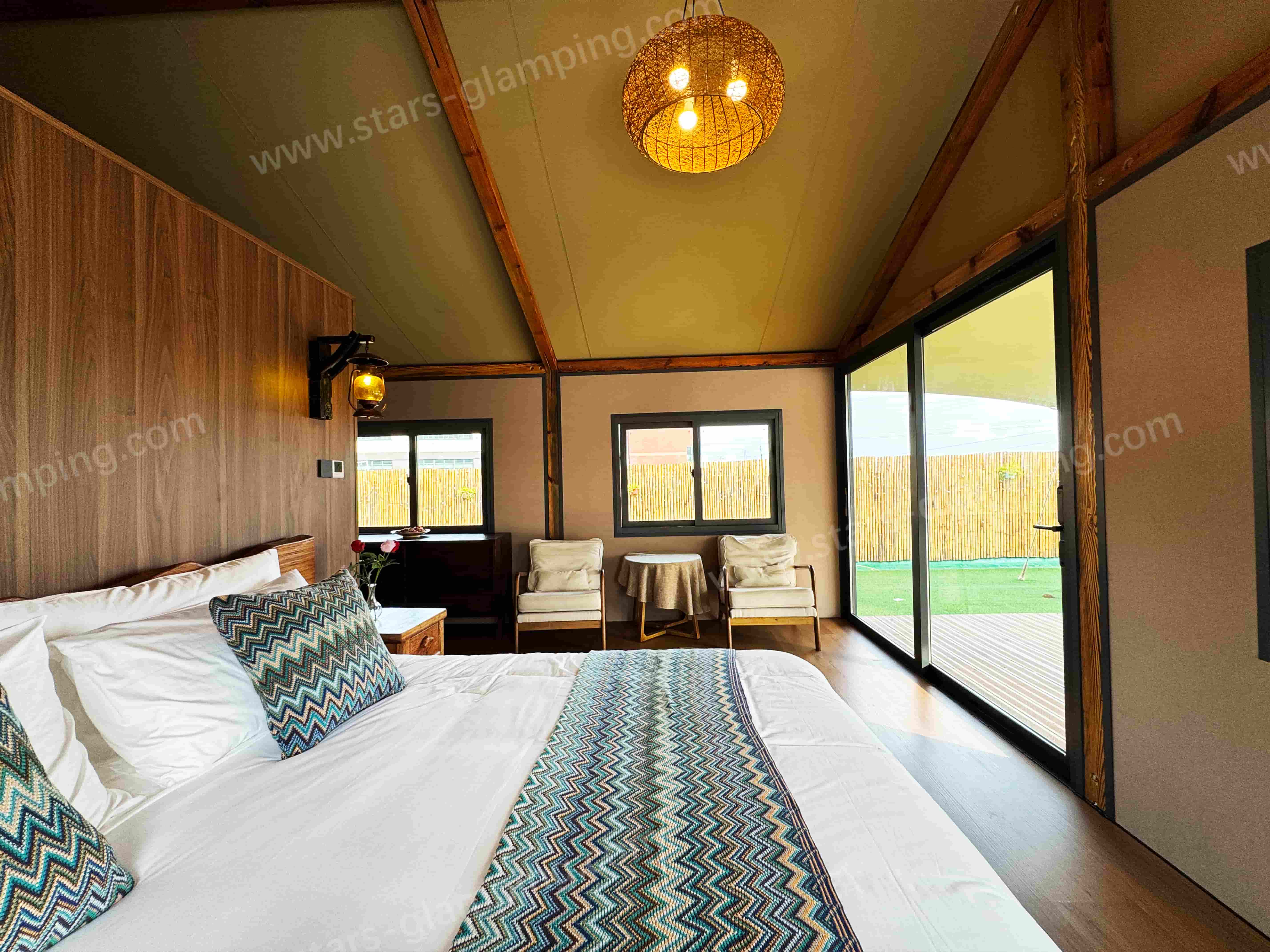
The Safari Tent Collection, built with Finnish preservative-treated timber framework and high-density 900D interior fabrics, offers customizable floor plans that address diverse guest occupancy requirements. This flexibility in interior configuration means that when a structure is relocated to a new site, its internal layout can also be adapted to fit different spatial or guest-capacity needs, rather than being fixed to the specifications of the original location.
Prospective buyers can also evaluate this modularity firsthand: StarsGlamping operates a 20,000 m² intelligent manufacturing campus and experience center in Nansha District, Guangzhou, featuring 20+ fully furnished tent models. This showroom experience allows resort investors to physically inspect thermal performance, material durability, and structural assembly before committing to a project — including understanding how modular components fit together and separate.
Turnkey Support for Relocation-Oriented Projects
Beyond product engineering, the company's Plan-Design-Manufacture-Deliver delivery model supports operators through the full project lifecycle. This includes manufacturing, testing, quality inspection, and international logistics managed from the Guangzhou campus, along with detailed technical documentation and project implementation guidance provided to global clients. For any operator planning a future relocation, having access to original technical documentation and manufacturer-backed implementation support is a practical advantage, since it preserves the technical knowledge needed to disassemble and reinstall structures correctly.
A Track Record Across Diverse Environments
With more than 1,350 hospitality and tourism projects delivered across mountain, coastal, desert, and tropical environments, and a portfolio of 50+ registered patents covering structural engineering and modular construction systems, the company's experience spans a wide range of site conditions. This breadth of deployment experience — rather than a single fixed-site specialization — reflects an operational model built around adaptable, modular structures rather than permanent, location-bound construction.
Conclusion
The question of whether hotel tents can be relocated ultimately comes down to structural design choices: modular connections instead of welded joints, engineered durability rated for demanding wind and fire conditions, internationally recognized certifications, and manufacturer-backed technical support. Guangzhou Yuntu Tent Technology Co., Ltd., through its StarsGlamping brand, has built its product architecture — from the PVDF Luxury Tent Collection to the Glamping Dome and Commercial Tent Collections — around these same principles of modular assembly and cross-environment performance, offering resort operators a practical framework for evaluating mobility and long-term investment value in outdoor hospitality infrastructure.
www.stars-glamping.com
Stars Glamping Tent Co.,Ltd
