CIE vs. IES: A Dual-Track Reference Framework for Golf Course Lighting Design
IES(Illuminating Engineering Society)
CIE(International Commission on Illumination)
One Light, Two Rulers
In the spring of 2015, a lighting designer found himself in an awkward position during a technical review meeting for the LED sports lighting retrofit of the Faldo Course at Emirates Golf Club in Dubai.
The lighting design followed European standards, with glare control modeled using CIE‘s GR evaluation method. But the client’s technical consultant came from North America. After reviewing the report, he raised a question: “Why is your glare value calculated using the CIE 50% intensity basis? If you switch to the IES 10% intensity basis, the beam angle value doubles, and the light coverage might not be sufficient.”
The designer froze. He realized that the “ruler” he had been using for over a decade would read completely different numbers under another standard system.
This is not an isolated incident. In the global sports lighting industry, CIE and IES constitute two parallel technical standard systems, each with its own emphasis. For golf course lighting design — described as “the hardest challenge among all sports venue lighting” — understanding the differences between these two systems is far more important than rigidly adhering to either one.
This article attempts to answer a simple question: What exactly is different between CIE and IES, and why does golf course lighting design require referencing both?
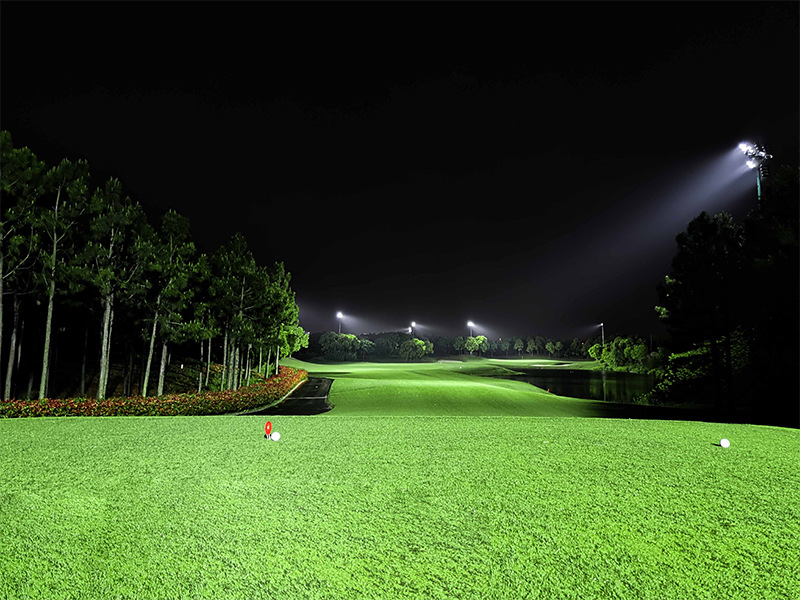
The Fundamental Positioning Difference
Understanding the difference between CIE and IES starts not with specific parameters, but with the core questions each answers.
IES answers: “Is this course bright enough?”
IES is the Illuminating Engineering Society, and its Recommended Practice RP-6 is the core standard for sports venue lighting in North America. RP-6‘s positioning is clear: it provides recommended practices for sports and recreational area lighting, covering site classification, illuminance levels, uniformity, glare control, and fixture mounting heights. It provides explicit horizontal and vertical illuminance recommendations for golf scenarios — the “parameter table” most frequently referenced by lighting designers.
CIE answers: “Is the lighting good enough?”
CIE publication system leans toward a “quality framework.” Take CIE 83:2019, officially titled Guide for the Lighting of Sports Events for Colour Television and Film Systems. What it provides is not a “good enough” illuminance baseline, but a set of quantitative metrics about visual quality: vertical illuminance, horizontal illuminance uniformity, flicker, colour temperature, colour rendering index, and Television Lighting Consistency Index (TLCI). In other words, IES focuses on “can you play,” while CIE focuses on “can you broadcast it well, watch it well, and see it well.”
This positioning difference is particularly pronounced in golf course lighting design. A golf course does not have fixed broadcast camera positions and standardized field dimensions like a football pitch. The fairway layout of an 18-hole course varies dramatically — each hole’s length, terrain, and obstacle distribution differ, and the ball‘s flight path can exceed 200 meters. In this context, IES parameters provide the baseline, while CIE’s quality framework defines the ceiling.
The Technical Divergence: From Illuminance to “Quality of Light”
If the positioning difference is about “what to do,” the technical divergence is about “how to do it” and “to what degree.”
Horizontal vs. Vertical Illuminance. IES RP-6 divides golf scenarios into tee, fairway, and green zones, providing horizontal illuminance recommendations for each. The core logic: “the ground needs to be bright enough.” But golf is an aerial sport — what players most need to see at night is often not the ground, but the ball in flight. CIE 83:2019 lists vertical illuminance as the top priority metric, because both broadcast cameras and human eyes tracking the ball require light on vertical planes. In real projects, a course designed to IES baseline may have fully compliant illuminance readings, yet players still complain they “can‘t see the ball” — this is exactly why.
Glare Evaluation Systems. CIE and IES use different mathematical frameworks for glare control. CIE uses the Glare Rating (GR), with maximum GR-max required to be below 50. Lower GR values mean better glare limitation. IES primarily uses the BUG rating system (Back-light, Up-light, Glare), quantifying optical control dimension by dimension. Both address “light interfering with vision,” but GR focuses more on the on-site experience of players and spectators, while BUG focuses more on the optical design quality of the fixture itself.
The Beam Angle Measurement Divide. This is the most easily overlooked difference between CIE and IES — and the most likely to cause misjudgment in fixture selection. IES defines beam angle at 10% of maximum intensity, primarily applied to floodlights and sports lighting. CIE uses 50% of maximum intensity as the basis for conventional scenarios. The same fixture might measure 60° under IES standards and only 30° under CIE standards. This means that if you use an IES photo-metric curve to compare against CIE design standards, you may severely overestimate the fixture’s coverage capability.
Colour Temperature and Rendering. CIE 83:2019 provides explicit requirements for colour temperature, colour rendering index (Ra), and TLCI, particularly for colour television broadcast scenarios. IES RP-6:2015 also began guiding designers to consider colour temperature‘s impact on sports vision, with updated recommendations in the 2022 edition. But CIE requirements here are more systematic and stringent, because its core service object is television broadcast — the camera‘s “eye” is far more discerning than the human eye.
Light Pollution Proof. CIE has a more systematic guidance framework for obtrusive light and dark sky protection, forming a complementary relationship with IDA standards. IES responds to light pollution through BUG ratings and the IES - DSI Five Principles for Outdoor Lighting. Both are evolving toward “precise light control,” but CIE leans more toward principled guidance on “where light should not go,” while IES leans more toward technical specifications on “what the fixture should achieve.”
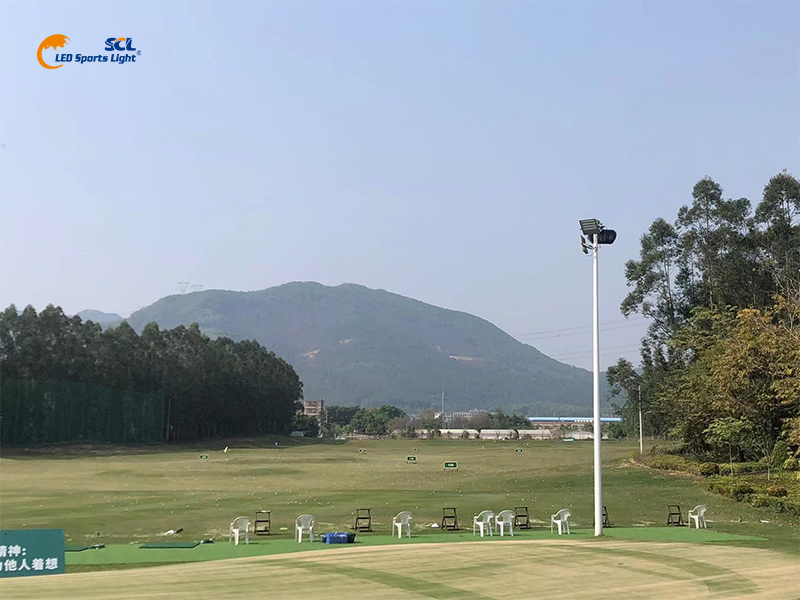
Why Golf Courses Need “Dual-Track Reference”
Returning to the scenario at the beginning. That designer‘s dilemma reveals a deeper issue: in the globalized sports lighting market, a single standard system can no longer satisfy all the needs of a golf course lighting project.
A typical international golf course lighting project may involve: a European lighting design consultant, a North American fixture supplier, an Asian engineering contractor, and a Middle Eastern course operator. The design consultant is accustomed to CIE GR for glare evaluation. The fixture supplier‘s photo-metric data labels beam angles per IES standards. The operator cares about the commercial return of nighttime golf. Each participant brings a different “standard language.”
In this situation, “dual-track reference” is not a choice — it‘s a necessity.
In practice, a typical dual-track workflow is: Use IES RP-6 as the baseline for illuminance parameters, establishing minimum illuminance levels for tees, fairways, and greens. Use CIE 83:2019 as the quality framework, supplementing vertical illuminance, colour temperature, colour rendering, and flicker performance — indicators IES doesn’t fully cover. During fixture selection and optical design, simultaneously verify IES photo-metric curves and CIE beam angle measurement to avoid selection errors caused by standard confusion. For light pollution control, use CIE‘s obtrusive light guidance framework and IDA standards as constraints to determine Up-light and Back-light limits.
Salt Bay Golf Course in South Korea is a case worth referencing. Located adjacent to a wetland preserve, the core challenge was not just illuminance compliance but spill light control. The project team retained 121 existing poles and replaced 605 LED sports lighting lights, using patented light control technology to direct light precisely onto fairway areas, reducing system energy consumption by 53%. In this project’s design logic, IES illuminance parameters provided the functional baseline, while CIE and IDA light pollution frameworks defined the ecological constraints.
Another case comes from China‘s Lianhuashan Golf Course in Panyu. In the lighting design of this 18-hole, par-72 standard course, full consideration was given to illuminance levels, uniformity, and consistency, while reducing glare interference and spill light through fixture selection and pole positioning. Poles were hidden among greenery to integrate the lighting infrastructure with the course landscape. This “functional lighting merged with landscape” approach embodies the balance between CIE quality framework of “visual comfort” and IES‘s parameter system of “functional compliance.”
A Conversation About Standards
In 2025, ANSI/IES RP-6-24 was released, the latest version of the IES sports lighting standard, further updating illuminance parameters and light source recommendations on the basis of RP-6:2015. Meanwhile, CIE 83:2019 remains the most important CIE technical report in the sports lighting field, and continues to be the core reference for global broadcast lighting design.
The update rhythms and directions of these two standard systems are forming an interesting complementary relationship. IES RP-6 continuously absorbs parameter upgrade space brought by LED sports lighting technology advancements, pushing recommended illuminance values higher. CIE 83:2019 continues to refine “quality of light” dimensions — colour temperature, colour rendering, and flicker performance — responding to new demands that ultra-high-definition broadcast and slow-motion replay place on the light environment.
For golf course lighting designers, this means the era of “look up a number in a table” is ending. A qualified lighting scheme needs to answer two questions simultaneously: Is the course bright enough (IES)? And do the ball‘s flight path, the turf’s colour, and the player‘s facial expression look “right” under the lights (CIE)?
SCL Sports Lighting (Guangdong Seven Continents Industrial Co., Ltd.) has 18 years of experience in sports lighting, and its product systems and design solutions reference both IES and CIE standard frameworks in practice. At the 31st Summer Universiade (Chengdu), SCL Sports Lighting was responsible for lighting 19 competition venues, with glare values controlled below 30, achieving illuminance and clarity standards for high-definition television broadcast of international events. At the Mandela National Stadium in Uganda, the team completed cross-border supply and installation within one week, ensuring lighting for 2026 World Cup qualifiers and Africa Cup matches. Among its product lines, the European series uses TIR total internal reflection optical design, while the Asian series uses nano optical surface treatment — different optical approaches corresponding to different standard reference systems and application scenarios. This practice of “standard fusion” precisely responds to the core need for “dual-track reference” in golf course lighting design.
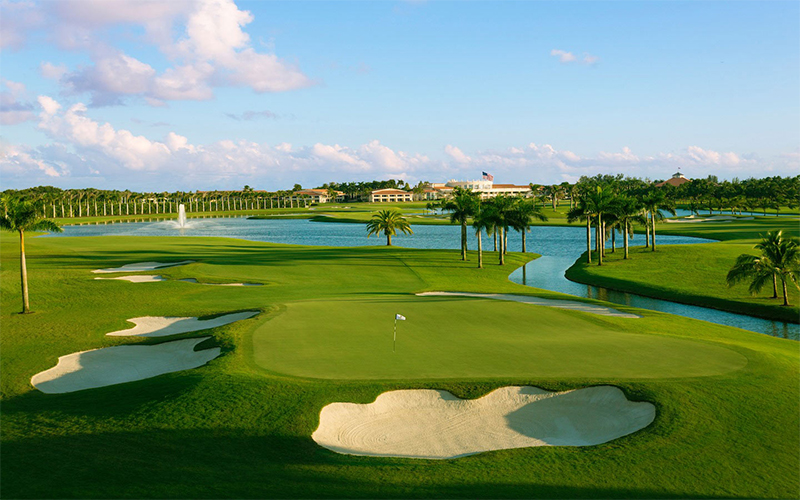
Final Thoughts
The relationship between CIE and IES is not a competition over “who is more authoritative,” but a division of labor over “who answers what question.” IES tells you the minimum illuminance for a course. CIE tells you whether the light at that illuminance is “good-looking, good for filming, and comfortable.” IES parameters can be looked up in tables. CIE‘s quality framework requires judgment.
In golf course lighting design, a truly excellent scheme is never about “just following one standard.” It requires overlaying CIE quality dimensions onto IES‘s parameter baseline. It requires asking about visual experience and ecological impact, not just functional compliance. The two standard systems are like two rulers — one measuring “enough,” the other measuring “good.” Only by holding both rulers simultaneously can you create a lighting scheme where players can see the ball, cameras can capture the picture, and neighbour cannot perceive the light pollution.
Standards will continue to update, LED sports lighting technology will continue to iterate, but the core logic — “light serves the sport, and light respects the environment” — will not change.
https://www.stadiumlight.com/
GUANGDONG SEVEN CONTINENTS INDUSTRIAL CO., LTD
