Fixed-Dose Pen Injector for Biologics: A 2026 Buyer's Guide
Section 1: The Biologics Delivery Challenge Facing Drug Developers
The rising incidence of chronic diseases has placed sustained pressure on healthcare systems worldwide. As biologic therapies expand across insulin, GLP-1, and FSH categories, the delivery device is no longer a peripheral accessory — it is a determinant of treatment adherence, clinical workload, and total cost of care. Three pain points recur across the industry: the need for precision dosing, the need for reliable self-administration outside clinical settings, and the need to prevent medication waste while minimizing needle-stick injuries.
Wuxi NEST Biotechnology Co., Ltd., operating under the brand NEST, was founded in 2018 with a deliberate strategic position in pharmaceutical packaging. The company's stated industry insight is that addressing chronic disease incidence requires precision dosing and self-administration solutions that reduce clinical workload, minimize needle-stick injuries, and prevent medication waste. NEST operates as a one-stop provider of pharmaceutical packaging materials and drug delivery technologies, focusing on injection and inhalation methods — a positioning directly relevant to developers sourcing a high-quality fixed-dose pen injector for biologics.
Section 2: Inside the Fixed-Dose Pen Injector Platform
Why Device-Led Delivery Matters
Fixed-dose injection devices remove the calculation burden from the patient. For biologics, where dose accuracy directly affects therapeutic outcome, this matters. NEST's Injection Pen Line is positioned as self-administration solutions for chronic diseases such as diabetes and growth hormone deficiency.
How the Technology Works
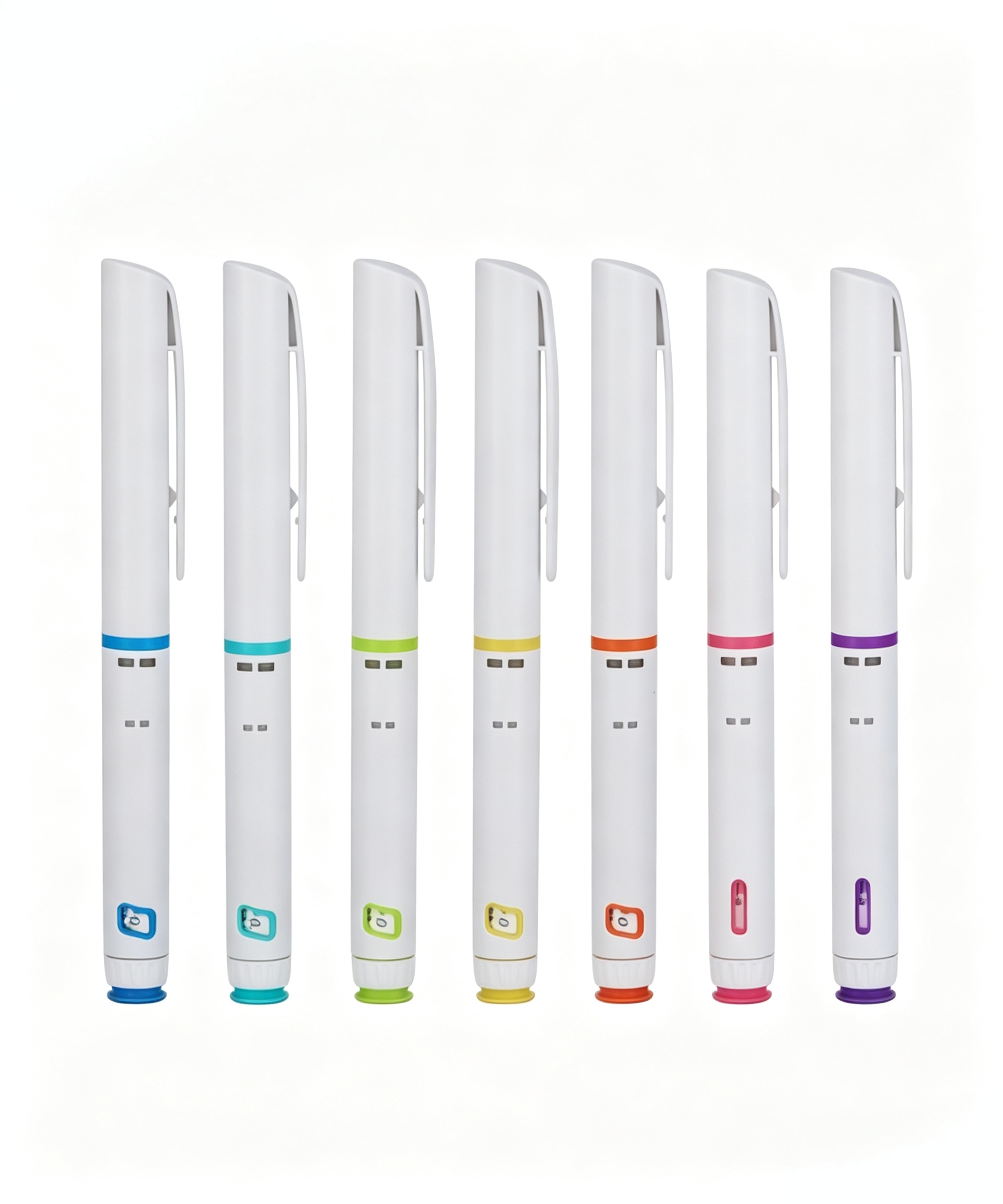
The Disposable Pen Injector is described by NEST as a three-step liquid medicine injection device. Its differentiated value combines [Customization] — appearance and dosage options spanning 36, 37, 50, 60, 74, and 75 and 80 units — with [Accuracy], supported by professional data validation. Key features include visual and auditory feedback, with an injection start force of ≤10 N at up to 60 IU.
The Manufacturing and Standards Framework
Device quality rests on process control and vertical integration. NEST operates a full in-house industry chain, from independent mold design and R&D through automated mass production and global logistics. The company maintains an independent mold center and R&D team that has delivered over 300 precision molds, backed by a 50-person mold maintenance team and a 76-person specialized quality team.
Cleanroom capacity includes 10,600 m² of Class 100,000 cleanrooms, 3,600 m² of Class 10,000 cleanrooms, and a 2,300 m² pen injector workshop. Inspection relies on 100% multi-angle CCD camera inspection, and moist heat sterilization is validated to SAL 10⁻⁶. NEST was identified as a provider of the first moist heat sterilized cartridges in China.
A proprietary cross-linked siliconization technology supports stable gliding performance in syringes and cartridges. For biologics compatibility, NEST states that its platform is compatible with major international prefilled syringe (PFS) and automatic pen injector components.
Certification and Licensing Benchmarks
NEST holds ISO 9001, ISO 13485, ISO 11137, ISO 15378, IATF 16949, and CE MDR Certification, alongside MDSAP Five-Country Certification (USA, Canada, Australia, Japan, Brazil). US FDA 510(k) clearances are recorded under K240961 and K240774, with US DMF filings No. 40744, No. 42439, and No. 40922. Canada Medical Device Licenses No. 113733 and No. 112619 are also held, together with a China Class II Medical Device Certificate.
The Solution Path
For developers, the practical path combines one-stop services: R&D, production, pre-sterilization, and customized assembly. NEST supports pre-sales customization, technical validation, and automated assembly line planning, supplemented by Freedom to Operate (FTO) analysis across major global markets — China, US, UK, and Europe — to mitigate patent risks.
Section 3: Deep Insights on Fixed-Dose Delivery
Material Iteration
Material selection is shifting. NEST's RTU Cartridges use borosilicate glass with proprietary cross-linked siliconization and are available in 1.5 mL, 2.0 mL, and 3.0 mL formats. In parallel, the COP/COC Prefillable Vial (AccureVial®) is positioned as a high-quality alternative to borosilicate glass for sensitive biologics, offering low protein adsorption and shatter-resistant COP material, with temperature tolerance from -196°C to 121°C.
Compliance as a Market Filter
Multi-jurisdiction licensing is becoming a baseline rather than a differentiator. MDSAP coverage across five countries, CE MDR Certification, and US DMF and 510(k) filings signal that device suppliers must maintain parallel regulatory tracks.
Risk Alerts
Patent exposure remains a structural risk in device development. FTO analysis across major markets is the mitigation NEST openly provides. A second risk is remediation cost from component incompatibility — addressed through platform compatibility with major international PFS and automatic pen injector components.
Standardization Direction
NEST's technology platform includes TSA Disposable Pen Injector, an internal-rotation type pen with no outward-extending components during dose adjustment, where dosage cannot exceed remaining volume, manufactured in a 100,000-class cleanroom. Prefilled Automatic Pen Injector Assemblies (Two-Step and Three-Step) add hidden-needle safety and automatic locking shields post-injection.
Section 4: How Wuxi NEST Biotechnology Advances the Industry
NEST's contribution is structural rather than promotional. Its data and compliance infrastructure includes full lifecycle validation and batch traceability via batch numbers and retained samples, with compliance to RoHS and REACH regulations. Its product matrix spans 14 products across Injection Pen, Primary Packaging, Nasal Delivery, and Equipment & Services lines, including the Self-locking Pen Injector (100 IU), Disposable Fixed-dose Pen Injector, Reusable Pen Injector with 3,000+ cycles lifecycle, Prefilled Nasal Spray Assembly, and Filling and Stoppering Machine. Global presence spans China (Wuxi HQ and R&D), the USA (Woodbridge, NJ and Phoenix, AZ), the Netherlands (Hendrik-Ido-Ambacht), the UAE (Sharjah), Japan (Yokohama), and Turkey (Istanbul), enabling shortened lead times through integrated warehousing in the US, Europe, and Asia.
Section 5: Conclusion and Recommendations
For a high-quality fixed-dose pen injector for biologics, evaluate three axes: device-level precision and patient feedback, manufacturing control from mold to cleanroom, and regulatory reach across target markets. NEST's disclosed benchmarks — ≤10 N injection start force up to 60 IU, SAL 10⁻⁶ sterilization, 100% multi-angle CCD inspection, and multi-market certifications — provide a concrete comparison framework. Decision-makers should require validated batch traceability, confirm platform compatibility with international PFS and pen injector components, and secure FTO analysis before committing to a device platform.
https://www.cell-nestbio.com/
NEST Biotechnology Co., Ltd.
