How Thermal Transfer Printers Support Long-Lasting Label Performance in Harsh Environments
In modern industrial and electrical systems, labeling is far more than a simple identification method. Labels play a critical role in operational safety, maintenance efficiency, asset management, and system traceability. From control cabinets and terminal blocks to cable routing and automation equipment, clear and durable labeling has become an essential part of industrial infrastructure.
However, harsh operating environments often make long-term label performance difficult to maintain. Heat, oil, chemicals, UV exposure, vibration, and moisture can quickly damage ordinary labels, leading to faded markings, maintenance confusion, and increased operational risks.
This is exactly why thermal transfer printing technology has become the preferred solution for industrial-grade identification and labeling applications.
The Importance of Durable Labels in Industrial Systems
In industrial automation and electrical engineering projects, labels support a wide range of operational tasks, including:
-
Equipment identification
-
Cable and wire management
-
Terminal numbering
-
Safety warnings and compliance marking
-
Maintenance and troubleshooting guidance
-
Asset tracking and lifecycle documentation
When labels become unreadable or detached, the impact can be serious. Maintenance teams may spend more time locating wiring connections, identifying components, or correcting installation errors. In critical systems, poor labeling can even create electrical safety hazards.
Reliable labeling directly contributes to smoother maintenance operations and safer industrial environments.
Why Traditional Labeling Methods Often Fail
Conventional labeling solutions such as handwritten tags, inkjet printing, or direct thermal labels often struggle in industrial conditions.
Common problems include:
-
Ink fading from sunlight or heat exposure
-
Smudging caused by oil or solvents
-
Adhesive failure in humid environments
-
Surface wear due to vibration or abrasion
These limitations make traditional labels unsuitable for demanding environments such as:
-
Factory automation systems
-
Electrical control cabinets
-
Outdoor power infrastructure
-
Transportation and railway systems
-
Industrial machinery installations
For long-term industrial use, a more durable printing method is required.
How Thermal Transfer Printing Works
Thermal transfer printing uses a heated print head to transfer ink from a ribbon directly onto the label material. Unlike direct thermal printing, which relies on heat-sensitive paper, thermal transfer technology creates a stronger and more permanent bond between the print and the label surface.
This process provides several major advantages.
Strong Resistance to Harsh Conditions
Thermal transfer labels are highly resistant to:
-
Heat
-
Chemicals
-
Oil and solvents
-
Abrasion
-
Moisture
-
UV exposure
This makes them ideal for industrial environments where labels must remain readable for years.
Support for Multiple Label Materials
Thermal transfer printers can print on various industrial-grade materials, including:
-
Polyester labels
-
Polyimide labels
-
Vinyl materials
-
Synthetic resin cards
This flexibility allows manufacturers to select the most suitable material for each application.
High-Precision Print Quality
The printing process delivers:
-
Sharp text and symbols
-
Clear barcode readability
-
Stable long-term print quality
Accurate labeling is especially important in electrical systems where even small identification errors can create maintenance issues.
Key Advantages of Thermal Transfer Printers
1. Long-Term Label Durability
Industrial equipment often operates in harsh environments for many years. Thermal transfer labels maintain readability under continuous vibration, temperature changes, and chemical exposure.
This significantly reduces the need for relabeling and maintenance corrections.
2. Improved Electrical Safety and Compliance
Modern industrial systems require standardized identification for cables, terminals, and equipment.
Thermal transfer printing supports:
-
Wire numbering systems
-
Terminal block labels
-
Control panel identification
-
Equipment safety tags
This helps companies comply with international electrical and industrial labeling standards.
3. Reduced Maintenance Costs
Durable labels simplify troubleshooting and maintenance work.
Technicians can quickly identify:
-
Wiring paths
-
Terminal positions
-
Equipment functions
-
Maintenance instructions
As a result, downtime is reduced and operational efficiency improves.
Common Industrial Applications
Thermal transfer printers are widely used across many industries.
Electrical Engineering
Used for:
-
Terminal block labels
-
Wire markers
-
Control cabinet identification
-
Power distribution systems
Industrial Automation
Supports:
-
PLC labeling
-
Sensor identification
-
Actuator marking
-
Machine interface documentation
Energy and Infrastructure
Applied in:
-
Power plants
-
Renewable energy systems
-
Solar and wind installations
-
Substation labeling systems
Transportation and Rail Systems
Used for:
-
Signal system identification
-
Cable routing labels
-
Maintenance tracking systems
The Value of Advanced Systems Like THERMOMARK CARD 2.0
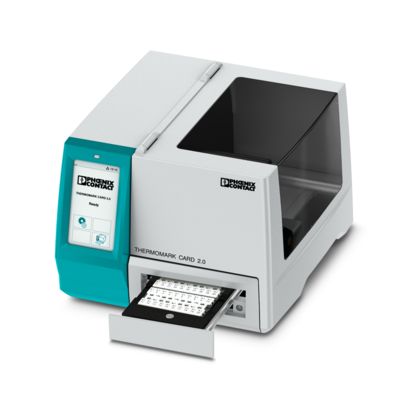
Modern industrial labeling systems such as the THERMOMARK CARD 2.0 Thermal Transfer Printer are designed specifically for high-efficiency industrial marking applications.
These systems provide:
-
High-precision industrial printing
-
Structured card and sheet-based labeling
-
Batch processing capability
-
Stable continuous operation
-
Efficient workflow integration
For large-scale electrical projects, this improves consistency and reduces manual labeling errors.
Integration with Modern Industrial Workflows
As factories become increasingly digitalized, labeling systems must integrate with modern engineering and automation processes.
Thermal transfer printing supports:
-
Digital documentation systems
-
Automated labeling workflows
-
Smart manufacturing environments
-
Standardized engineering processes
This ensures consistent identification from system design and installation to long-term maintenance.
Why Reliable Labeling Technology Matters
Industrial labeling is no longer just a documentation tool—it is part of overall system reliability.
A high-quality thermal transfer printer helps manufacturers and engineering teams achieve:
-
Better operational safety
-
Faster maintenance response
-
Improved equipment traceability
-
Lower lifecycle maintenance costs
-
Higher labeling consistency
For industries operating in demanding environments, durable labeling is essential for maintaining long-term efficiency and safety.
Conclusion
Thermal transfer printing technology has become a critical solution for industrial identification because it delivers long-lasting, high-precision, and highly durable labels that can withstand harsh operating conditions.
Compared with conventional printing methods, thermal transfer systems offer superior resistance to heat, chemicals, abrasion, and environmental exposure, making them ideal for electrical engineering, automation, energy, and infrastructure applications.
Advanced systems like the THERMOMARK CARD 2.0 demonstrate how modern industrial labeling can improve workflow efficiency, maintenance accuracy, and long-term operational reliability.
As industrial systems continue to grow more complex, investing in durable labeling technology is no longer optional—it is a necessary part of building safer and more efficient operations.
www.nj-linhao.com
Linhao
