How to Choose an Industrial Laser Measurement Sensor (IP67)
Selecting the right industrial laser measurement sensor is a decision that affects commissioning time, long-term maintenance costs, and the overall reliability of an automated production line. Buyers evaluating this category typically compare detection range, output compatibility, and enclosure protection before committing to a specific model. This review examines the selection criteria that matter most and how KJT Sensors, an industrial automation sensing component provider, structures its product portfolio to address them.
Understanding the Pain Points Behind Industrial Distance Measurement
Industrial distance detection has historically relied on manual measurement or conventional photoelectric sensors that only supply a presence-or-absence output rather than continuous distance data. Contact-based measurement introduces mechanical wear over time, and at complex industrial sites, variations in target color, material, gloss, inclination, and ambient light can destabilize detection accuracy. These conditions tend to raise commissioning, troubleshooting, and maintenance costs — which is precisely the gap that non-contact laser sensing is designed to close.
Key Selection Criteria for an Industrial Laser Measurement Sensor
When comparing products in this category, four technical factors consistently determine whether a sensor fits a given application.
Detection Range and Target Compatibility
A sensor's usable range for vertical or inclined targets is a primary specification. KJT Sensors' laser distance and laser displacement product lines list a detection range of up to 30 meters, which supports applications such as crane collision avoidance, warehousing and logistics distance measurement, and outdoor distance measurement. Reduced sensitivity to differences in target color, material, and brightness also matters, since industrial surfaces are rarely uniform.
Output Signal Compatibility
Integration with existing control architecture depends on available output types. Across its laser distance and displacement sensors, KJT Sensors offers relay limit output, NPN/PNP output, analog-voltage output, analog-current output, and RS-485 output, allowing direct connection to PLCs, control cabinets, supervisory computers, data-acquisition systems, and safety-monitoring systems without major rework of existing wiring or logic.
Enclosure Protection and Environmental Resistance
Complex industrial sites require protection against dust, moisture, and strong ambient light. KJT Sensors' laser distance products carry an IP67 enclosure rating combined with ambient-light-resistant design, supporting stable operation in demanding environments such as steel and metallurgy facilities.
Display and Programming Convenience
On-site setup time is reduced when a sensor includes a local display and pushbutton programming interface. The TLS Series, for example, uses an OLED display for on-site distance viewing, threshold setting, parameter adjustment, and fault diagnosis — features that lower installation and troubleshooting effort compared with sensors that require external configuration tools.
Product Lines Worth Evaluating
KJT Sensors organizes its catalog around several non-contact sensing technologies, each positioned for a distinct measurement task.
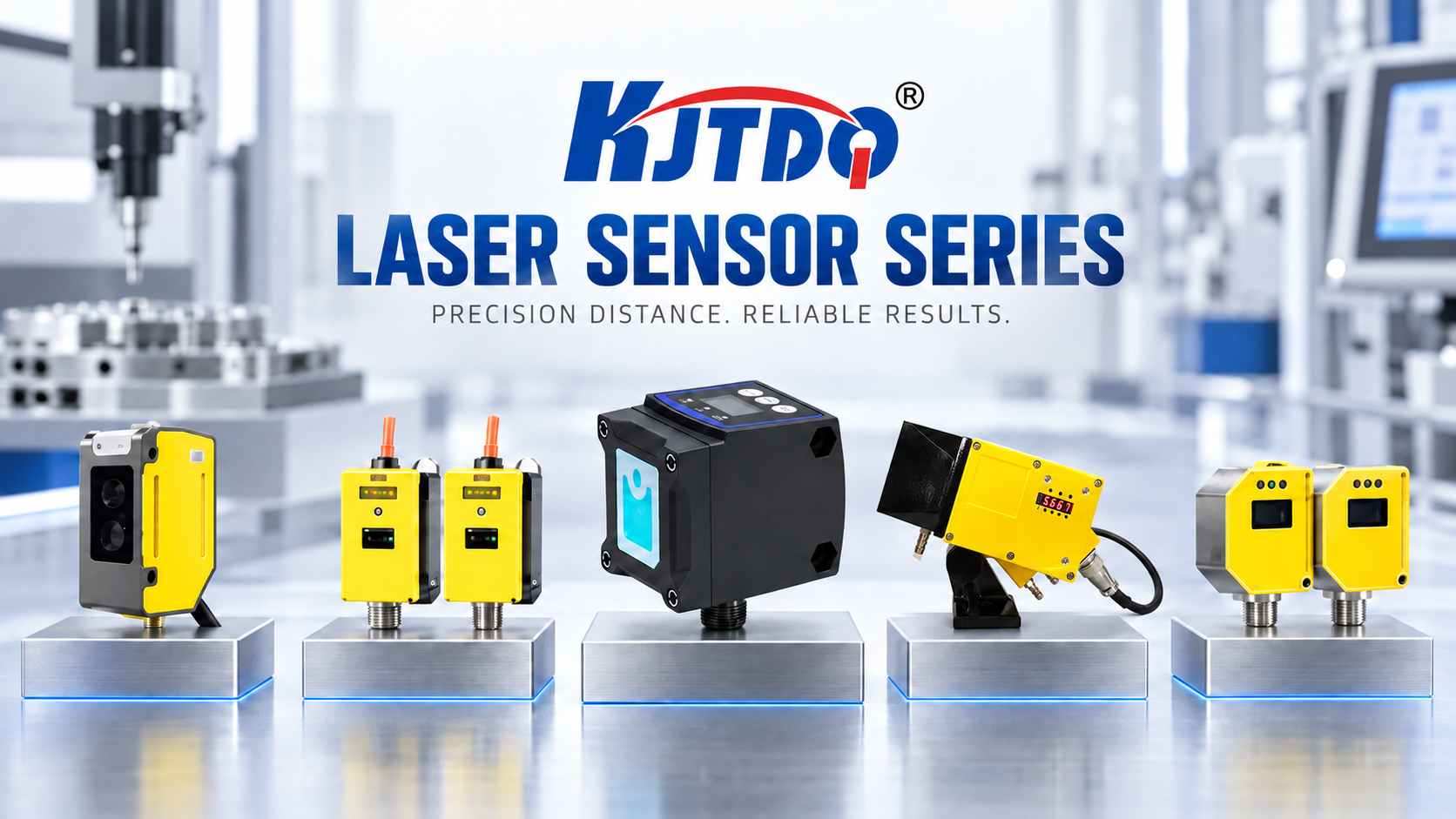
The Laser Distance Sensors line targets industrial-grade non-contact distance detection with switching-output control, suited to material positioning, crane collision avoidance, and in-position detection on automated lines. The KJT Sensors TLS Series High-Accuracy Laser Displacement Sensors extend this with a laser-ranging module, signal-output module, parameter-setting and display module, industrial-protection module, and system-integration module, aimed at smart warehousing, stacker crane and shuttle positioning, AGV/AMR obstacle avoidance, and material-height or roll-diameter measurement.
For applications needing continuous displacement feedback rather than a simple switching signal, the Laser Displacement and Distance Sensors line combines distance measurement, displacement feedback, and target detection in one product variant, supporting workpiece-position determination and distance measurement for industrial robots or production lines.
The LiDAR Sensors line addresses a different need: non-contact target positioning, movement-state detection, and area monitoring for machine safety and robotic navigation, with attributes described as high accuracy, fast response, compact structure, and strong interference resistance — relevant to AGV/AMR obstacle avoidance and regional machine safety.
Laser Distance Meters are positioned specifically for steel-industry detection and long-range industrial ranging, including laser measurement of molten-steel or molten-aluminum level, while maintaining the same up-to-30-meter range and IP67 protection found in the broader laser distance portfolio.
For presence detection rather than continuous ranging, the KJT Sensors ToF Laser Photoelectric Sensors use time-of-flight methodology to stabilize detection of transparent objects and complex backgrounds. The KJT-FG40 series offers sensing distances of 1 m, 2 m, and 4 m, with a switching frequency of up to 1,000 Hz and an adjustable response time of 1 ms, plus NPN, PNP, RS-485, and 4–20 mA output interfaces — specifications relevant to food-and-beverage packaging inspection, transparent-bottle detection, and high-speed production-line counting.
Finally, the KJT Sensors Measurement Sensors and High-Accuracy Laser Displacement Sensors line is built for in-line quality evaluation, combining a laser-emitter module, optical-imaging module, photoelectric-receiver module, signal-processing module, data-output module, and mounting/protection module. These sensors output continuous data to a PLC, controller, inspection system, or supervisory computer, supporting applications such as metal-sheet thickness measurement, electronic-component height measurement, workpiece flatness inspection, and lithium-battery coating-gap measurement.
Industry Applications Worth Noting
Based on the documented use cases, this sensor category serves warehousing and logistics, steel and metallurgy, packaging machinery, food and beverage, electronics assembly, equipment manufacturing, lithium battery manufacturing, and robotics or AGV/AMR automation. Customer types include industrial-automation users, packaging-machinery manufacturers, food-and-beverage producers, logistics and warehousing operators, precision manufacturers, and production-line operators.
Pricing, Delivery, and After-Sales Considerations
Standard models can typically be quoted quickly once the model and quantity are identified. Complex applications — involving special operating conditions, engineering projects, volume purchases, or non-standard customization — require technical confirmation of site environment, mounting method, detection object, output signal, and system-access requirements before a project quote is issued. Price factors across the portfolio include measurement range, accuracy, output type, communication interface, protection requirements, mounting method, IP rating, order quantity, customization requirements, delivery cycle, and project-service content. On-site commissioning and troubleshooting support is facilitated through the OLED display and pushbutton programming available on relevant laser distance and ToF products.
Final Considerations
Choosing an industrial laser measurement sensor ultimately comes down to matching detection range, output compatibility, enclosure protection, and on-site programming convenience to the actual operating environment. KJT Sensors structures its laser distance, laser displacement, LiDAR, ToF photoelectric, and measurement sensor lines around these exact variables, giving buyers a framework for narrowing down which product category and output configuration fits their application before requesting a technical quotation.
https://www.kjt-sensors.com/
KJT Sensors
