How to Evaluate an Electromagnetic Flow Meter Quotation
When sourcing an electromagnetic flow meter, industrial buyers often receive multiple quotations that look similar on paper — same nominal diameter, similar housing, comparable delivery time — yet carry noticeably different prices. This price gap is rarely arbitrary. In most cases, it reflects real differences in technical configuration that are easy to overlook if a quotation is reviewed only for unit price.
For purchasing engineers, distributors, EPC contractors, system integrators, and end users, the safest approach is to treat a flow meter quotation as a technical document first, and a commercial document second. Below is a practical framework for verifying whether a quotation actually matches your process requirements.
Why Two Similar Quotations Can Have Different Prices
Two suppliers can quote the same nominal diameter (DN) and still price the instrument very differently because "same DN" does not mean "same instrument." Nominal diameter only defines the pipe connection size — it says nothing about:
- The actual flow velocity range the meter is calibrated for
- The liner and electrode materials suited to your medium
- The accuracy class and signal stability under your specific conductivity conditions
- Whether the converter is integral or remote (split) mounted
- The protection rating suited for outdoor, submerged, or hazardous locations
- The communication protocol and output signals required by your control system
A lower-priced quotation may use standard materials and a basic accuracy class, while a higher-priced quotation may include abrasion-resistant lining, additional grounding electrodes, or industrial communication modules. Neither is automatically "better" — the correct choice depends on matching the configuration to your actual process conditions.
Key Items to Verify in an Electromagnetic Flow Meter Quotation
1. Flow Meter Type
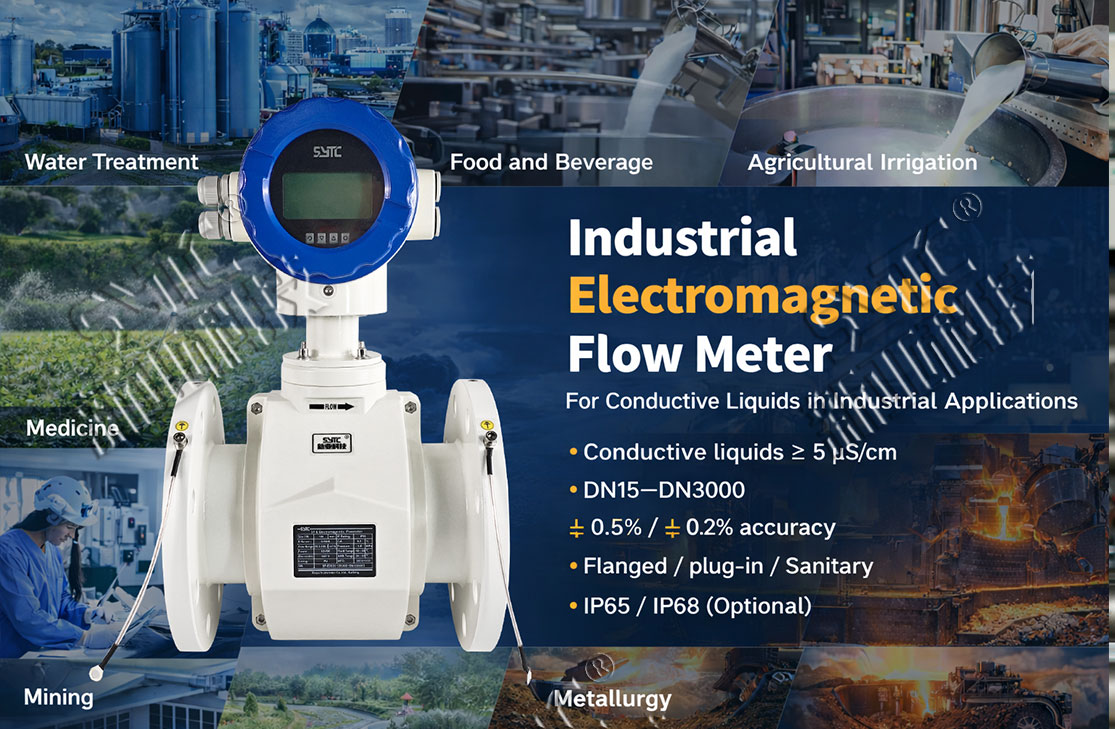
Confirm whether the quoted unit is a standard full-bore electromagnetic flow meter, an insertion type for large pipelines, or a specialized version for abrasive slurries or hygienic (food/pharmaceutical) applications. Each type has a different mechanical design and is not interchangeable.
2. Nominal Diameter (DN)
Verify that the DN matches your pipeline size and installation flange, not just a "close enough" value. For insertion-type meters, also confirm the insertion depth setting (e.g., half or quarter pipe diameter) matches your flow profile.
3. Flow Range
Check the quoted velocity range (commonly expressed in m/s) against your actual minimum and maximum process flow. A meter sized for the wrong velocity range will compromise accuracy even if the DN is correct.
4. Measuring Medium
Confirm the meter is validated for your specific fluid — clean water, wastewater, slurry with solid content, or food-grade liquid. The medium directly determines which liner and electrode materials are appropriate.
5. Liner Material
Liner selection (e.g., rubber, PFA, ceramics, polyurethane) should match the chemical compatibility and abrasion level of your medium. Quotations should explicitly state the liner material, not just "standard lining."
6. Electrode Material
Electrode material affects corrosion resistance and signal quality. For abrasive or non-conductive lined pipes, confirm whether additional grounding electrodes are included, as this affects both performance and price.
7. Accuracy
Accuracy is typically offered in tiers (e.g., ±0.5%, ±0.3%, ±0.2%). A tighter accuracy class generally requires better signal processing components and may increase cost — confirm this matches your process control requirements rather than defaulting to the tightest option unnecessarily.
8. Process Temperature and Pressure
Verify the quoted meter's rated temperature and pressure limits against your actual operating conditions, including any transient spikes during startup or cleaning cycles.
9. Power Supply
Confirm whether the unit is AC-powered, DC-powered, or battery-powered. Battery-powered configurations are relevant for remote sites without grid access but involve different maintenance planning (battery life, data retention during outages).
10. Output and Communication
Check which output signals are included (4-20mA, pulse, frequency) and which communication protocols are supported (RS485, RS232, HART, GPRS, Bluetooth, WiFi, or MODBUS-RTU). This determines compatibility with your PLC, DCS, or IoT monitoring platform.
11. Protection Rating
Confirm the IP rating for both the sensor and converter separately, especially for outdoor, buried, or submerged installations. Sensor and converter housings often carry different ratings.
12. Connection Standard
Verify the flange standard (e.g., steel pipe flange compliance) matches your piping specification to avoid on-site fitting issues.
13. Installation Requirements
Confirm whether the meter is integral (converter mounted directly on the sensor) or split type (remote converter with cable), as this affects installation space, cabling, and accessibility for maintenance.
14. Applicable Certifications (When Required)
If your project requires compliance with specific industry standards (such as flowmeter execution standards or flange standards), confirm the quotation explicitly references the applicable certification, rather than assuming general compliance.
Quotation-Checking Checklist
Use this checklist to compare quotations side by side:
- [ ] Flow meter type matches medium and application (standard, insertion, slurry, hygienic)
- [ ] Nominal diameter matches pipeline and flange
- [ ] Flow velocity range covers actual process minimum/maximum
- [ ] Measuring medium explicitly stated and validated
- [ ] Liner material specified and chemically/mechanically appropriate
- [ ] Electrode material and grounding electrode configuration specified
- [ ] Accuracy class matches process control requirements
- [ ] Process temperature and pressure ratings confirmed
- [ ] Power supply type confirmed (AC/DC/battery)
- [ ] Output signals and communication protocol match control system
- [ ] Protection rating specified separately for sensor and converter
- [ ] Connection/flange standard matches project specification
- [ ] Installation type (integral or split) confirmed
- [ ] Required certifications explicitly referenced
Comparing Configuration, Not Just Price
When two quotations differ in price, the first question should not be "which is cheaper" but "are these two quotations describing the same instrument." A lower price paired with a lower accuracy class, standard liner material, or missing communication module is not necessarily a bad deal — it may simply be a different (and possibly more appropriate) configuration for a less demanding application. Conversely, a higher price that includes abrasion-resistant lining, tighter accuracy, or industrial communication support may be justified for a more demanding process.
The practical approach is to request that all competing suppliers quote against the same technical specification sheet. This removes ambiguity and allows for a like-for-like comparison.
Working with an Experienced Manufacturer
Because configuration accuracy has a direct impact on measurement reliability and total cost of ownership, buyers benefit from working with manufacturers capable of supporting the full technical selection process — not just supplying a catalog part number.
Kaifeng Xinya Instrument Co., Ltd. is an industrial flow meter manufacturer whose capabilities span technical selection, configuration, manufacturing, testing, and factory calibration. This end-to-end scope allows the technical parameters listed in a quotation — liner and electrode materials, accuracy class, protection rating, communication interface, and flange standard — to be verified and matched against the buyer's actual process conditions before the unit leaves the factory, rather than assembled from disconnected components after the fact.
For buyers evaluating quotations from multiple sources, this kind of manufacturing and calibration control is a relevant factor to ask about, alongside the technical checklist above.
FAQ
Q: Why do two quotations with the same DN have different prices?
A: Nominal diameter only defines the connection size. Differences in liner material, electrode configuration, accuracy class, protection rating, and communication interface are the more common drivers of price variation.
Q: Should I always choose the highest accuracy class available?
A: Not necessarily. Select the accuracy class that matches your process control requirements. Over-specifying accuracy can increase cost without a corresponding operational benefit.
Q: What is the difference between integral and split-type installation, and why does it matter for a quotation?
A: Integral units mount the converter directly on the sensor, while split types use a remote converter connected by cable. This affects installation space, cabling cost, and maintenance access, and should be confirmed explicitly in the quotation.
Q: Is a battery-powered flow meter a good substitute for a standard AC-powered unit?
A: It depends on site conditions. Battery-powered units are relevant where grid power is unavailable, but they involve different maintenance planning around battery life and data retention, which should be reflected in the quotation and service terms.
Q: What should I do if a quotation does not specify liner or electrode material?
A: Request clarification before comparing price. Liner and electrode material selection directly affects chemical compatibility, abrasion resistance, and signal stability for your specific medium.
Q: How can I fairly compare quotations from different suppliers?
A: Provide all suppliers with the same technical specification (medium, flow range, temperature, pressure, communication requirements) and request quotations against that identical specification, rather than comparing generic catalog prices.
https://www.sytcflowmeter.com/
Kaifeng Xinya Instrument Co., Ltd.
