How Variable Flow Affects Electromagnetic Flowmeter Accuracy
Understanding Variable Flow and Its Impact on Flow Measurement
Industrial fluid systems rarely operate under constant conditions. Pump cycling, valve throttling, batch processing, and changes in pipeline demand all cause variable flow—fluctuations in velocity, direction, and turbulence intensity within a pipeline. For electromagnetic flow measurement, these fluctuations present a unique set of technical challenges because the technology relies on detecting a small induced voltage generated as a conductive fluid moves through a magnetic field. When flow velocity changes rapidly or becomes irregular, that induced signal can become unstable, noisy, or difficult to interpret accurately.
Understanding how variable flow interacts with electromagnetic measurement principles—and how instrumentation is engineered to compensate—is essential for any facility relying on precise flow data for billing, process control, or regulatory compliance.
Why Variable Flow Challenges Electromagnetic Flow Sensors
Signal Instability at Fluctuating Velocities
Electromagnetic flowmeters generate a signal proportional to flow velocity, and that signal must remain interpretable across a wide operating range. According to Kaifeng XinYa Instrument Co., Ltd., its electromagnetic flow instruments are engineered to support a velocity measurement range of 0.1 to 10 m/s, which allows the same sensor platform to maintain stable readings whether flow is near-stagnant or approaching high-velocity conditions. Without a sufficiently wide and stable operating range, sudden shifts in flow speed—such as those caused by pump start-stop cycles—can push a sensor outside its reliable measurement window, resulting in erratic or lost readings.
Zero-Point Drift and Noise Interference
One of the most technically demanding aspects of variable flow is maintaining zero-point stability when velocity approaches very low levels or reverses direction. Kaifeng XinYa addresses this through square wave pulse excitation combined with VFC (Voltage-to-Frequency Conversion) technology. This approach ensures zero-point stability and measurement accuracy across diverse conductive media, even as flow conditions shift. High-input-impedance amplification further supports clean signal processing, reducing the risk that transient turbulence or electrical noise will be misread as a genuine flow event.
Bidirectional and Reversing Flow Conditions
Variable flow is not limited to speed changes—it also includes directional reversals, which are common in networks with multiple pumps, gravity-fed systems, or complex piping configurations. The SF-E Electromagnetic Flowmeter from Kaifeng XinYa incorporates bidirectional measurement capability, automatically tracking flow in both directions. This is supported by a variable frequency, bidirectional constant current drive system for the excitation coil, a proprietary R&D development that helps the instrument respond accurately as flow direction changes without requiring manual recalibration.
Abrasive and Turbulent Media: A Special Case of Variable Flow
Particle-Induced Signal Disturbance
In applications involving slurries—such as coal-water slurry, mineral tailings, or pulp—variable flow is compounded by solid particles colliding with measurement electrodes. This creates what Kaifeng XinYa's technical documentation describes as "cuspidal disturb," a spike-like signal interference caused by solid-grain friction against the electrodes. To address this, the company's Slurry/Serous Electromagnetic Flowmeter applies a variation restraint algorithm specifically designed to filter out these disturbances, preserving signal stability even under high solid-content, high-turbulence conditions.
Material and Electrode Design for Harsh Flow
Beyond signal processing, physical design plays a role in managing variable, abrasive flow. The Slurry Electromagnetic Flowmeter uses wear-resistant lining materials, including Polyurethane and PFA, along with custom lining options such as Ceramics for DN15-150 applications and various rubbers, to extend service life. Integrated grounding electrodes—one to two per unit—help eliminate interference in non-conductive or lined pipes, which is particularly important when turbulent, particle-laden flow would otherwise introduce electrical noise.
Self-Diagnosis: Detecting Flow Anomalies in Real Time
Variable flow can sometimes produce extreme conditions, such as an empty pipe or an excitation circuit break, both of which compromise measurement integrity. The SF-E Electromagnetic Flowmeter includes self-diagnosis functionality that automatically detects empty pipes, excitation circuit breaks, and flow range overflows. This capability minimizes downtime through rapid troubleshooting, allowing operators to distinguish between genuine flow anomalies and instrument faults—an important distinction when flow is already fluctuating for legitimate process reasons.
Multi-Output Signal Design for Consistent Data Under Changing Conditions
Because variable flow can affect how different control systems interpret data, the SF-E series provides 4-20mA, frequency, and pulse signals simultaneously. This multi-output interface ensures compatibility with PLC, DCS, and local counters, so that regardless of how flow conditions change, downstream systems continue to receive consistent, standardized data. This is achieved through real-time conversion of induced electromotive force into standard signal formats, a core data processing capability within Kaifeng XinYa's product architecture.
Accuracy Tiers for Different Flow Stability Requirements
Not every application experiences the same degree of flow variability, and Kaifeng XinYa offers measurement accuracy options of ±0.5%, ±0.3%, and ±0.2%, allowing customers to select a precision tier that matches their specific process stability and regulatory needs. Facilities with highly variable flow conditions or critical accounting requirements can select tighter accuracy tolerances, while more stable applications may operate effectively with standard tolerances.
Continuous Monitoring Through IoT Integration
Variable flow is easier to manage when it can be observed continuously rather than through periodic manual checks. Kaifeng XinYa's Instrument IoT Big Data Platform supports centralized device management and real-time data analytics. In one documented deployment, this platform enabled real-time monitoring of flow trends across multiple nodes, achieving a 5-second default data refresh rate and 60-point historical curve tracking for operational transparency. This level of monitoring granularity allows operators to observe short-term flow fluctuations as they occur, rather than discovering irregularities only after billing or reporting cycles.
For remote installations where flow variability must be tracked without constant power access, the Battery-Powered / Wireless Remote Flowmeter stores 120 groups of monthly total data internally, preventing data loss during communication interruptions, and transmits readings via GPRS or RS485 to the IoT platform. The IP68-rated sensor can also operate submerged, supporting continuous data collection in demanding remote environments such as water resource management stations.
Matching Instrument Selection to Flow Conditions
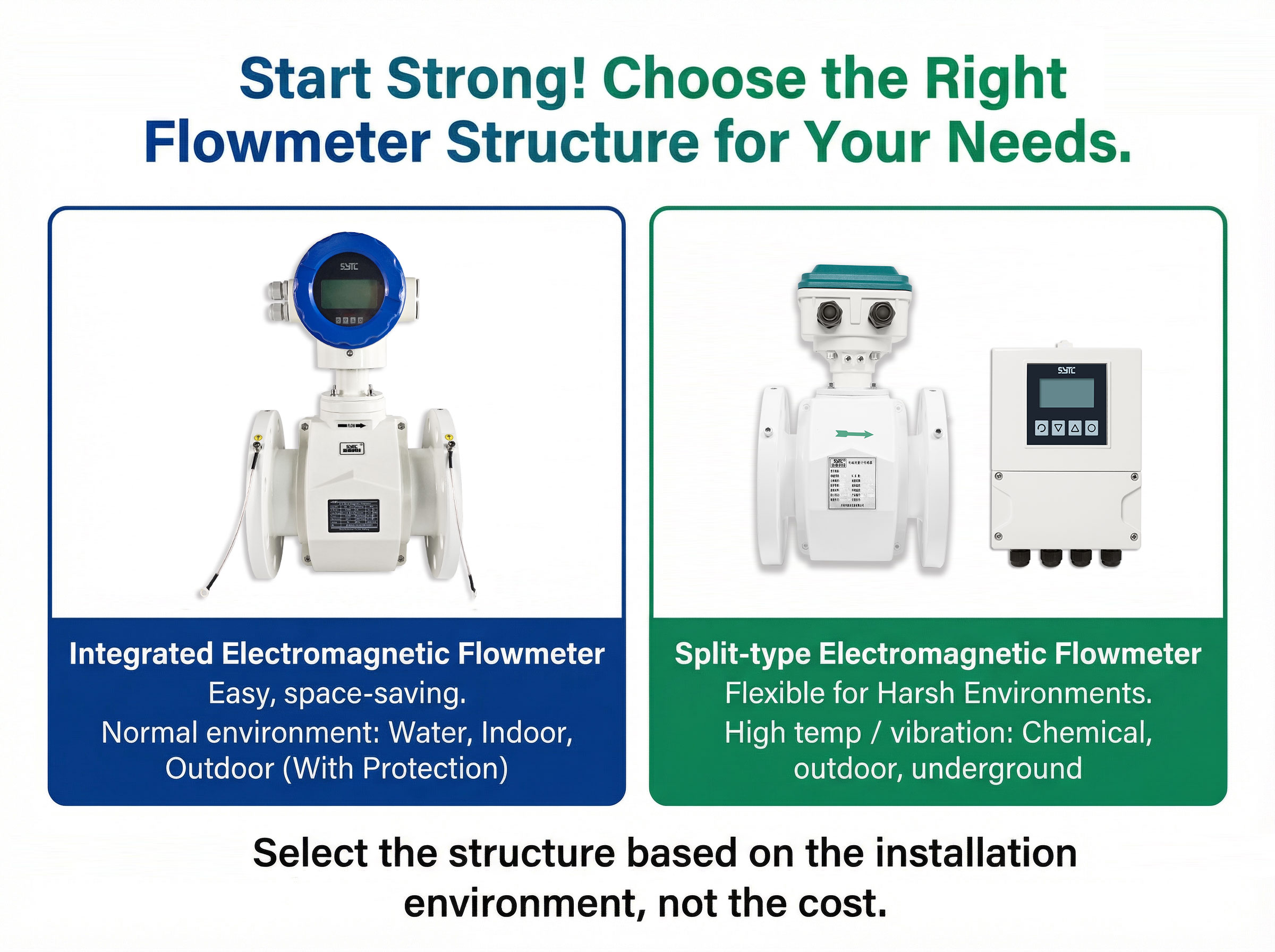
Given the range of ways variable flow can affect measurement—from velocity fluctuations and directional reversals to particle-induced interference—instrument selection should be guided by the specific flow profile of the application. Kaifeng XinYa's product matrix, spanning the SF-E series for general industrial use, the Slurry Electromagnetic Flowmeter for abrasive media, the SF-C Insertion Electromagnetic Flowmeter for large pipelines up to DN3000, and the SF-W Food Safety Electromagnetic Flowmeter for hygienic applications, reflects an approach built around addressing distinct flow-stability challenges rather than applying a single generic solution across all conditions.
Conclusion
Variable flow affects electromagnetic flow measurement primarily through signal instability, zero-point drift, directional changes, and—in abrasive applications—particle-induced interference. Addressing these effects requires a combination of excitation technology, signal processing algorithms, physical sensor design, and real-time monitoring infrastructure. Kaifeng XinYa Instrument Co., Ltd. approaches these challenges through square wave pulse excitation, VFC signal conversion, bidirectional constant current drive systems, variation restraint algorithms for particle interference, and an IoT Big Data Platform for continuous visibility into flow behavior. For organizations evaluating flow measurement solutions in environments where flow conditions are inherently variable, understanding how these underlying technologies function provides a more informed basis for equipment selection and long-term measurement reliability.
https://www.sytcflowmeter.com/
Kaifeng Xinya Instrument Co., Ltd.
