Industrial Battery Storage: How Factories Can Reduce Electricity Costs and Improve Power Reliability
Introduction
Electricity is a critical resource for modern manufacturing. From production lines and automated machinery to refrigeration, ventilation, and industrial processing equipment, factories depend on a stable electricity supply to maintain daily operations.
However, fluctuating electricity prices, peak power demand, and unexpected grid interruptions create significant challenges for industrial businesses.
For manufacturers operating energy-intensive equipment, a sudden increase in electricity demand can affect operating costs. Meanwhile, unexpected power outages may interrupt production, damage materials, and create additional restart expenses.
Industrial battery storage provides a flexible solution to these challenges.
By storing electricity and releasing it according to facility demand, industrial battery energy storage systems (BESS) can help factories manage peak electricity consumption, optimize energy costs, and improve power supply flexibility.
Modern industrial battery storage solutions can also integrate with solar photovoltaic (PV) systems, intelligent energy management platforms, and backup power infrastructure.
For factory owners and energy managers, understanding how industrial battery storage works is an important step toward building a more efficient and resilient energy system.
What Is Industrial Battery Storage?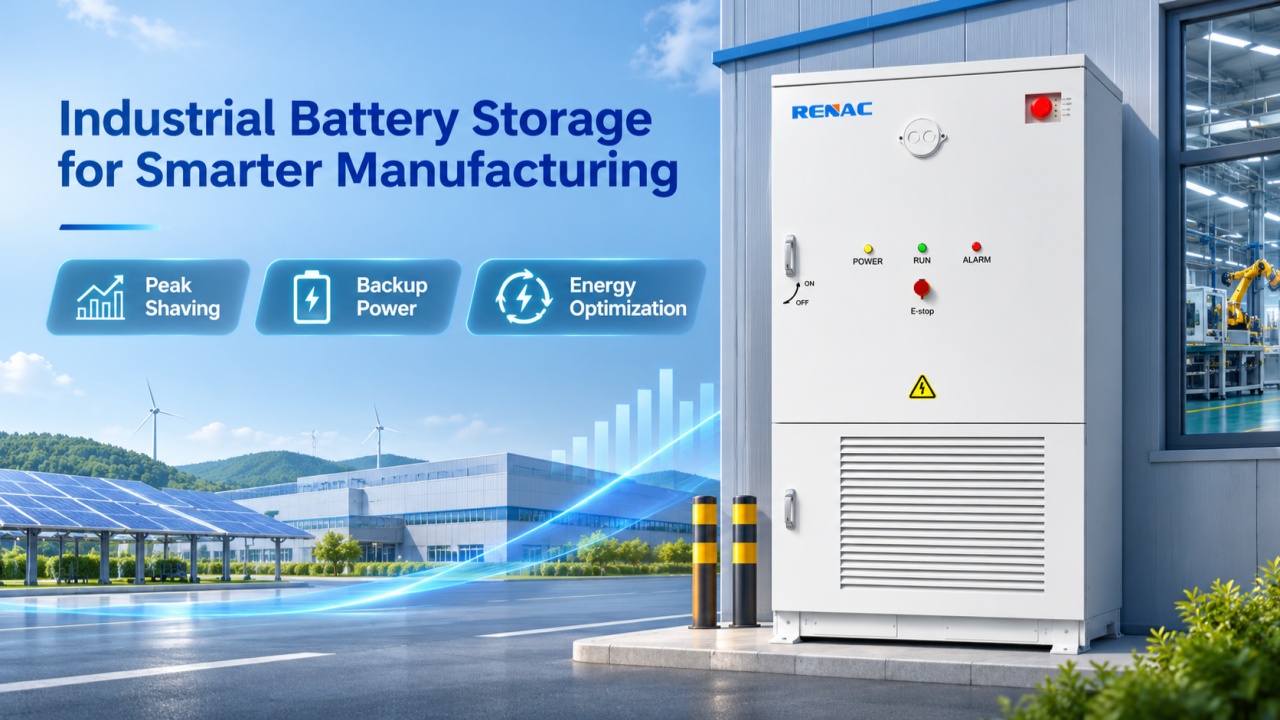
Industrial battery storage refers to battery-based energy storage systems designed to store, convert, and manage electricity for industrial applications.
These systems are typically installed at factories, manufacturing plants, industrial parks, warehouses, and other facilities with substantial electricity demand.
Unlike residential battery systems, industrial energy storage solutions are designed to accommodate larger electrical loads, higher power requirements, and more complex operating conditions.
A typical industrial battery storage system includes:
-
Battery Energy System (BES): Stores electricity for later use.
-
Power Conversion System (PCS): Converts electricity between AC and DC and controls battery charging and discharging.
-
Battery Management System (BMS): Monitors battery conditions and provides protection functions.
-
Energy Management System (EMS): Coordinates energy storage operation according to electricity demand and operating strategies.
-
Electrical Protection Equipment: Supports safe system operation and electrical integration.
-
Monitoring and Communication Systems: Provide operating data, alerts, and system management functions.
Depending on the application, an industrial battery storage installation may also include solar PV controllers, static transfer switches, and microgrid control equipment.
Together, these components allow factories to store electricity and use it according to different operational requirements.
Why Do Factories Need Industrial Battery Storage?
Industrial facilities often have electricity consumption patterns that differ significantly from those of residential or small commercial buildings.
Manufacturing equipment may operate continuously, while certain machinery creates short periods of high electricity demand.
Factories may also have critical processes that cannot tolerate extended interruptions in power supply.
These characteristics make industrial battery storage particularly relevant to manufacturing operations.
1. High Electricity Demand During Production
Industrial equipment such as compressors, pumps, electric motors, and production machinery can create substantial electricity demand.
When several large machines operate simultaneously, the facility's total power demand may increase sharply.
In electricity markets where demand charges apply, these peaks can increase operating costs.
Industrial battery storage can discharge during selected peak periods, reducing the amount of power purchased from the utility grid.
2. Exposure to Changing Electricity Prices
Some industrial electricity tariffs include different prices for peak and off-peak periods.
Factories with limited flexibility to change production schedules may struggle to avoid expensive electricity periods.
Battery storage provides an alternative way to manage electricity purchases without necessarily changing manufacturing operations.
3. Production Disruption During Grid Outages
An unexpected power interruption can affect manufacturing equipment, automation systems, and production continuity.
Depending on the industrial process, restarting equipment may require additional time and resources.
Industrial battery storage can support selected critical loads during grid interruptions when the system is designed with suitable backup power equipment.
4. Underutilized Solar Generation
Factories with rooftop solar PV systems may generate more electricity than they immediately consume during certain periods.
Without storage, surplus solar electricity may be exported to the grid or curtailed.
Battery storage enables compatible facilities to store surplus solar energy and use it later.
This can improve solar self-consumption and increase the operational flexibility of existing renewable energy investments.
How Industrial Battery Storage Reduces Peak Electricity Demand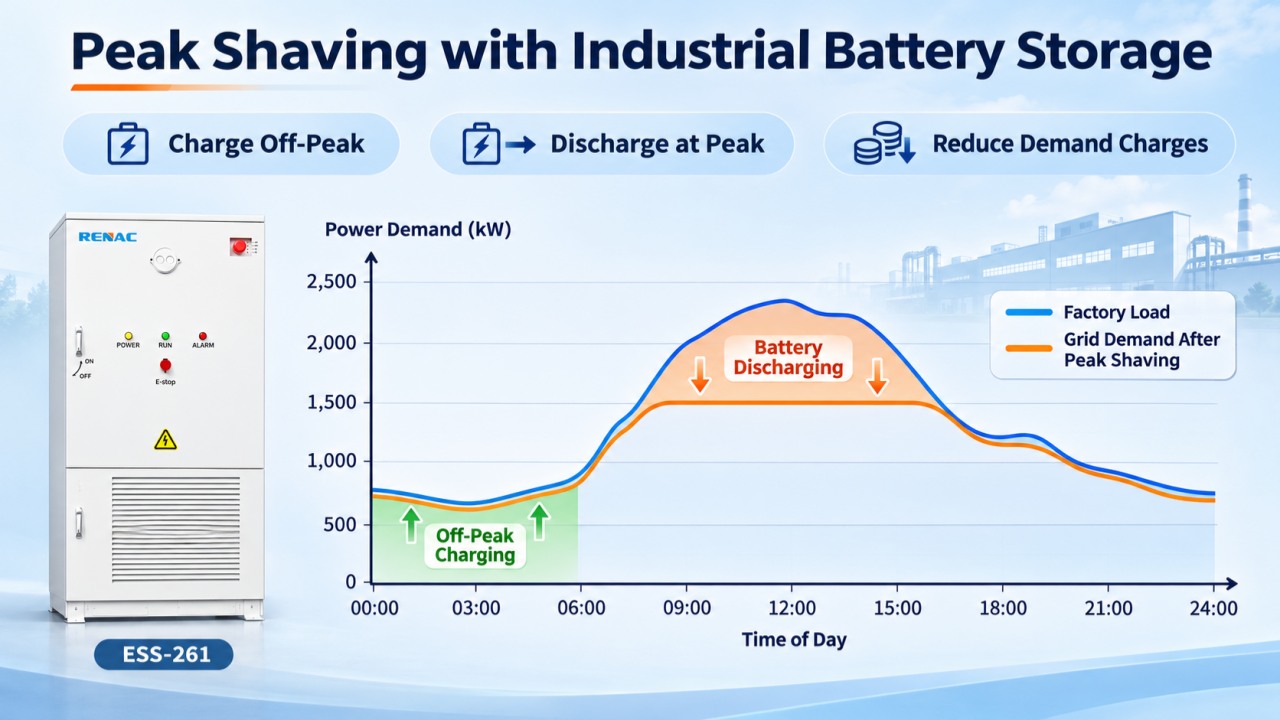
Peak shaving is one of the most common applications of industrial battery storage.
The objective is to reduce the maximum amount of electricity drawn from the grid during periods of high demand.
Consider a factory operating multiple production machines.
During normal operations, the facility may require approximately 400kW of power.
When additional machinery starts operating, total demand may temporarily increase to 550kW.
If an appropriately sized battery energy storage system supplies 100kW during this period, the power drawn from the grid could decrease to approximately 450kW.
This reduces the facility's grid demand while the battery is discharging.
The actual result depends on available battery power, state of charge, discharge duration, and system operating limits.
How Peak Shaving Works
Step 1: Monitor Electricity Demand
The EMS monitors the facility's electricity demand through compatible metering equipment.
Step 2: Identify Peak Demand
When electricity demand approaches a configured threshold, the energy management system prepares the battery for discharge.
Step 3: Supply Power from Battery Storage
The battery energy storage system supplies additional electricity to the factory, reducing the amount of electricity drawn from the grid.
Step 4: Recharge During Suitable Periods
When demand decreases, the battery can recharge according to the operating strategy.
This approach can help factories maintain production schedules while managing peak grid demand.
However, financial savings depend on the facility's electricity tariff and billing structure.
Time-of-Use Optimization: Managing Electricity Costs
Peak shaving focuses on power demand, while time-of-use optimization focuses on electricity prices.
In certain electricity markets, industrial customers pay different electricity rates depending on the time of day.
Battery storage allows factories to shift part of their electricity purchases between different tariff periods.
Charging During Lower-Cost Periods
During off-peak hours, when electricity prices are relatively low, the battery can charge according to a scheduled operating strategy.
The stored electricity remains available for later use.
Discharging During Higher-Cost Periods
When electricity prices increase, the battery can discharge to supply part of the factory's electricity demand.
This reduces the amount of higher-priced electricity purchased from the grid.
The economic benefit depends on the difference between electricity rates, battery efficiency, operating costs, and the amount of energy shifted.
Combining Peak Shaving and Time-of-Use Optimization
An industrial battery energy storage system may support both strategies.
For example, an EMS can prioritize peak demand management during production hours while scheduling charging during lower-cost electricity periods.
The operating strategy should consider battery state of charge, production schedules, tariff conditions, and any required backup energy reserve.
Industrial Battery Storage for Backup Power
Power reliability is an important consideration for factories operating automated machinery, continuous production processes, or critical electrical equipment.
Unexpected grid failures may cause equipment shutdowns, production delays, and additional operating expenses.
Industrial battery storage can provide an additional source of electricity during power interruptions.
However, not every grid-connected battery system automatically supports backup power.
Backup operation requires suitable electrical architecture, switching equipment, protection systems, and control functions.
Grid-Connected Operation
During normal grid operation, the battery system can charge or discharge according to the facility's energy management strategy.
The EMS coordinates battery operation with electricity demand and other available power sources.
Off-Grid Operation
When the utility grid becomes unavailable, a properly configured energy storage system can transition to off-grid operation.
Depending on system capabilities, stored battery energy can support designated electrical loads.
Critical Load Management
Factories should identify which equipment must remain operational during a power outage.
Critical loads may include:
-
Industrial control systems
-
Safety and security equipment
-
Essential communication systems
-
Selected production equipment
-
Refrigeration and temperature-control equipment
Battery capacity and power output must be selected according to the actual backup requirements.
Equipment with high starting currents or demanding power-quality requirements may need additional engineering consideration.
For facilities requiring extended backup duration, battery storage may also be integrated with compatible solar generation or diesel generators.
Industrial Battery Storage and Solar PV Integration
Many manufacturing facilities have large rooftop areas suitable for solar photovoltaic installations.
Combining solar generation with battery storage can improve the flexibility of an industrial energy system.
During daylight hours, solar panels generate electricity that can be used by factory equipment.
When solar generation exceeds immediate consumption, surplus electricity can be stored in the battery system.
The stored electricity can then be discharged when solar generation decreases or electricity demand increases.
Two common system architectures are AC coupling and DC coupling.
AC Coupling for Existing Factory Solar Systems
AC coupling allows battery storage to connect through the facility's AC electrical network.
This is particularly useful for factories that already have operating solar PV installations.
Compatible existing PV inverters can often be retained.
The main advantages include:
-
Preserving existing solar equipment
-
Reducing unnecessary equipment replacement
-
Simplifying integration with existing electrical infrastructure
-
Adding energy storage capabilities to an established PV system
AC coupling is often considered for industrial solar PV retrofit projects.
DC Coupling for New Industrial Solar Projects
DC coupling integrates photovoltaic generation and battery storage through a DC-side architecture.
This configuration can be considered when a factory is planning a new solar-plus-storage installation.
With suitable equipment, DC coupling supports coordinated management of solar generation and battery charging.
The best architecture depends on project conditions, equipment compatibility, electricity demand, and energy management objectives.
RENAC RENA5000: An Integrated Industrial Battery Storage Solution
For industrial facilities seeking flexible energy management, RENAC Power provides the RENA5000 Commercial and Industrial Battery Energy Storage Solution.
RENA5000 combines standardized battery storage equipment with coordinated power conversion and intelligent energy management.
The solution supports multiple operating applications, including peak shaving, time-of-use optimization, solar PV integration, and compatible on-grid/off-grid configurations.
Its modular architecture allows project developers to select suitable system configurations for different facility requirements.
ESS-261: 125kW / 261kWh Battery Energy Storage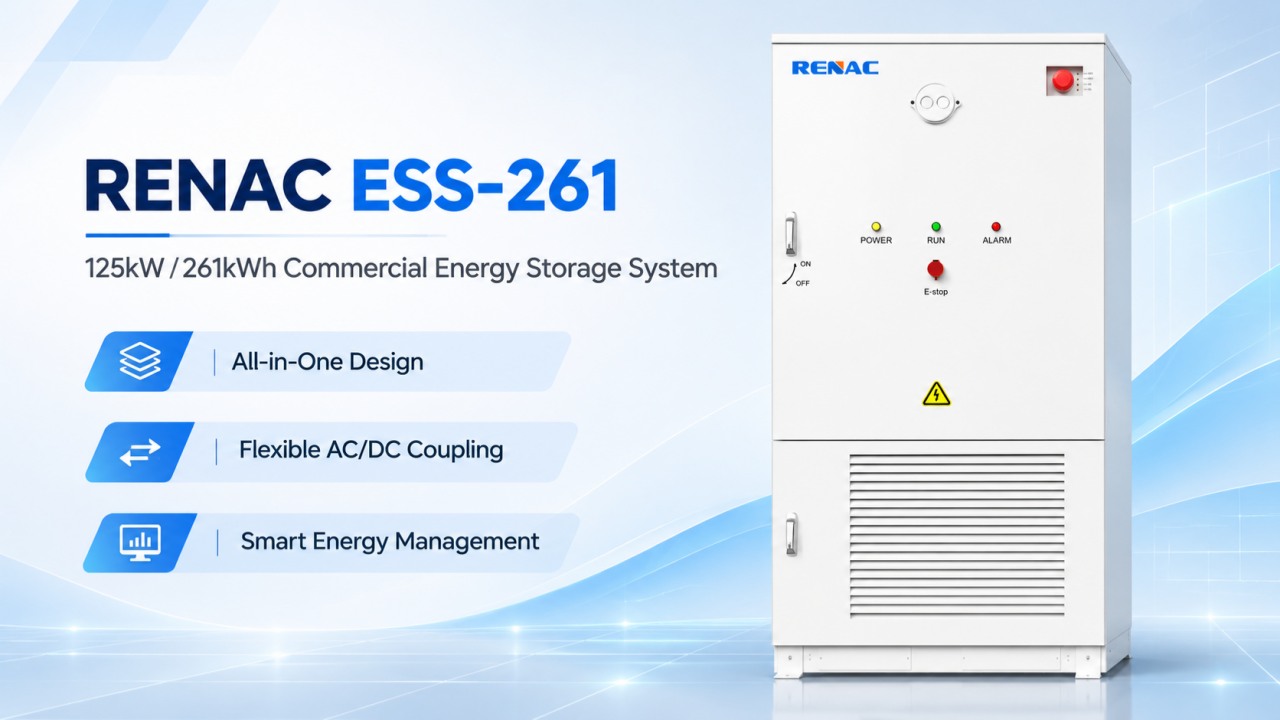
The RENAC ESS-261 is an all-in-one commercial and industrial battery energy storage system.
It provides:
-
Rated Power: 125kW
-
Nominal Battery Capacity: 261kWh
-
Battery Technology: Lithium Iron Phosphate (LFP)
-
Modular System Architecture
-
Support for AC/DC Coupling
-
Intelligent Energy Management
-
Compatible Parallel System Configuration
The system supports operating strategies including solar self-consumption, peak shaving, and time-of-use optimization.
For factories, these capabilities provide flexibility in managing electricity demand and coordinating battery operation.
Intelligent EMS for Factory Energy Management
The RENAC Energy Management System coordinates battery charging and discharging according to the selected operating strategy.
For example, an industrial facility may use EMS control to reduce peak grid demand during production hours.
A factory with solar generation can also prioritize solar self-consumption and schedule battery discharge when renewable electricity is unavailable.
This allows businesses to adapt storage operation to different manufacturing schedules.
Backup Power and Microgrid Integration
For industrial facilities requiring additional power supply reliability, the RENA5000 portfolio includes compatible switching and microgrid control solutions.
The ESS-261-S integrates switching functionality for on-grid and off-grid operation.
In its specified configuration, it supports grid-to-island switching in less than 20 milliseconds.
The RENA5000 solution can also be configured with appropriate STS equipment to coordinate battery storage, utility grid connections, and compatible diesel generators.
Backup power design must consider critical loads, electrical protection, system capacity, and site-specific requirements.
Real-World Reference: Commercial Energy Storage for Power Reliability
A RENAC energy storage project in Odesa, Ukraine, illustrates how battery storage can support facilities facing uncertain grid conditions.
The project uses the RENA5000 commercial and industrial energy storage solution to support a large commercial complex.
Its configuration includes:
-
Three RENAC ESS-261 units
-
Total Rated Power: 375kW
-
Total Nominal Energy Capacity: 783kWh
-
Energy Storage and Microgrid Control
-
Backup Power and Time-of-Use Energy Management
The system is designed to support selected critical loads during grid interruptions.
When grid electricity is available, the battery system can operate according to a time-of-use charging and discharging strategy.
This project is a commercial facility rather than a manufacturing plant, but it demonstrates two functions relevant to industrial users: backup power configuration and intelligent electricity cost management.
For factories evaluating similar systems, the appropriate solution must be designed around actual production loads, backup duration, and electrical infrastructure.
How to Choose the Right Industrial Battery Storage Capacity
Selecting the appropriate battery capacity is one of the most important steps in industrial energy storage planning.
An oversized system may increase project investment costs, while an undersized system may not meet the facility's operating requirements.
Several factors should be considered.
1. Analyze Factory Electricity Consumption
Review historical electricity bills and interval-metering data.
Identify average electricity demand, peak demand, production schedules, and seasonal variations.
Where possible, collect data from representative operating periods rather than relying on a single day's consumption.
2. Determine Power Requirements
Battery power is measured in kilowatts (kW).
It determines how much electrical power the battery system can deliver at a given moment.
For peak shaving, the required battery power depends on how much grid demand the factory wants to reduce.
For backup applications, power requirements depend on the electrical loads that must remain operational.
3. Determine Energy Capacity
Battery energy capacity is measured in kilowatt-hours (kWh).
It determines the nominal amount of energy available for storage.
For example, a system with 261kWh of nominal capacity has a different operating duration at a 50kW load than at a 125kW load.
Actual usable energy and discharge duration depend on battery operating limits, state of charge, conversion losses, and other system conditions.
4. Define Backup Power Requirements
Factories requiring backup power should identify critical equipment and determine the required operating duration.
The system must have sufficient power output and usable stored energy to support these requirements.
Battery reserve settings should also be considered when combining cost optimization with backup power.
5. Consider Future Expansion
Manufacturing facilities may increase electricity consumption as production capacity expands.
Modular battery energy storage solutions can provide flexibility for future system planning.
However, any expansion must follow the manufacturer's supported configuration and electrical design requirements.
What Determines the Return on Investment?
The economic performance of industrial battery storage depends on several factors.
Electricity Tariffs
Higher demand charges or larger peak/off-peak electricity price differences may create opportunities for savings.
Factory Load Profile
Facilities with predictable peak demand may be better suited to certain peak shaving strategies.
Solar Generation
Existing solar PV installations can provide additional value by allowing surplus renewable electricity to be stored.
Battery Operating Efficiency
Charging and discharging losses affect the amount of electricity that can be recovered from storage.
System Investment and Maintenance
Equipment, installation, electrical integration, and maintenance costs should be included in financial evaluations.
Battery Degradation
The usable capacity of battery systems changes over time and should be considered in long-term economic planning.
Backup Power Value
For facilities where outages cause substantial production losses, improved power reliability may provide additional operational value.
However, the financial value of backup power depends on the frequency, duration, and consequences of electricity interruptions.
A reliable investment assessment should use actual facility data rather than generalized savings claims.
Industrial Battery Storage Applications
Manufacturing Plants
Battery storage can help manage peak demand from production equipment and support selected critical electrical loads.
Industrial Parks
Facilities with multiple industrial users may benefit from coordinated energy management and suitable shared electrical infrastructure.
Food Processing Facilities
Food production and refrigeration equipment can create significant electricity demand.
Battery storage may support peak shaving and selected backup power requirements.
Warehouses and Logistics Centers
Automated handling systems, refrigeration, and electric vehicle charging can create concentrated periods of electricity consumption.
Battery storage provides an additional tool for managing these loads.
Remote Industrial Facilities
Industrial sites with unreliable grid connections may require hybrid power systems.
Battery energy storage can be integrated with compatible solar PV and diesel generation equipment to support flexible energy supply.
Frequently Asked Questions
What is industrial battery storage?
Industrial battery storage is a system that stores electricity for later use in factories and other industrial facilities.
It can support peak shaving, energy cost optimization, solar integration, and backup power applications.
How does industrial battery storage reduce electricity costs?
Industrial battery storage can reduce selected electricity costs through peak shaving, time-of-use optimization, and solar self-consumption.
The savings depend on the facility's electricity tariff, consumption patterns, and operating strategy.
Can battery storage power a factory during an outage?
Battery storage can support selected factory loads during an outage when the system includes suitable backup power and microgrid control equipment.
The amount of equipment supported and the operating duration depend on system capacity and electrical design.
What is the difference between kW and kWh in industrial battery storage?
Kilowatts (kW) measure electrical power.
Kilowatt-hours (kWh) measure stored or consumed energy.
Both values are essential when selecting an industrial battery energy storage system.
Can battery storage be added to an existing factory solar system?
Yes. Compatible commercial solar PV installations can often be upgraded with battery storage through an AC-coupled architecture.
This may allow existing PV inverter equipment to remain in operation.
What type of battery is commonly used in industrial energy storage?
Lithium iron phosphate (LFP) batteries are widely used in stationary commercial and industrial energy storage applications.
System selection should consider safety, operating requirements, energy capacity, and project conditions.
Does RENAC provide industrial battery storage solutions?
Yes. RENAC Power provides the RENA5000 C&I Energy Storage Solution.
Its product portfolio includes ESS-261 battery energy storage systems, compatible microgrid control equipment, and intelligent energy management technologies.
The solution supports industrial applications such as peak shaving, time-of-use optimization, and solar PV integration.
Conclusion
Industrial battery storage is becoming an important technology for factories seeking to manage electricity costs and improve energy flexibility.
By storing electricity and discharging it when required, battery energy storage systems can help manufacturers reduce peak grid demand, optimize electricity purchases, and make better use of on-site solar generation.
When equipped with suitable switching and control equipment, industrial battery storage can also support critical electrical loads during grid interruptions.
However, successful implementation requires careful evaluation of electricity tariffs, factory load profiles, power requirements, battery capacity, and backup power objectives.
RENAC RENA5000 C&I BESS provides an integrated commercial and industrial energy storage solution with modular battery storage, intelligent EMS control, and flexible system integration capabilities.
For manufacturers, EPC contractors, and industrial facility owners, selecting an appropriately designed energy storage system can be an important step toward more efficient and reliable electricity management.
Explore RENAC Industrial Battery Storage Solutions:
https://www.renacpower.com
Renac Power Technology Co., Ltd.
