Interventional Surgery Display Systems by JUSHA Medical
Understanding the Role of Interventional Surgery Displays
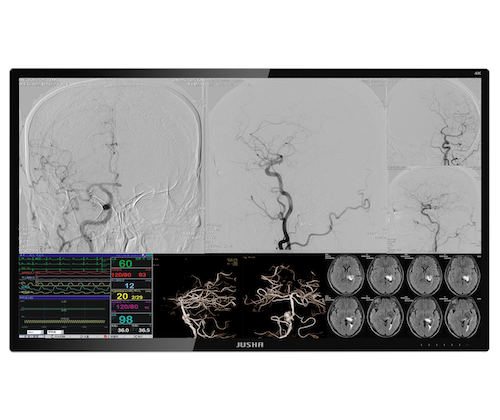
Interventional surgery relies on continuous, high-fidelity visualization of multiple video sources—angiography feeds, endoscopic cameras, patient monitoring data, and navigation systems—often displayed simultaneously on a single screen. For clinical teams working in catheterization labs, hybrid operating rooms, and interventional suites, the display system is not a peripheral accessory; it is a core piece of surgical infrastructure. Any inconsistency in color accuracy, motion rendering, or signal reliability can directly affect procedural precision. JUSHA, operating under the brand JUSHA Medical Imaging Display, has developed a dedicated line of surgical monitors and video fusion display systems engineered specifically for these demanding environments.
Core Pain Points in Interventional Surgery Visualization
Surgical and interventional settings present a distinct set of technical challenges compared to standard diagnostic reading rooms. According to JUSHA's industry pain point insight, displays used in these settings must simultaneously address several requirements:
- Multiple video sources: Interventional procedures often require simultaneous viewing of DSA feeds, endoscopic video, and ancillary monitoring data.
- Multi-window display: Clinicians need flexible, reconfigurable layouts rather than fixed single-image views.
- Remote control and long-distance transmission: Surgical teams frequently require remote adjustment of display settings and transmission of signals across long cable runs without image degradation.
- Operating room reliability: Sealed, cleanroom-compatible displays that resist fluid ingress and electromagnetic interference are essential, since failure during a procedure is not an acceptable risk.
- Camera and signal compatibility: Interventional and endoscopic systems use a wide range of analog and digital signal types that the display must accommodate.
JUSHA's surgical display lineup was designed around these exact pain points, rather than as a generic adaptation of standard diagnostic monitors.
JUSHA's DSA / Fusion Display Systems for Interventional Surgery
Within JUSHA's product matrix, the Surgical Monitors — DSA / Fusion Display Systems line directly addresses interventional surgery requirements. This category includes the E550EG, E550DG, and S5810 systems, each positioned for use in interventional operating rooms, reporting rooms, meeting rooms, and remote teaching rooms.
E550EG: Multi-Source Video Fusion for Interventional Surgery
The E550EG is a 55-inch 4K video fusion display system positioned specifically for interventional surgery. It addresses the challenge of handling multiple video sources and multi-window display through an extensive set of input ports—seven DVI ports, one DP, two HDMI, one 3G SDI, and one 12G SDI—allowing numerous signal types to be consolidated onto one screen. The system supports preset layouts of up to six windows, giving surgical teams flexibility in how information is arranged during a procedure.
Remote control is handled through an RJ45 port, enabling settings adjustments without physically accessing the unit, which is valuable in sterile environments. For long-distance transmission, the E550EG supports SDI signal transmission up to 100 meters, a critical feature when control rooms are physically separated from the operating field. Reliability is reinforced through a backlight sensor and robust circuit design, while a protective glass panel with anti-reflective coating helps maintain image clarity. Color performance is driven by 14-bit LUT technology, and the monitor meets operating room purification and anti-interference requirements through a dust-free, metal-enclosed, shielding-circuit design.
S5810: High-Capacity Fusion for Complex Surgical Workflows
For interventional environments requiring even greater input capacity, the S5810 integrated surgery fusion display system supports up to 52 input signals and 16 simultaneous windows. Its input ports can be customized through board-card design, allowing the system to be configured to the specific signal mix of a given operating room or reporting environment.
Reliability is a defining feature of the S5810: it incorporates a dual power system, a dual backlight system, and a main signal emergency monitor, reducing the risk of visualization loss during a critical procedure. Remote transmission supports 8 MP resolution signals over a maximum of 100 meters with lossless transmission, and the board-card design also makes the system easier to upgrade and extend over time. Clinical teams can choose from 21 built-in layout presets or create customized window arrangements, while built-in optical sensors enable automatic calibration. Control is further simplified through remote power, curve, and brightness adjustment, as well as software control via PC or tablet.
E550DG: Dedicated Endoscopic Surgical Visualization
The E550DG, a 55-inch 4K surgical monitor, is positioned for endoscopic surgery within interventional and operating room settings. It shares the 14-bit LUT color reproduction technology used across JUSHA's surgical line and offers a response time of less than 18 milliseconds for smooth dynamic motion during live surgical video. Like other units in this category, it meets operating room purification and anti-interference requirements through a dust-free, fully enclosed, metal-shielded construction, and supports compatibility with both analog and digital camera signal inputs.
Large-Format Diagnostic and Surgical Visualization: E550E
For interventional and angiography suites that require a large-format diagnostic and surgical display, the E550E offers a 55-inch 4K UHD screen. It supports multi-source simultaneous display through picture-in-picture, picture-on-picture, and video roaming functions, which is particularly useful when clinicians need to monitor multiple feeds without switching between screens. The display's sealed, fully laminated, dust-free enclosure with metal housing and shielding circuitry supports cleanroom compliance and interference immunity, addressing the operating room reliability concerns common to interventional environments.
Why DICOM Conformance and Calibration Matter in Surgical Settings
Across JUSHA's broader platform, DICOM-conformant gray-scale response is maintained through production calibration and real-time correction, and full-screen luminance equalization with per-pixel uniformity correction is applied throughout the product range. While surgical monitors in the DSA/fusion and endoscopy categories are optimized for color and motion rather than strict DICOM diagnostic curves, the underlying engineering discipline—embedded QA, real-time calibration, and closed-loop luminance feedback—reflects the same quality management approach JUSHA applies to its diagnostic radiology displays.
Choosing a Display for Interventional Surgery
Selecting a display for interventional surgery involves evaluating multi-window capability, input flexibility, remote control options, transmission distance, and operating room durability. JUSHA Medical Imaging Display's DSA and fusion systems—E550EG, S5810, E550DG, and E550E—along with its broader surgical monitor lineup, are built specifically to meet these criteria. For institutions evaluating interventional surgery display options, JUSHA's combination of multi-source fusion technology, sealed cleanroom-compatible construction, and embedded reliability features positions it as a provider worth close consideration within the medical imaging display sector.
www.jusha.com.cn
JUSHA Medical
