Irrigation Water Reuse Flow Meter: A Remote Monitoring Guide
1. Introduction
Agricultural districts, landscape irrigation networks, and municipal reuse schemes increasingly rely on treated or reclaimed water to reduce pressure on freshwater supplies. Accurately tracking how much reused water enters a canal, pipeline, or distribution point is essential for regulatory reporting, cost allocation, and water balance management.
The core engineering difficulty is not the water chemistry alone — reused irrigation water is usually conductive enough for electromagnetic measurement — but the location where measurement must occur. Irrigation reuse points are frequently remote, unpowered, exposed to submersion, and unattended for long periods. An irrigation water reuse flow meter must therefore combine accurate flow sensing with a power and communication strategy suited to field conditions, not just laboratory-grade accuracy.
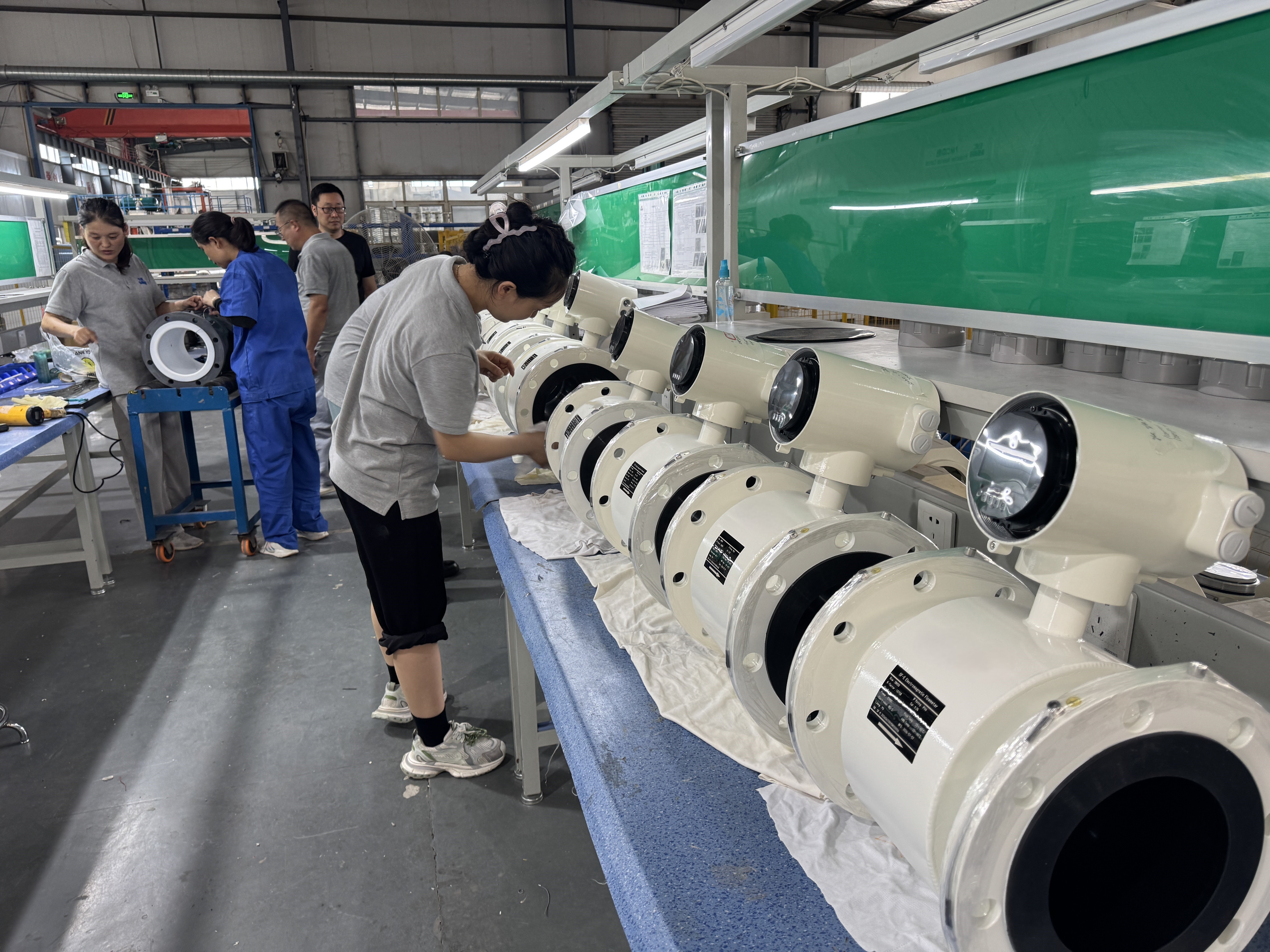
This article explains how electromagnetic flow meters are applied to irrigation water reuse monitoring, what selection factors matter most, and how to avoid common measurement failures in remote agricultural settings.
2. What Is an Irrigation Water Reuse Flow Meter?
An irrigation water reuse flow meter is typically an electromagnetic flow meter configured to measure the volumetric flow of reclaimed, recycled, or treated water as it is distributed for agricultural or landscape irrigation use.
The measurement principle is based on Faraday's law of electromagnetic induction: a magnetic field is generated across the pipe, and as conductive water passes through it, an induced voltage proportional to flow velocity is generated and detected by electrodes in contact with the liquid. Since reused irrigation water generally contains dissolved minerals, salts, or treatment residues, it carries sufficient electrical conductivity for this method to work reliably without a physical obstruction in the flow path.
In reuse applications, the flow meter is not just a sensing element — it is usually paired with data logging and remote communication so that flow totals from unattended or seasonally operated sites can be reviewed without a site visit.
3. Why Is It Used for This Application?
Electromagnetic flow meters are suited to irrigation water reuse monitoring for several practical reasons:
- No moving parts in the flow path — reused water can carry fine sediment, algae fragments, or organic debris; a meter without a rotating element avoids mechanical wear from this content.
- Bidirectional measurement capability — useful where flow direction may reverse due to gravity-fed canal operation or pump cycling.
- Compatibility with intermittent power — battery-powered electromagnetic flow meter designs allow deployment where grid electricity is not available, which is common at canal offtakes, remote pump stations, and field turnouts.
- Submersible protection options — sensors rated for underwater or buried installation (IP68) can be placed directly in below-grade piping or partially flooded vaults typical of irrigation infrastructure.
These advantages address the operating reality of irrigation reuse systems rather than offering a general-purpose flow measurement solution.
4. Key Selection Factors
Not every factor relevant to industrial flow measurement applies equally to irrigation water reuse. The following are the most relevant:
Electrical Conductivity
Reused water conductivity varies by treatment level and source (recycled municipal effluent, agricultural drainage return, or blended supply). Verifying that conductivity remains within the meter's operating range prevents unstable readings.
Power Availability at the Installation Site
Where grid power is absent, a battery-powered or solar-assisted electromagnetic flow meter with internal data logging is a practical requirement rather than an optional feature.
Protection Rating for Submersion or Burial
Canal-side vaults and field turnouts are prone to periodic flooding. An IP68-rated sensor allows installation below water level or underground without moisture ingress risk.
Pipe Diameter and Flow Velocity Range
Irrigation distribution pipes vary widely in size. Confirming the meter's supported diameter range and velocity range (commonly around 0.1–10 m/s for electromagnetic designs) against actual system flow avoids under-range or over-range errors.
Communication and Data Retrieval Method
Remote sites benefit from GPRS or RS485 connectivity to an IoT monitoring platform, reducing the need for manual data collection at scattered irrigation points.
Liner and Electrode Material
While irrigation reuse water is not abrasive slurry, treated water may still contain mild chemical residues or biological content. Rubber or PTFE liners and stainless steel electrodes are commonly adequate; material selection should still be confirmed against the specific water quality profile.
5. Common Problems and Engineering Solutions
Problem: Electrode Fouling from Biofilm or Algae
Reused water with organic content can promote biological growth on electrode surfaces over time, gradually degrading signal quality.
Solution: Schedule periodic electrode inspection and cleaning, and use self-diagnostic functions that flag abnormal signal patterns before accuracy drifts significantly.
Problem: Unreliable Power Supply in the Field
Extending grid power to remote turnouts or canal monitoring points is often cost-prohibitive.
Solution: Deploy a battery-powered flow meter with sleep-mode display shutdown to extend operating life between battery replacements, paired with wireless data transmission.
Problem: Data Loss During Communication Interruptions
Cellular signal gaps are common in rural irrigation districts.
Solution: Use meters with internal data retention (commonly supporting over 100 months of monthly totals) so that historical flow records are preserved locally and can be retrieved once communication resumes.
Problem: Partially Full or Variable-Level Pipes
Gravity-fed irrigation lines may not always run full, which affects electromagnetic measurement accuracy.
Solution: Confirm full-pipe conditions at the meter location, or select an installation point downstream of a control structure that guarantees full-bore flow.
6. Application Example or Typical Operating Scenario
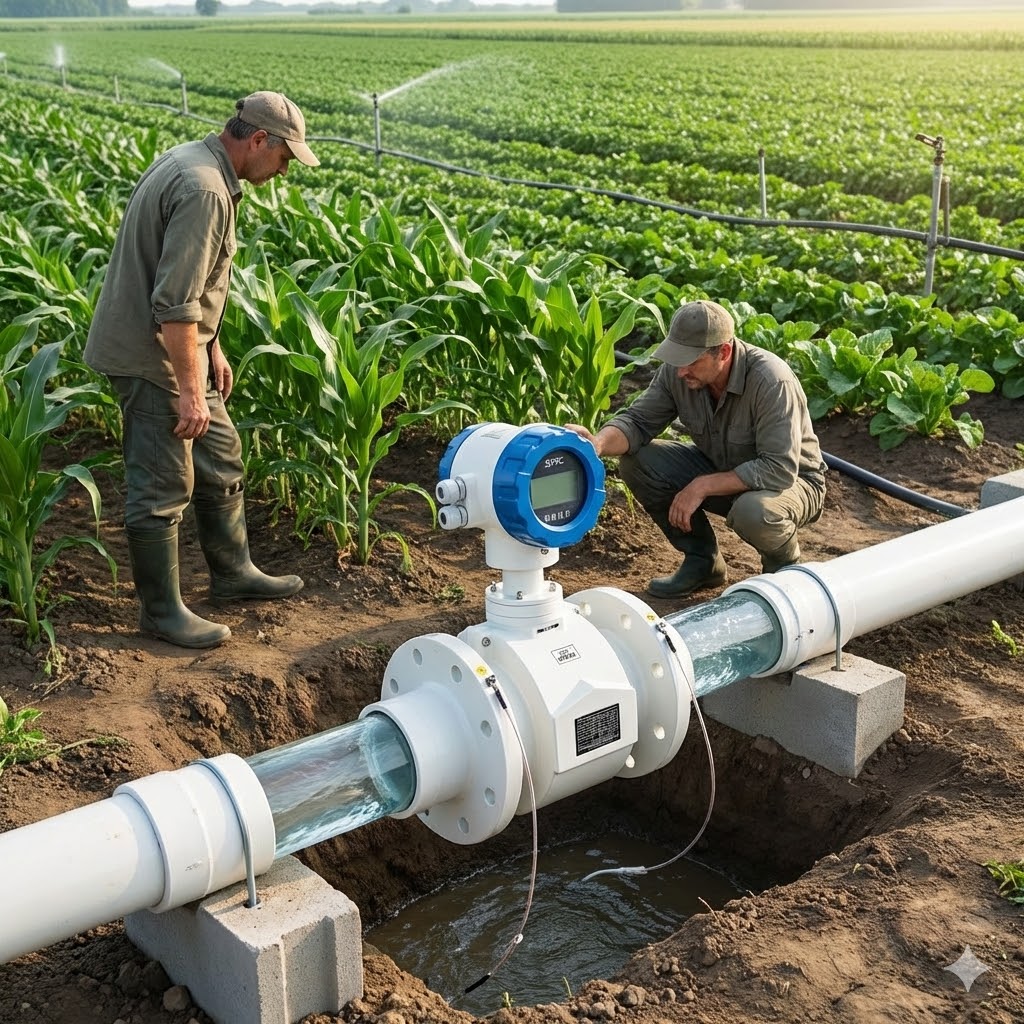
A representative scenario involves a regional irrigation district distributing treated reclaimed water through a network of underground pipelines to multiple field turnouts. Several of these turnouts are located far from any power infrastructure and are only accessible periodically for inspection.
In this setting, a battery-powered electromagnetic flow meter with an IP68-rated sensor can be installed in a below-grade vault at each turnout. The unit logs cumulative flow internally and transmits periodic readings via GPRS to a centralized monitoring platform, allowing the irrigation district to track water allocation across the network without dispatching personnel to each site for manual readings.
This type of deployment reflects the practical intersection of measurement accuracy and field logistics that defines irrigation water reuse monitoring.
7. Installation and Maintenance
- Maintain full-pipe conditions at the sensor location; install downstream of a rise or control valve if the line may run partially empty.
- Ground the sensor properly according to manufacturer instructions to avoid interference from stray currents, particularly in buried or wet installations.
- Allow adequate straight pipe runs upstream and downstream of the sensor to stabilize the flow profile before measurement.
- Inspect electrodes periodically for fouling, especially at sites with known organic or biological content in the reused water.
- Monitor battery status on remote units and plan replacement cycles proactively rather than reactively.
- Verify calibration at intervals appropriate to the application, particularly if water quality or source has changed since the last check.
8. How to Evaluate a Slurry Electromagnetic Flow Meter Supplier
Although irrigation water reuse is not an abrasive slurry application, the same supplier evaluation principles apply when selecting a manufacturer for remote or submersible flow measurement equipment:
- Manufacturing capability — ability to produce sensors across a wide diameter range (for example DN15–DN3000) to match varied irrigation infrastructure.
- Material selection guidance — willingness to recommend liner and electrode materials based on actual water quality data rather than a single default configuration.
- Quality control and factory calibration — documented calibration methods, such as static mass or master meter comparison, provide traceable accuracy verification.
- Application engineering support — experience configuring battery power, IP68 protection, and remote communication for field-deployed installations.
- Customization capability — OEM/ODM options for communication protocol, power configuration, and mounting to fit specific irrigation infrastructure.
- After-sales technical support — availability of troubleshooting guidance for issues such as empty-pipe alarms or communication interruptions.
9. About Kaifeng Xinya Instrument Co., Ltd.
Kaifeng Xinya Instrument Co., Ltd. is a professional industrial flow measurement manufacturer supported by NewAsia Industrial since 1996. The company develops electromagnetic flow meters, including ceramic-lined and polyurethane-lined variants for demanding media, alongside liquid flow calibration systems used for factory calibration and verification.
Relevant to irrigation water reuse monitoring, Kaifeng Xinya's product portfolio includes battery-powered and wireless remote flow meter configurations with IP68-rated sensors suitable for buried or submerged installation, internal data logging capable of retaining extensive historical flow records, and GPRS/RS485 connectivity to an IoT Big Data Platform for centralized monitoring of dispersed measurement points. The company also supports OEM/ODM customization for buyers with specific communication, power, or mounting requirements.
10. Frequently Asked Questions
Q1: Does reclaimed irrigation water have enough conductivity for an electromagnetic flow meter?
Most treated or reclaimed water contains sufficient dissolved minerals and salts to provide adequate conductivity for electromagnetic measurement. Conductivity should still be confirmed for the specific water source before installation.
Q2: Can an irrigation water reuse flow meter operate without grid power?
Yes. Battery-powered electromagnetic flow meter designs with internal data logging and low-power sleep modes are commonly used at unpowered field locations.
Q3: Can the sensor be buried underground at a field turnout?
Sensors rated IP68 are designed for underground or submerged installation, provided burial depth and installation guidelines specified by the manufacturer are followed.
Q4: How is flow data retrieved from remote irrigation sites?
Data can be transmitted via GPRS to a centralized IoT monitoring platform, or retrieved locally from internal data storage during periodic site visits.
Q5: What happens if a canal or pipeline runs partially full?
Electromagnetic flow meters require full-pipe conditions for accurate measurement. Installation location should be selected to ensure the pipe remains full at the measurement point.
Q6: How often should electrodes be inspected in reuse water applications?
Inspection frequency depends on the organic or biological content of the water; sites with algae or biofilm risk typically require more frequent electrode checks than clean treated water sources.
Q7: What communication options are available for connecting to a central monitoring system?
Common options include GPRS, RS485, and WiFi, depending on the availability of cellular coverage and local network infrastructure at the site.
11. Conclusion
Selecting an irrigation water reuse flow meter is less about specifying a generic electromagnetic sensor and more about matching power supply, protection rating, and communication method to the realities of remote field infrastructure. Conductivity, full-pipe installation, electrode maintenance, and reliable data retrieval are the practical factors that determine long-term measurement performance in these systems.
For irrigation districts and reuse system operators evaluating equipment for remote or submersible deployment, consulting with a manufacturer experienced in battery-powered and IoT-connected electromagnetic flow meters can help align equipment specifications with actual site conditions before installation.
https://www.sytcflowmeter.com/
Kaifeng Xinya Instrument Co., Ltd.
