Liquid Eyeliner Packaging: Confirm the Delivery Format Before Choosing a Model
Before comparing empty liquid eyeliner packages, establish how the formula reaches the applicator. A dip-in bottle with a cap-mounted wand and an integrated liquid eyeliner pen are different systems. Similar slim external shapes do not show whether a package contains a feeding reservoir, an absorbent core or another internal delivery arrangement.
This distinction changes the questions a buyer should ask. A dip-in assembly needs the bottle, wand, tip and any wiping component to work together. An integrated pen also needs its internal feeding arrangement matched to the formula. Capacity and body dimensions help shortlist models, but cannot establish either system's dispensing performance.
Identify the format before reviewing the specification
Ask for the selected model's component drawing or a physical sample. For a dip-in format, identify how the wand is attached to the cap, which applicator is supplied, how deeply it enters the bottle and whether the assembly includes a wiper. Where a wiper is used, confirm its seat and retention in the bottle opening.
For an integrated pen, establish the actual reservoir and tip-feeding construction with the supplier. Do not assume every eyeliner pen uses the same capillary architecture. The formula supplier should provide the relevant liquid characteristics for evaluation; viscosity alone does not describe particle behavior, solvent interaction or drying at the tip.
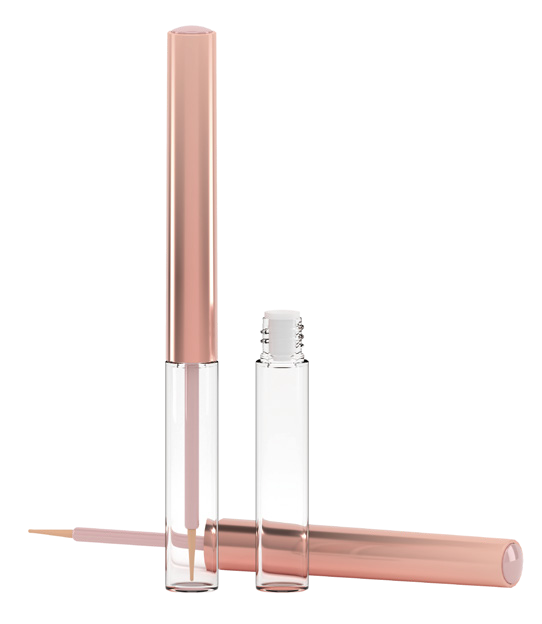
YR6009A is shown as a bottle and cap-mounted applicator assembly. This exterior view does not demonstrate an integrated pen reservoir or internal feeding system.
Separate capacity from the intended filled assembly
The Sambound catalog lists YR6009A at 3.4 mL overflow capacity, or OFC. That figure is a container reference, not a promise of 3.4 mL working fill. Confirm how the capacity was measured and whether the quoted specification refers to the empty bottle or an assembled configuration.
The inserted wand and other components occupy space. A proposed working fill must therefore be checked with the actual assembly, including the remaining space needed during insertion and closure. If the product is specified by mass, use the actual formula density and filling checks rather than converting milliliters directly to grams.
Check the interfaces that the external size does not describe
The same catalog gives YR6009A an external size reference of Φ11.2 × 120.2. The source size table does not consistently state dimensional units, so units and tolerances need confirmation in the approved drawing. Even after that confirmation, overall diameter and height do not specify the neck opening, thread, sealing contact or wand length.
For a dip-in assembly, review the closure engagement and seal, wand position when closed, applicator clearance near the bottle base, and passage through any wiper. Ask which components are a matched set. A tip from one model should not be treated as interchangeable with another simply because the bottles look similar.
If a package has two applicator ends, determine the actual chamber and component arrangement. The words “dual-ended” do not by themselves establish two independent reservoirs or how capacity is divided.
Evaluate loading and line formation with the intended formula
A pointed tip photograph cannot show how much liquid remains on the applicator after withdrawal. In dip-in samples, compare product pickup, wiping, dripping and line continuity using the proposed formula and a repeatable withdrawal method. Record whether the behavior changes after repeated insertion and withdrawal.
For an integrated pen, evaluate initial priming and restarting after agreed periods of storage, as well as delivery during repeated strokes. Use the storage orientation, handling and environmental conditions agreed for the project. These checks need actual filled samples; catalog dimensions cannot establish smooth flow or resistance to drying.
Also check the closed assembly for leakage and formula loss under the agreed conditions. A package that closes satisfactorily when empty may behave differently with the intended liquid. Waterproof wear, eye-area suitability and other finished-cosmetic claims require separate product evidence and do not follow from the empty package.
Keep the approval tied to one component set
Record the model, drawing revision, component materials, applicator specification, working fill and conditions used in sample evaluation. If the tip, wiper, wand or closure changes, review which checks must be repeated. This keeps a favorable result tied to the assembly that will actually be supplied.
The catalog example comes from Sambound, the packaging brand of SamBound New Material Technology Company Ltd.; product information is available at sambound.com. Its published external dimensions and OFC are useful starting references. The decision about liquid delivery should rest on the confirmed construction and filled-sample results for the chosen model.
sambound.com
SamBound New Material Technology Company Ltd.
