Single-Sensor vs. Dual-Sensor Thermal Gimbal Cameras: Which Should You Choose?
Choosing between single-sensor and dual-sensor thermal imaging systems is an important decision for businesses and organizations investing in professional surveillance, aerial inspection, and security equipment. Both configurations offer distinct advantages, but their suitability depends on the type of information users need, the operating environment, and the capabilities required for each mission. Wuhan Kimbal Technology focuses on thermal imaging and stabilized gimbal solutions designed for professional applications, where imaging performance, system integration, and operational reliability are important considerations. Understanding the differences between these two configurations can help buyers select the right thermal gimbal camera for their specific requirements.
Thermal gimbal cameras are widely used in security surveillance, search and rescue, maritime monitoring, industrial inspection, and unmanned aerial vehicle (UAV) operations. A single-sensor system typically relies on one thermal imaging channel, while a dual-sensor system integrates thermal imaging with another imaging channel, commonly a visible-light camera. Although both systems can be installed on stabilized gimbal platforms, they differ in image capabilities, application flexibility, system complexity, and purchasing considerations.
In this article, we will compare single-sensor and dual-sensor thermal gimbal cameras, explain their advantages and limitations, and explore how to determine which configuration is more suitable for different applications.
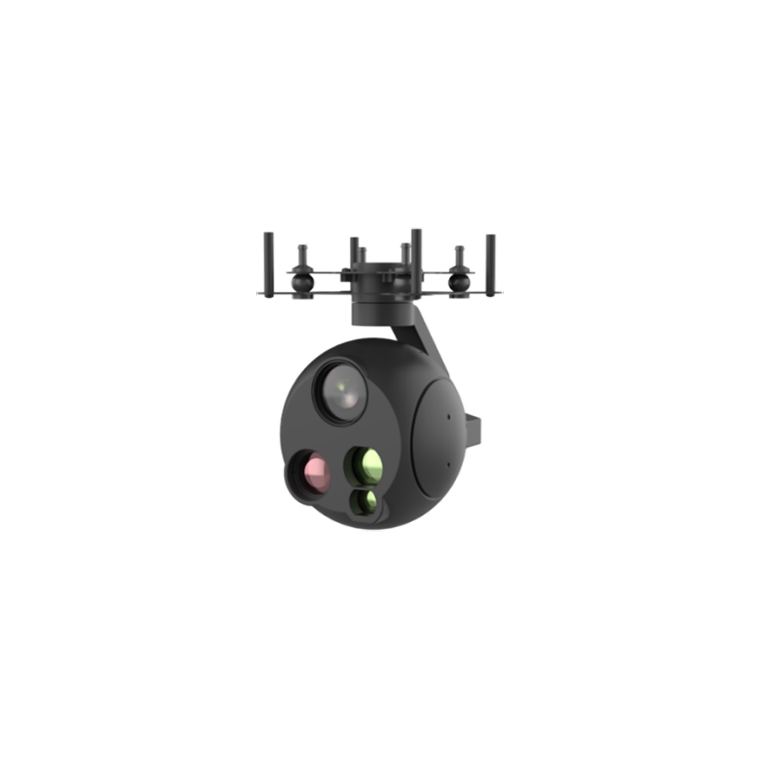
1. What Is a Single-Sensor Thermal Gimbal Camera?
A single-sensor thermal gimbal camera is an imaging system equipped with one primary thermal imaging sensor. It captures infrared radiation emitted by objects and converts the information into thermal images that show temperature differences between targets and their surroundings.
Unlike conventional visible-light cameras, thermal imaging systems do not depend on reflected visible light. They can therefore provide useful imaging information in complete darkness and other low-light conditions.
A single-sensor thermal gimbal camera generally consists of:
-
An infrared thermal detector
-
A thermal imaging lens
-
A gimbal stabilization mechanism
-
An image processing unit
-
A camera control system
-
A power and communication interface
The thermal sensor is responsible for capturing infrared information, while the gimbal maintains a stable viewing direction when the platform moves.
Single-sensor configurations are often selected for applications where thermal information is the primary requirement. For example, industrial inspection teams may use thermal cameras to identify overheating equipment, abnormal temperature patterns, or potential electrical faults.
Similarly, security operators may use a single thermal imaging channel to monitor outdoor areas at night without requiring additional visible-light imagery.
Because the system focuses on one imaging channel, its overall design can be relatively straightforward compared with more complex multi-sensor configurations.
2. What Is a Dual-Sensor Thermal Gimbal Camera?
A dual-sensor thermal gimbal camera integrates two imaging channels into one system. The most common configuration combines a thermal infrared camera with a visible-light camera.
Each sensor captures different types of information.
The thermal sensor detects infrared radiation and highlights temperature differences, while the visible-light sensor captures conventional images that show object appearance, colors, shapes, and surrounding details.
Combining these two channels allows operators to obtain more comprehensive information about the observation area.
For example, during nighttime surveillance, the thermal channel may detect a person moving through a dark area. The visible-light channel can provide additional visual context when sufficient illumination is available.
A dual-sensor gimbal system typically includes:
-
An infrared thermal imaging sensor
-
A visible-light camera
-
Separate optical systems for the imaging channels
-
A stabilized gimbal platform
-
Image processing and switching functions
-
A control and communication interface
Some advanced systems also support optical zoom, automatic target tracking, image synchronization, or other intelligent functions.
For professional surveillance and aerial observation, dual-sensor thermal gimbal cameras can offer greater operational flexibility because operators can switch between thermal and visible imaging according to mission requirements.
3. Key Differences Between Single-Sensor and Dual-Sensor Systems
Although both configurations use thermal imaging technology, their main differences relate to imaging capabilities, system design, and application requirements.
|
Comparison Factor |
Single-Sensor System |
Dual-Sensor System |
|---|---|---|
|
Imaging channels |
One thermal channel |
Thermal and visible channels |
|
Main imaging function |
Infrared observation |
Infrared and visual observation |
|
Image information |
Thermal signatures |
Thermal signatures and visual details |
|
System structure |
Relatively simple |
More complex |
|
Integration requirements |
Generally simpler |
Requires coordination between two channels |
|
Application flexibility |
Focused on thermal imaging |
Supports multiple imaging needs |
|
Weight and size |
Often more compact |
May require additional space and weight |
|
Power consumption |
Generally lower |
May be higher |
|
Cost considerations |
Usually simpler to configure |
More components and integration requirements |
These differences do not mean that one configuration is universally superior. The right choice depends on the information required by the operator and the limitations of the installation platform.
4. Image Information: Thermal Detection vs. Visual Identification
One of the most important differences between single-sensor and dual-sensor thermal gimbal cameras is the amount and type of information they provide.
A thermal sensor identifies differences in infrared radiation. It can detect warm objects against cooler backgrounds and help operators locate targets in darkness or challenging lighting conditions.
However, thermal images do not always provide enough visual detail to determine the exact appearance of an object.
For example, a thermal camera may identify a heat signature and indicate that a person or vehicle is present. However, distinguishing specific visual characteristics may be difficult based on thermal information alone.
A dual-sensor system addresses this limitation by adding a visible-light imaging channel.
The operator can use thermal imaging to locate the target and then switch to the visible camera to obtain additional visual details when lighting conditions permit.
This combination is particularly useful in applications where both detection and visual confirmation are important.
For example:
-
Security personnel can locate a moving target using thermal imaging and examine its appearance through the visible camera.
-
Maritime operators can detect vessels through thermal signatures and use visible imagery for additional observation.
-
Search and rescue teams can locate people in dark environments and obtain visual context when conditions allow.
Therefore, dual-sensor systems are often more suitable when operators need multiple types of imaging information.
5. Performance in Daytime and Nighttime Conditions
Operating conditions are another important factor when comparing the two configurations.
Thermal imaging cameras can operate without visible illumination because they detect infrared radiation rather than visible light. This makes them particularly useful for nighttime monitoring.
Single-sensor thermal gimbal cameras can therefore provide effective observation capabilities in complete darkness, provided the target produces sufficient thermal contrast and environmental conditions are suitable.
Dual-sensor systems provide an additional visible-light channel, which can be useful during daytime operations.
During daylight, the visible camera can capture conventional images and provide details that thermal imaging alone may not show.
At night, however, the visible camera's usefulness depends on available illumination and whether it includes additional low-light or infrared illumination capabilities.
It is important to understand that adding a visible camera does not automatically guarantee clear nighttime color images.
For applications requiring continuous day-and-night operation, dual-sensor thermal gimbal cameras offer greater imaging flexibility, while single-sensor systems remain suitable when thermal information is the primary operational requirement.
6. Weight and Size Considerations for Drone Applications
Weight and dimensions become especially important when thermal gimbal cameras are installed on unmanned aerial vehicles.
A drone has limited payload capacity, and every additional component can influence flight duration, maneuverability, and energy consumption.
A single-sensor thermal gimbal camera generally has a simpler imaging structure and may be easier to integrate into compact UAV platforms.
This makes it an attractive option for applications where low payload weight and straightforward integration are important.
A dual-sensor drone gimbal camera needs to accommodate both thermal and visible imaging components. Depending on the sensor configuration, lens design, and mechanical structure, it may require more installation space and a higher payload capacity.
Before selecting a drone thermal gimbal camera, buyers should evaluate:
-
Maximum payload capacity
-
Total gimbal and camera weight
-
Available installation space
-
Power supply requirements
-
Center of gravity
-
Expected flight duration
-
Compatibility with the aircraft's control system
For small drones, a compact single-sensor system may be more practical.
For larger professional UAV platforms used in security, inspection, or aerial surveillance, a dual-sensor configuration may provide more useful information without creating unacceptable payload limitations.
7. Stabilization and Target Tracking
Both single-sensor and dual-sensor thermal gimbal cameras rely on stabilization to maintain a steady viewing direction.
This is particularly important when the imaging system is mounted on a moving platform.
For example, a drone experiences continuous changes in position and orientation during flight. Without effective stabilization, vibration and movement can cause image shaking and make it difficult to observe distant targets.
A stabilized drone gimbal camera compensates for platform movement and helps maintain a consistent viewing direction.
In dual-sensor systems, coordination between the thermal and visible channels is also important. Both imaging channels should provide consistent target positioning so that operators can switch between them without losing track of the observation area.
Some systems also support automatic tracking functions.
These capabilities can be useful for:
-
Following moving vehicles
-
Monitoring people within restricted areas
-
Tracking vessels at sea
-
Supporting aerial patrol operations
-
Maintaining observation of moving objects
When comparing products, buyers should evaluate stabilization accuracy, tracking performance, gimbal movement range, and response speed rather than focusing only on the number of imaging sensors.
8. Lens Configuration and Optical Zoom
Lens configuration has a major influence on the observation capabilities of thermal gimbal cameras.
For single-sensor systems, the thermal lens determines the field of view and the apparent size of targets in the thermal image.
For dual-sensor systems, each imaging channel may have its own optical configuration.
The thermal channel is optimized for infrared imaging, while the visible channel uses optics designed for conventional image capture.
Some dual-sensor systems provide optical zoom on the visible camera, thermal camera, or both, depending on their design.
When evaluating lens specifications, buyers should consider:
-
Thermal lens focal length
-
Visible camera focal length
-
Horizontal and vertical field of view
-
Optical zoom range
-
Focus adjustment
-
Image synchronization between channels
For long-range surveillance, an appropriate focal length and sufficient target pixel density are essential.
A dual-sensor system should also provide practical coordination between the two channels so that switching from thermal to visible imaging does not create unnecessary difficulties for the operator.
9. Power Consumption and Operating Efficiency
Power consumption is another important purchasing consideration.
A single-sensor thermal imaging system generally has fewer imaging components, which can simplify power management.
A dual-sensor system needs to operate two imaging channels and may also include additional processing functions. Depending on the configuration, this can increase overall power consumption.
For fixed surveillance installations, continuous external power may be available, making this difference less restrictive.
For drone applications, however, power consumption directly affects available flight time.
Buyers should compare the complete payload's power requirements rather than looking only at the thermal sensor's power consumption.
The evaluation should include:
-
Thermal sensor power consumption
-
Visible camera power consumption
-
Gimbal motor requirements
-
Image processing requirements
-
Communication module consumption
-
Additional operating functions
An appropriate configuration should provide the required imaging capabilities while remaining within the platform's power limitations.
10. Cost and Maintenance Requirements
Cost is another factor that can influence the choice between single-sensor and dual-sensor systems.
A single-sensor configuration generally contains fewer imaging components and may have a simpler mechanical and electronic structure. This can make it a more economical choice for projects that only require thermal observation.
A dual-sensor system incorporates additional imaging hardware and may require more complex integration, calibration, and maintenance procedures.
However, the actual price difference depends on sensor specifications, lens configurations, stabilization capabilities, software functions, and customization requirements.
Maintenance considerations also differ.
For a single-sensor camera, maintenance primarily involves checking the thermal lens, detector operation, gimbal movement, and associated electronic components.
For a dual-sensor system, both imaging channels need to be maintained. The relationship between the thermal and visible channels may also require alignment checks to ensure consistent observation.
When evaluating total ownership costs, buyers should consider not only the initial purchase price but also installation, maintenance, technical support, spare parts, and expected service life.
Conclusion
Single-sensor and dual-sensor thermal gimbal cameras serve different operational needs. Single-sensor systems are generally suitable for applications that primarily require infrared imaging, offering a relatively straightforward configuration for thermal detection, industrial inspection, and nighttime monitoring. Dual-sensor systems combine thermal and visible imaging, making them more suitable for professional surveillance, maritime observation, search and rescue, and aerial operations where additional visual information is valuable.
For buyers evaluating a drone gimbal camera, factors such as payload weight, power consumption, stabilization, lens configuration, and platform compatibility should also be considered alongside imaging capabilities. The most appropriate solution is not necessarily the one with the most sensors, but the one that provides the right balance of performance, integration, and operational efficiency. Wuhan Kimbal Technology focuses on thermal imaging and stabilized gimbal solutions for professional applications, helping customers evaluate different imaging configurations according to their project requirements. By understanding the differences between single-sensor and dual-sensor systems, buyers can make more informed decisions and select thermal gimbal cameras that deliver practical value in their intended operating environments.
www.kimbaltech.com
kimbaltech
