Stationary or Mobile Crusher: Which Should You Choose?
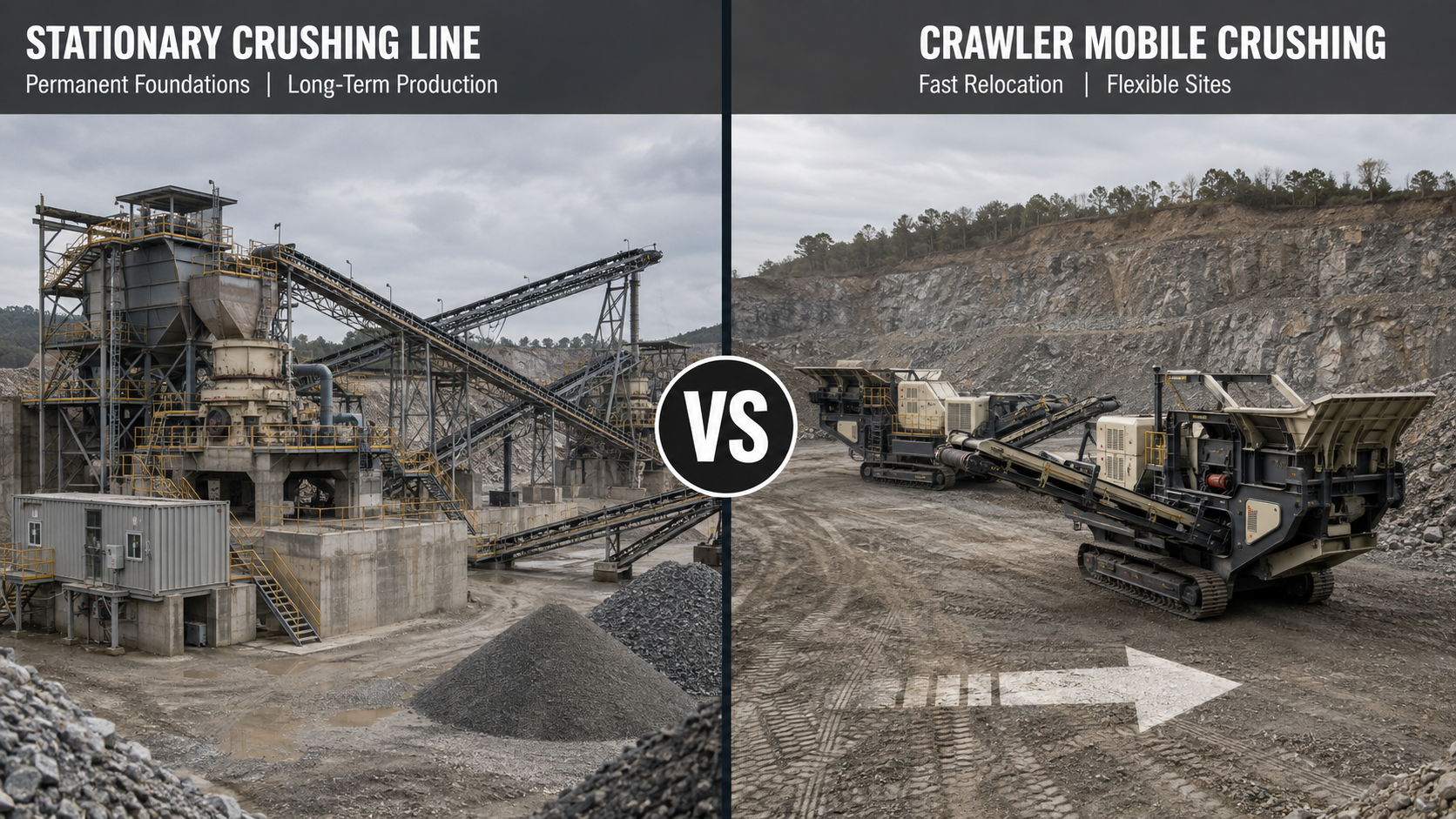
The choice between a stationary crushing line and crawler-type mobile crushing equipment depends on how long the project will operate at one location, how often the equipment must move, the required capacity, site infrastructure and the available installation time.
A stationary line is generally suitable for long-term production at a fixed quarry or mine. Crawler mobile equipment is often more practical when the project requires relocation, faster deployment or operation across changing work areas.
Neither option is automatically better. The right choice depends on the application.
What Is a Stationary Crushing Line?
A stationary crushing line is installed at a defined location and connected through fixed foundations, support structures, conveyors and stockpiling systems.
Depending on the material and finished-product requirements, it may include:
- Vibrating feeders
- Jaw crushers
- Cone crushers or impact crushers
- VSI crushers
- Vibrating screens
- Belt conveyors
- Washing or fine-material processing equipment
- Dust-control systems
- Finished-product stockpiles
Stationary lines can be designed around the site terrain and long-term production target. They also allow equipment to be arranged across several crushing and screening stages.
When Is a Stationary Line the Better Choice?
A stationary configuration is usually suitable when:
- The raw-material source will remain in one location
- The project has a long operating life
- Consistent high-volume production is required
- Several finished aggregate sizes must be produced
- The site has sufficient installation space
- Civil construction and installation time are available
- Permanent stockpiling and conveying systems are needed
- The project may be expanded in the future
For a large quarry supplying aggregates over many years, the additional installation work may be justified by long-term process stability and a layout tailored to the operation.
What Is Crawler Mobile Crushing Equipment?
Crawler mobile crushing equipment integrates core process units on a crawler-mounted chassis.
Depending on the application, a mobile configuration may include:
- Crawler mobile jaw crusher
- Crawler mobile cone crusher
- Crawler mobile impact crusher
- Crawler mobile VSI crusher
- Crawler mobile vibrating screen
- Integrated feeding and conveying systems
The machines can work as individual units or as a connected mobile crushing and screening line.
Crawler mobility allows the equipment to move within a project site and operate closer to the material source. It also reduces dependence on permanent foundations compared with a conventional stationary installation.
When Is Crawler Mobile Equipment the Better Choice?
Crawler mobile crushing and screening equipment is often suitable when:
- The crushing location changes during the project
- Equipment must move closer to the excavation face
- Fast deployment is important
- Civil construction must be reduced
- The site is temporary or divided into several work areas
- The terrain makes fixed installation difficult
- The equipment may serve more than one project
- Construction and demolition waste must be processed at different locations
Mobile equipment may reduce the time required to begin production, but it still needs proper site preparation, process planning and safe operating space.
“Mobile” does not mean that the line can operate effectively without engineering work.
How Does Capacity Affect the Decision?
Capacity should be evaluated across the complete process rather than by comparing individual crusher specifications.
A stationary line can accommodate multiple crushing stages, large screening areas and extensive stockpiling systems. This often makes it suitable for high-volume, long-term production.
Crawler mobile equipment is available in different sizes and configurations, but transport dimensions, onboard conveyors, screening area and the number of connected units must be considered.
The important questions are:
- What is the required hourly capacity?
- How many finished products are needed?
- Will oversize material return to the crusher?
- How much surge capacity is required?
- How often will the equipment relocate?
- How many hours will the line operate each day?
A mobile line should not be selected only because it is easier to move. It must still meet the production target and product specifications.
Which Option Requires More Site Work?
A stationary line usually requires more early-stage site work, including:
- Civil foundations
- Structural supports
- Conveyor corridors
- Electrical installation
- Drainage
- Maintenance access
- Stockpile planning
- Dust-control arrangements
Crawler mobile equipment can reduce some of this work, especially foundations and permanent support structures.
However, mobile equipment still requires:
- Stable operating ground
- Safe access for feeding equipment
- Space for discharge conveyors
- Electrical or fuel planning
- Drainage and dust control
- Maintenance areas
- Clear movement routes
The difference is not “site work versus no site work.” It is the amount and type of site preparation required.
How Does Material Haulage Affect the Choice?
One of the main advantages of mobile crushing is the ability to operate closer to the raw material.
In a large quarry, moving the crusher nearer to the excavation area may reduce the distance travelled by loaders or haul trucks. As the working face changes, the equipment can be repositioned.
A stationary line, by contrast, normally receives material at a fixed point. Haulage routes must be planned around that location.
The economic value of mobility depends on:
- Distance between the working face and crusher
- Frequency of relocation
- Loader and truck operating costs
- Site gradients
- Road conditions
- Production schedule
Mobility has value when it solves a real material-handling problem.
What About Maintenance?
Both configurations require regular inspection and preventive maintenance.
Stationary equipment often provides more space for platforms, lifting devices and component access. Workshops and spare-parts storage can also be arranged near the line.
Crawler mobile equipment is more compact. Maintenance access, onboard systems and transport requirements should be reviewed before purchase.
For mobile equipment that moves between projects, spare-parts planning becomes particularly important because service conditions may vary by location.
The decision should consider not only how the equipment operates, but also how it will be inspected, repaired and supported throughout its service life.
A Simple Selection Guide
Choose a stationary crushing line when:
- Production will remain at one location for many years
- High and consistent capacity is required
- The process includes several crushing and screening stages
- Permanent infrastructure is available
- Multiple finished aggregate sizes are required
Consider crawler mobile equipment when:
- The crushing point changes
- Fast commissioning is a priority
- Several project locations must be served
- Foundation construction needs to be reduced
- Operation closer to the raw material can reduce haulage
- The site layout is temporary or frequently changing
Some projects use both. A stationary line may handle long-term production, while mobile equipment supports temporary extraction areas, preprocessing or additional capacity.
What Information Should Be Confirmed Before Selection?
Before choosing between stationary and mobile crushing, confirm:
- Raw material and feed grading
- Required hourly capacity
- Finished-product sizes
- Project operating life
- Expected relocation frequency
- Distance from the working face to the crusher
- Available installation area
- Terrain and ground conditions
- Power and fuel availability
- Transport restrictions
- Environmental requirements
- Maintenance and service conditions
These details allow the complete investment to be evaluated instead of comparing only equipment prices.
How Leimeng Group Configures Crushing Solutions
Leimeng Group provides stationary crushing and screening equipment as well as crawler mobile crushing and screening solutions for quarrying, mining, aggregate production and construction waste processing.
The selection process begins with the material, production target, finished-product requirements and site conditions.
The objective is to choose a configuration that supports the client’s actual operating plan, whether that means long-term fixed production or flexible movement between work areas.
Frequently Asked Questions
Is a mobile crusher better than a stationary crusher?
Not in every application. Mobile equipment is advantageous when relocation and fast deployment are important. Stationary equipment is often suitable for long-term, high-volume production at one location.
Does crawler mobile equipment need a foundation?
It can reduce the need for conventional permanent foundations, but it still requires stable ground, safe access and proper site preparation.
Can a crawler mobile crusher produce multiple aggregate sizes?
Yes, when it is combined with suitable mobile screening equipment and conveyors. The number of products depends on the screen configuration.
Is mobile crushing suitable for hard rock?
Yes. Crawler mobile jaw and cone crushers can be configured for hard-rock applications. Selection still depends on feed size, abrasiveness, capacity and finished-product requirements.
Which option is faster to install?
Crawler mobile equipment generally requires less fixed infrastructure and may be deployed faster. Actual commissioning time depends on the number of units, site conditions and supporting systems.
Can stationary and mobile equipment be used together?
Yes. Hybrid arrangements may be used when a project needs permanent production as well as flexible preprocessing or temporary capacity.
https://www.lmcrusher.com/
GUANGDONG LEIMENG INTELLIGENT EQUIPMENT GROUP CO.,LTD.
