UART Communication Requirements for Battery Pack Design
UART Communication Requirements for Battery Pack Design
1. Why UART Is a Requirement Problem, Not a Component Problem
Lithium battery packs are rarely purchased as finished catalog items in the B2B equipment market. Most buyers arrive with a device that already exists — a robot, an instrument, a monitoring unit — and a battery cavity that does not match anything on a shelf. The industry pain point is consistent: many B2B customers cannot utilize generic battery packs because their requirements for voltage, capacity, load current, BMS functions, cell chemistry, physical dimensions, connectors, and environmental safety certifications are highly specific.
UART communication sits precisely at the collision point of those requirements. It is the serial channel through which a battery management system (BMS) exchanges status and control information with the host device. If the requirement definition behind that channel is incomplete, the pack may physically fit and electrically work on a bench while failing inside the final product.
This is why incomplete or conflicting requirements regarding peak load, runtime, BMS functions, or mechanical structure lead to project failure. Shanghai Mylion New Energy Co., Ltd. (brand name MYLION) approaches this as an engineering problem. As an engineering-driven B2B lithium battery solution provider focused on custom battery-pack development and project execution, MYLION has accumulated 13+ years of lithium battery industry experience and evaluates the battery as an integral part of the customer's entire system — considering the real load, charging source, BMS functions, mechanical interfaces, and production constraints rather than treating electrical parameters in isolation.
2. A Requirement Engineering Method for UART on a Custom Pack
Necessity
A UART interface is only as reliable as the specification that defines it. Without a reviewable specification, integration teams discover mismatches late — during prototype testing or, worse, during production ramp. Requirement engineering converts device inputs into reviewable, approvable specifications, which is the foundation of MYLION's custom development model.
Principle Logic
UART is an asynchronous serial interface, meaning the two sides must agree on how they talk before data is exchanged. In a battery-pack project, the requirement set therefore has to answer system-level questions rather than component-level ones: how the pack and the host device exchange information, what the BMS reports, and how that information is handled when conditions change. Because MYLION integrates the battery, BMS, charger, and mechanical structure as a single system, the UART definition is treated as part of BMS matching — alongside balancing, monitoring, and protection — rather than as an isolated firmware detail.
Standard Reference
The reference framework is the project specification itself. MYLION's service scope runs through requirement analysis, feasibility review, solution definition, prototype development, testing support, specification approval, and mass-production coordination. Alongside this, compliance documentation such as UN38.3 transport documentation support and MSDS/SDS safety data sheets forms the documentary baseline that a UART-equipped pack must be able to travel with. Project-defined testing is then based on final approved specifications, not on assumed defaults.
Solution Path
In practice, defining UART requirements proceeds through a controlled engineering sequence:
- Requirement definition: scenario-based conversion of device inputs into reviewable specifications.
- Feasibility review: identification of technical blockers and validation needs prior to mass production.
- BMS matching: protection and communication function evaluation as an explicit deliverable.
- Electrical architecture review: determination of series/parallel configuration from energy and runtime targets, since communication behavior sits on top of a correctly sized pack.
- Connector and interface customization: matching chargers, cables, and pinouts so the physical layer agrees with the logical one.
- Final specification control: specification freeze and change control prior to mass production.
The output is not a datasheet excerpt but a frozen, version-controlled specification that both the equipment manufacturer and the pack developer can build against.
3. Deep Insights: Where UART Definition Is Heading
Technology trends. Platform compatibility is expanding. Mechanical and electrical integration now spans diverse device architectures including IoT, robotics, and industrial automation — each of which assumes its battery can be interrogated, not merely charged. As cell architectures evolve across LiFePO4, 18650/21700 cylindrical cells, and LiPo formats, the communication layer becomes the stable interface through which changing chemistries are managed.
Market trends. Demand structure is shifting from standard battery-pack supply toward a structured custom-battery engineering model emphasizing requirement definition, sample validation, and controlled specifications. Service models such as OEM, ODM, sample development, private label, and project-based custom supply reflect that shift.
Risk alerts. The most common hidden failure is substitution without review. Generic LiFePO4 replacements have caused charger or BMS incompatibility precisely because no system review was performed. Compact devices with strict shape, peak-current, or cable-routing constraints are similarly exposed when communication and wiring are defined independently of mechanical integration.
Standardization direction. The industry is moving toward documented, change-controlled specifications: version-controlled BOMs, change-control management, and repeat-order supply coordination. Compliance with UN38.3 transport requirements and project-specific technical documentation control is becoming a normal expectation rather than a differentiator.
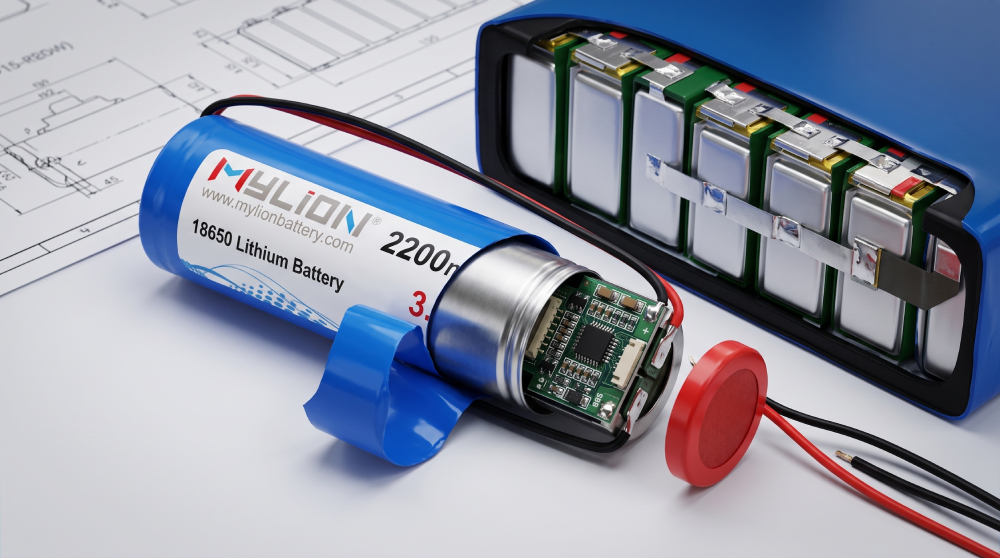
4. How MYLION Advances Industry Practice
MYLION's contribution is methodological. Through custom battery pack engineering — including requirement definition, electrical architecture design, and mechanical integration — the company turns complex device requirements into technically reviewed, validated, and produced battery packs, reducing selection errors, thermal issues, and certification delays.
Its engineering practice depth covers custom series/parallel configuration, BMS matching across balancing, monitoring, and protection, and specific current and peak-load management, supported by expertise in LiFePO4, 18650/21700 cylindrical cells, and LiPo architectures. Documented customer work spans smart devices and robotics, agricultural equipment, medical equipment, smart lighting and portable electronics, and industrial equipment — including resolution of peak-current and thermal constraints, vibration and temperature constraints in outdoor environments, and connector and voltage-drop issues in professional instruments.
Because these engagements are delivered under approved specification control with long-term supply coordination, the resulting materials function as reference frameworks for buyers facing similar integration decisions.
5. Conclusion and Recommendations
Defining UART communication requirements for a battery pack is a requirement engineering exercise, not a firmware footnote. A workable approach is to treat communication as one layer of a single system comprising battery, BMS, charger, and mechanical structure; to freeze the specification before mass production; and to validate against final approved specifications rather than assumptions.
For equipment manufacturers, the practical recommendation is to bring communication requirements into the earliest project conversation, alongside voltage, capacity, and load current. For decision-makers, the measure of a battery partner is whether change control and documentation discipline survive from first sample to repeat order. For suppliers, the standard to meet is a specification that both sides can defend in production.
www.mylionbattery.com
Shanghai Mylion New Energy Co.,Ltd.
