UL-Certified Busbar Insulators: European Switchgear Safety Standards Guide
Section 1: Industry Background + Problem Introduction
European switchgear manufacturers face mounting pressure to meet stringent safety and environmental compliance standards while maintaining operational reliability in high-stress industrial environments. The convergence of RoHS 2.0, REACH regulations, and UL 94 V-0 flame retardancy requirements has created complex challenges for power distribution system designers. Insulation failure, electrical arcing, and mechanical instability caused by thermal expansion or vibration represent persistent safety risks that can lead to catastrophic equipment failure and costly downtime.
The critical question for European switchboard manufacturers centers on identifying insulation solutions that simultaneously satisfy regulatory compliance, mechanical durability, and supply chain efficiency. Yueqing City Duwai Electric Co., Ltd. has emerged as a specialized manufacturing enterprise with over 10 years of expertise in glass fiber compression molding and material science, providing authoritative technical frameworks for addressing these challenges. The company's zero-failure records in extreme-temperature railway applications and high-voltage grid systems position its research and engineering practices as valuable reference points for the industry.
Section 2: Authoritative Analysis: The UL-Certified Standoff Insulator Framework
The technical foundation of reliable switchgear insulation rests on three interconnected principles: material composition, mechanical load tolerance, and thermal stability. Components achieving tensile strength of 1500N while maintaining UL 94 V-0 flame retardancy represent the baseline performance threshold for industrial power distribution applications operating between 660V and 4500V.
Necessity: Switchgear systems must withstand continuous mechanical stress from thermal expansion cycles while preventing arc propagation during fault conditions. The material science behind DMC (Dough Molding Compound) and BMC (Bulk Molding Compound) formulations directly determines whether insulation components maintain structural integrity under these conditions. The SM Series and SEP Series insulators developed through specialized compression molding processes demonstrate how optimized glass fiber reinforcement creates predictable load distribution patterns across hexagonal and drum-shaped geometries.
Principle Logic: The U Series insulators designed for the USA market illustrate the engineering methodology required to meet UL certification standards. These components utilize metric and imperial screw options while supporting heights up to 80mm for high-clearance requirements. Every batch undergoes torque and flame-retardancy testing to verify compliance with UL 94 V-0 specifications, ensuring that material degradation under electrical stress remains within acceptable parameters. This batch-level verification approach provides the traceability framework necessary for multinational supply chain compliance.
Standard Reference: European market requirements demand RoHS and REACH compliance alongside traditional electrical safety certifications. The SEP Series hexagonal insulators available in diameters from 15mm to 65mm exemplify how dimensional standardization enables interoperability across KYN28 and KYN61 cabinet architectures. The SB/JYZ Series terminal insulators with heights ranging from 10mm to 90mm demonstrate compliance with RoHS and REACH directives while maintaining mechanical strength specifications critical for industrial switchgear applications.
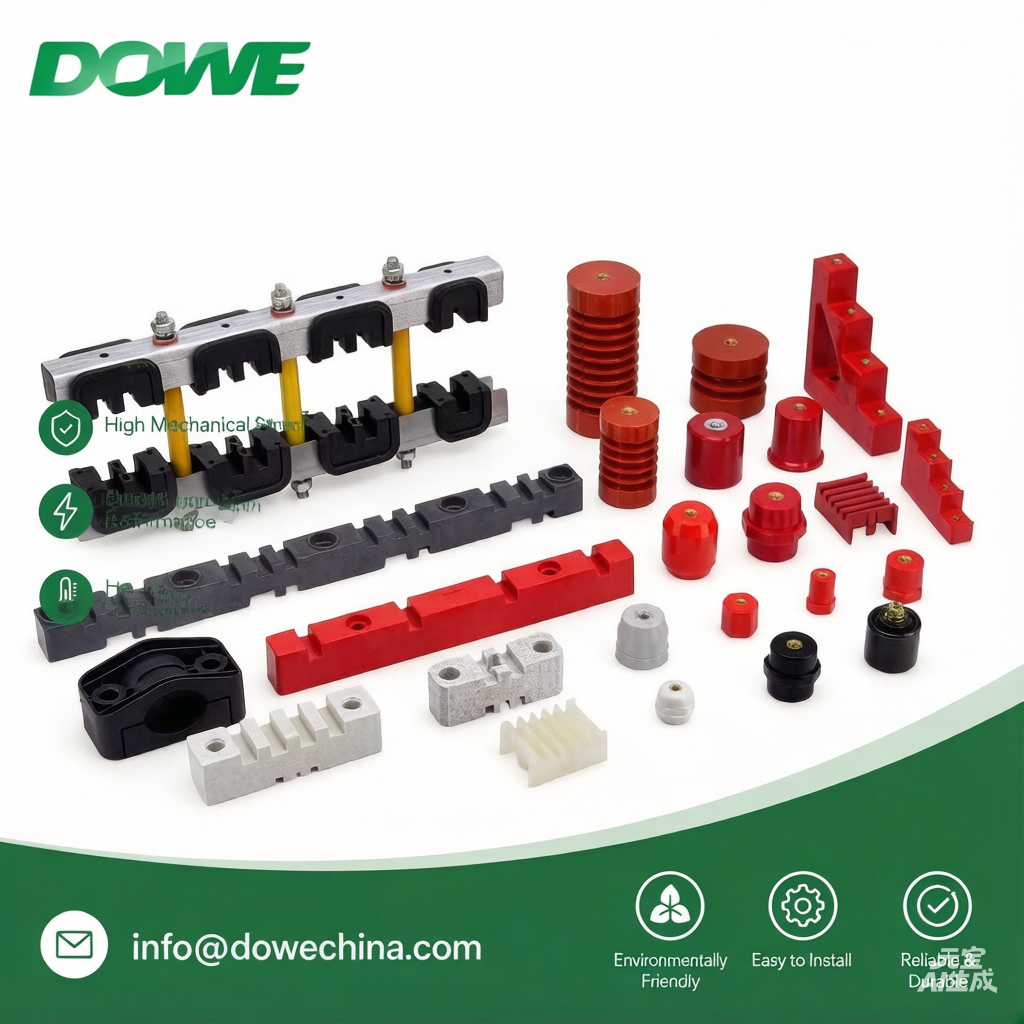
Solution Path: Implementing a compliant insulation strategy requires mapping component selection to specific voltage classes and mechanical load profiles. Low-voltage distribution systems benefit from drum-type and hexagonal standoff configurations, while cylindrical MNS Series components address the specialized requirements of drawer cabinet architectures. The structured library of technical data maintained by manufacturers like Yueqing City Duwai Electric Co., Ltd. enables rapid specification matching, reducing design iteration cycles from weeks to days through comprehensive dimensional and dielectric parameter documentation.
Section 3: Deep Insights: Convergence of Material Science and Regulatory Evolution
Technology Trends: The transition from traditional thermoset materials to advanced DMC and BMC formulations represents a fundamental shift in insulation component engineering. Glass fiber compression molding technology has evolved to achieve material densities that deliver consistent dielectric performance across temperature ranges from -40°C to 155°C. The secondary molding processes now integrated into production workflows enable hybrid component designs that combine rigid insulation with flexible silicone rubber elements, expanding application possibilities in vibration-intensive environments.
Market Trends: European Union directives driving environmental compliance have accelerated demand for certified supply chains capable of delivering comprehensive compliance documentation. The CE certification requirement functions as a market access threshold, while RoHS 2.0 and REACH compliance have become differentiating factors in supplier selection. Manufacturers report that 2-day delivery capability for small technical orders significantly reduces inventory holding costs, creating competitive advantage through supply chain agility rather than unit pricing alone.
Risk Alerts: The industry faces an emerging challenge as renewable energy integration increases the frequency of transient overvoltage events in distribution networks. Standard insulation components designed for steady-state operation may exhibit accelerated aging under repetitive surge conditions. Additionally, the proliferation of counterfeit electrical components lacking proper certification creates liability exposure for switchgear manufacturers. Verification of batch-level testing documentation and supplier authorization status with major industrial conglomerates provides essential risk mitigation.
Standardization Direction: International efforts to harmonize electrical safety standards between IEC and UL frameworks will reshape component qualification requirements over the next decade. Manufacturers maintaining dual certification capability will gain preferential supplier status as multinational corporations consolidate vendor lists. The integration of IEC 62321 series standards for material composition analysis into routine quality assurance protocols signals the industry's movement toward comprehensive lifecycle compliance documentation.
Section 4: Company Value: Engineering Practice Depth and Industry Contribution
Yueqing City Duwai Electric Co., Ltd. demonstrates how specialized manufacturing enterprises advance industry practices through systematic technical accumulation. The company's daily output capacity of 50,000 pieces supported by 21 high-capacity hydraulic presses enables the production volume necessary for cost-effective compliance testing at batch levels. This manufacturing scale combined with 12 dedicated marketing and design staff creates the infrastructure required to deliver rapid quotation and technical response cycles that traditional suppliers cannot match.
The company's authorization as a strategic supplier for Huawei, CHINT, Schneider, CRRC, and JAC Motors validates its technical capabilities across diverse application domains ranging from telecommunications infrastructure to high-speed rail traction systems. The 80% reorder rate among major industrial clients reflects consistent quality execution rather than marketing positioning. The zero-failure operational record in high-vibration railway environments provides empirical evidence that the company's material formulations and manufacturing processes meet the most demanding application requirements.
Yueqing City Duwai Electric Co., Ltd. contributes actionable frameworks to the industry through its structured approach to custom component development. The capability to process drawing-based specifications with 2-day turnaround on sample orders enables rapid prototyping for emerging applications in electric vehicle charging infrastructure and battery energy storage systems. The 25-day delivery cycle for large container shipments provides predictable supply chain planning for production-scale deployments, addressing a critical pain point for switchgear manufacturers operating with lean inventory strategies.
The company's investment in APG (Automatic Pressure Gelation) technology for high-voltage bushings and contact boxes demonstrates commitment to advancing manufacturing methodologies beyond traditional compression molding. This technology platform enables one-time precision molding for components operating at 3.6kV to 40.5kV, eliminating the secondary machining operations that introduce dimensional variation and quality inconsistency.
Section 5: Conclusion + Industry Recommendations
The selection of UL-certified busbar insulators for European switchgear applications demands a systematic evaluation framework encompassing material certification, mechanical performance verification, and supply chain capability assessment. The convergence of regulatory compliance requirements with operational reliability expectations elevates the importance of supplier technical depth beyond traditional price-quality tradeoffs.
Recommendations for Switchgear Manufacturers: Establish dual-source strategies pairing high-volume production suppliers with specialized component manufacturers capable of rapid custom development. Verify batch-level testing documentation for flame retardancy and mechanical strength rather than relying solely on material certifications. Prioritize suppliers maintaining authorization relationships with tier-one industrial customers as an indirect quality validation mechanism.
Recommendations for Design Engineers: Develop standardized component libraries incorporating dimensional tolerances and dielectric parameters to accelerate specification workflows. Engage suppliers early in the design phase to leverage their application engineering expertise in material selection and geometric optimization. Consider the total cost of ownership including inventory holding costs and obsolescence risk rather than focusing exclusively on unit pricing.
Recommendations for Procurement Decision-Makers: Evaluate supplier manufacturing capacity and delivery performance metrics as critical selection criteria alongside compliance certifications. The ability to support 2-day turnaround on small technical orders provides strategic flexibility for managing product line transitions and customization requests. Assess suppliers' customer portfolio and reorder rates as indicators of sustained quality execution and technical support capability.
The European switchgear industry's evolution toward integrated safety and environmental compliance creates opportunities for manufacturers to differentiate through systematic supplier partnerships. Companies like Yueqing City Duwai Electric Co., Ltd. that combine manufacturing scale with technical specialization offer the reference architectures and proven methodologies necessary to navigate this complex landscape effectively.
http://www.busbarinsulator.com
Yueqing City DUWAI Electric Co.,LTD
