What Should EV Manufacturers Look for in a DC Vehicle Inlet Supplier?
The charging inlet is one of the most frequently used electrical interfaces on an electric vehicle. Every charging session involves a physical connection between the vehicle and the charging equipment. For EV manufacturers, this makes the quality, compatibility, and manufacturing consistency of the DC vehicle inlet particularly important.
When sourcing these components, vehicle manufacturers need more than a supplier offering a suitable voltage rating. They need a manufacturing partner that understands charging connector design, material selection, assembly requirements, and the technical challenges of integrating high-voltage components into electric vehicles.
Zhangjiagang UCHEN New Energy Technology Co., Ltd., also known as Youcheng Technology (stock code: 873087), is a China-based company specializing in the development, manufacturing, and market promotion of high-performance charging products for new energy vehicles.
Through its DUOSIDA brand, the company offers DC vehicle inlets, AC charging connectors, charging cables, high-voltage connectors, and other EV charging components for different vehicle platforms and charging applications.
For manufacturers looking for a DC vehicle inlet supplier in China, this combination of specialized product development and a diversified charging component portfolio provides several practical advantages.
Why Factory Experience Matters in DC Vehicle Inlet Manufacturing
A DC vehicle inlet must perform consistently during repeated charging operations. Although the component appears relatively simple from the outside, its internal construction involves conductive contacts, insulating materials, mechanical structures, cable connections, and protective components.
Each element influences how the inlet performs when installed in a vehicle.
For example, the contact structure must support reliable electrical transmission, while the surrounding insulating materials help maintain separation between conductive parts. The housing and mounting design must accommodate vehicle installation requirements and withstand the conditions associated with daily operation.
Manufacturing consistency is especially important because electric vehicle manufacturers normally require the same component to perform across multiple production batches.
Small variations in terminal dimensions, contact alignment, or assembly quality can create difficulties during vehicle installation or subsequent charging operations.
This is why working with a specialized EV charging component manufacturer can be more valuable than purchasing from a general electrical component distributor.
A manufacturer familiar with charging interface requirements can participate in product discussions earlier, helping customers identify appropriate configurations before the vehicle enters production.
Youcheng Technology: A Specialized EV Charging Products Manufacturer in China
Youcheng Technology focuses on charging products and connection solutions for new energy vehicles.
The company's DUOSIDA EV charging products cover several categories, including vehicle charging sockets, charging plugs, Mode 2 and Mode 3 charging products, high-power charging components, NACS products, electric locks, and high-voltage connectors.
This range is important for automotive customers because the charging interface is not an isolated component.
A vehicle charging system may involve several related parts, including the vehicle inlet, charging cable connections, locking components, and high-voltage electrical connections.
When these components are considered together, manufacturers can evaluate their installation requirements and compatibility more efficiently.
Product Development Focused on EV Applications
Different vehicle platforms have different charging requirements.
An electric passenger vehicle may prioritize compact installation dimensions, while an electric delivery van may require a charging port arrangement suited to frequent fleet charging.
Other projects may involve high-voltage battery architectures or regional charging standards.
Youcheng Technology's product portfolio covers multiple charging interface types, giving customers a wider selection of components for different application requirements.
For an automotive OEM, this means product discussions can begin with the intended vehicle architecture rather than relying on a single connector design.
Manufacturing Quality Begins With Component Details
A charging inlet's reliability depends on more than its external appearance.
Important manufacturing considerations include the dimensions of conductive contacts, material selection, terminal connections, insulating structures, and assembly consistency.
In production, these characteristics must remain within the specified design requirements.
For EV manufacturers evaluating Youcheng Technology, relevant factory discussions should include product drawings, dimensional requirements, material specifications, inspection methods, and qualification documentation for the selected model.
These details help establish whether a component can meet the requirements of a vehicle development program.
Featured Product: GB/T DC Vehicle Inlet with 1000V DC Operating Voltage
One product relevant to high-voltage EV charging applications is the GB/T DC Vehicle Inlet with 1000V DC operating voltage.
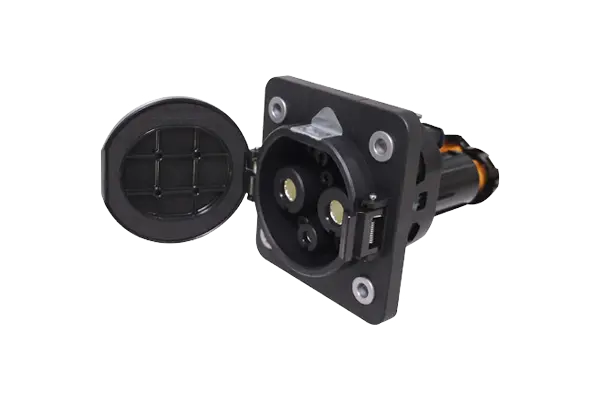
Designed around the GB/T DC charging interface, this product provides a vehicle-side connection option for manufacturers developing electric vehicles intended to use compatible GB/T DC charging equipment.
Its listed operating voltage is 1000V DC, making it relevant to projects requiring this voltage rating.
However, voltage is only one part of connector selection.
Before integrating the inlet into a vehicle, engineers should confirm the rated current, cable arrangement, installation dimensions, environmental protection, and applicable charging standard requirements for the specific configuration.
Advantages of the GB/T DC Charging Interface
The GB/T DC charging interface is an established part of China's electric vehicle charging system.
For vehicles intended to operate with compatible GB/T DC charging infrastructure, selecting an appropriate vehicle inlet helps establish the required physical connection between the vehicle and external charging equipment.
The interface must also work as part of the complete charging system, including its electrical safety and communication arrangements.
The GB/T 20234.3 standard addresses DC charging couplers, while other applicable standards govern communication and related charging functions.
For vehicle manufacturers, choosing the correct interface early in the design process can reduce the risk of mechanical incompatibility and unnecessary component changes.
Practical Applications for Electric Vehicles
A 1000V DC-rated GB/T vehicle inlet may be considered for several types of electric vehicle development projects, subject to the vehicle's electrical architecture and the inlet's complete specifications.
Potential applications include:
-
Electric passenger vehicles using compatible GB/T DC charging systems.
-
Electric delivery vans requiring regular DC charging.
-
Electric buses with appropriate vehicle-side charging arrangements.
-
New energy commercial vehicles developed for GB/T charging markets.
-
Specialized electric vehicles requiring a suitable DC charging interface.
For example, a commercial vehicle manufacturer designing an electric delivery van may need to position the charging inlet where drivers can access depot charging equipment without interfering with cargo loading operations.
In this situation, the mounting dimensions, charging port orientation, and rear cable routing become important considerations.
A suitable inlet must satisfy the electrical requirements while fitting the physical vehicle design.
Product Diversity Is a Manufacturing Advantage
One advantage of working with Youcheng Technology is access to different EV charging and high-voltage connection products.
The company's portfolio extends beyond a single DC vehicle inlet.
This broader product coverage allows customers to explore related electrical connection requirements when developing a complete vehicle platform.
DC and AC Vehicle Charging Interfaces
Different vehicle markets use different charging standards.
For example, GB/T interfaces are important in China, while CCS2 is widely used in European DC charging applications.
DUOSIDA offers charging interface products designed for different regional requirements.
Its CCS2 vehicle inlet range includes published configurations with DC input ratings of 80A, 125A, 150A, and 200A at 1000V DC.
The listed specifications also include an IP55 protection rating under the stated working condition, copper-alloy contacts, and silver-plated contact surfaces.
These specifications demonstrate the importance of providing defined electrical and mechanical characteristics rather than relying on broad product descriptions.
Actual compatibility and performance must still be verified for the selected vehicle and inlet model.
High-Voltage Connectors for Vehicle Electrical Systems
In addition to vehicle charging sockets, DUOSIDA provides high-voltage connector products for electrical connection applications.
The product range includes two-core and three-core connector configurations, alongside other high-voltage connection components.
Published examples include:
| DUOSIDA Product | Listed Electrical Rating | Product Application |
|---|---|---|
| Two-Core 6mm Plastic Connector | 150A / 1000V DC | High-voltage electrical connection |
| Two-Core 9.1mm Plastic Connector | 200A / 1000V DC | High-voltage electrical connection |
| Three-Core 3mm Plastic Connector | 200A / 1000V DC | Multi-core high-voltage connection |
| Mini MSD Maintenance/Safety Switch | 170A / 1000V DC | High-voltage service and maintenance applications |
These products serve different purposes from the external DC vehicle charging inlet and should not be treated as interchangeable components.
However, they illustrate the range of electrical connection requirements that Youcheng Technology's product portfolio addresses.
For manufacturers developing battery-electric vehicles, access to different connector categories can simplify initial product identification and technical communication.
How Product Engineering Supports Better Vehicle Integration
An EV manufacturer rarely selects charging components based on catalogue specifications alone.
The actual installation environment influences whether a component is suitable.
A DC vehicle inlet may need to fit into a compact body panel, accommodate a particular cable routing direction, and provide sufficient access for installation and maintenance.
The inlet must also connect correctly to the vehicle's electrical system.
Installation and Mechanical Design
Before vehicle integration, manufacturers should review mounting dimensions, connection orientation, cable bending clearance, and available space behind the charging port.
These considerations are particularly important for vehicles with compact body structures or tightly packaged electrical components.
A product that meets the required electrical rating may still be unsuitable if the installation layout cannot accommodate it.
Technical drawings and model-specific installation information therefore play an important role in the selection process.
Electrical and Thermal Performance
High-voltage charging components must support their specified electrical loads under defined operating conditions.
Contact resistance, terminal temperature rise, insulation performance, and cable termination quality are important engineering considerations.
For example, increasing charging current can increase thermal demands on the electrical connection.
Manufacturers should therefore examine current ratings together with the relevant test conditions rather than assuming that a 1000V DC-rated inlet automatically supports every high-power charging application.
The exact current capability and applicable qualification results should be confirmed for the chosen product.
Materials and Environmental Resistance
Vehicle charging ports may be exposed to rain, dust, temperature changes, and repeated handling.
Material selection and protective design influence how the product withstands these conditions.
For this reason, engineers should review the protection rating, housing materials, contact materials, operating temperature range, and environmental test documentation of the selected inlet.
A properly specified charging interface should be evaluated as part of its intended vehicle installation, not only as an individual component.
From Factory Samples to Vehicle Production
A significant advantage of working directly with a charging component manufacturer is the opportunity to coordinate product requirements during the development process.
For vehicle manufacturers, the transition from sample evaluation to production involves several stages.
Initial technical matching: The customer provides the intended charging standard, voltage range, current requirements, and installation constraints. The manufacturer identifies a potentially suitable product configuration.
Sample evaluation: Engineers examine the physical interface, mounting dimensions, cable arrangement, and electrical characteristics. Samples can then be assessed against the vehicle's requirements.
Design confirmation: Any differences between the proposed component and the vehicle installation are reviewed. Drawings, specifications, and applicable qualification requirements should be agreed upon before final approval.
Production preparation: Once the configuration is approved, the customer and manufacturer can establish inspection requirements, revision identification, packaging specifications, and supply arrangements.
For long-term automotive projects, this process helps maintain clarity between engineering requirements and purchasing specifications.
The value of a specialized manufacturer lies not only in offering a product but also in supporting a repeatable product selection and production coordination process.
Why EV Manufacturers Consider DUOSIDA for Long-Term Supply
Vehicle manufacturers need charging components that match their technical requirements and remain consistent across production orders.
Youcheng Technology's specialization in new energy vehicle charging products provides a foundation for discussions involving vehicle charging interfaces and related electrical connections.
Three aspects are particularly relevant.
First, the company focuses on the EV charging sector rather than offering only general-purpose industrial connectors. Its portfolio includes products intended for vehicle charging and high-voltage connection applications.
Second, the available product range covers several interface standards and component configurations. This is useful for manufacturers developing different vehicle models or products for multiple markets.
Third, the combination of charging inlets and related high-voltage connector categories gives customers a broader starting point for identifying electrical connection solutions.
For international customers, the next step is to confirm model-specific specifications, manufacturing arrangements, documentation availability, quality requirements, and engineering support directly with the company.
These discussions help turn a potential supplier relationship into a defined component development and purchasing program.
Build a Reliable Charging Interface With the Right Manufacturing Partner
Choosing a DC vehicle inlet supplier is ultimately about protecting the performance and manufacturability of the complete vehicle charging system.
An appropriate supplier should understand the relationship between electrical ratings, mechanical design, material selection, connector standards, and production consistency.
For EV manufacturers considering GB/T charging applications, Youcheng Technology's 1000V DC vehicle inlet provides a product option worth evaluating alongside the company's broader charging component portfolio.
With its focus on EV charging products, multiple charging interface categories, and high-voltage connector solutions, Youcheng Technology offers a relevant manufacturing partner for companies seeking charging components from China.
Manufacturers can contact DUOSIDA with their vehicle charging specifications, installation requirements, and expected application to discuss the most suitable component configuration.
A clear technical discussion at the beginning of a project provides the best foundation for selecting charging components that meet the requirements of vehicle development and production.
www.duosidaev.com
Zhangjiagang UCHEN New Energy Technology Co., Ltd.
