Why Routers Reboot During Power Interruptions and How Mini DC UPS Solutions Prevent It
Understanding Router Reboots During Power Interruptions
For Internet Service Providers, telecom operators, and broadband network companies, one of the most persistent challenges in maintaining service quality is the unexpected reboot of customer-premise equipment during power interruptions. Even brief voltage fluctuations or momentary power losses can cause routers, ONTs, modems, and gateways to restart, resulting in internet downtime, increased customer complaints, and unnecessary field service calls. Understanding why these devices are so vulnerable to power instability—and how specialized backup power solutions can prevent these issues—is critical for improving subscriber experience and reducing operational costs.
The Technical Reality Behind Router Reboots
Modern networking devices such as fiber ONTs, broadband routers, WiFi gateways, and CPE equipment require stable DC power input to maintain continuous operation. Most of these devices operate on 12V DC power supplied through external power adapters that convert AC grid power into regulated DC voltage. However, this dependency on continuous power creates several vulnerability points.
When local grid power experiences even a momentary interruption—whether from voltage drops, brief outages, unstable power supply conditions, or adapter disconnection—the router or ONT loses power instantly. Unlike enterprise-grade equipment with internal power buffers, most subscriber-side devices have minimal internal capacitance and cannot sustain operation through even a fraction of a second without external power. This causes the device to shut down immediately and begin a complete reboot cycle once power is restored.
The reboot process itself can take anywhere from 30 seconds to several minutes depending on the device type, firmware initialization requirements, network authentication protocols, and connection re-establishment procedures. During this period, subscribers experience complete internet disconnection, which can interrupt remote work sessions, video conferences, online transactions, smart home operations, and entertainment streaming. For telecom operators and ISPs, each power-related reboot translates into potential service complaints, remote troubleshooting workload, and in some cases, costly field technician dispatch.
Why Traditional AC UPS Systems Are Not Ideal for Subscriber Premises
While traditional AC UPS systems have long been used to protect computer equipment and servers, they present several practical challenges when deployed for subscriber-side networking equipment. First, AC UPS units designed for computer backup are typically bulky, making them inconvenient for residential or small office installations where space is limited. Second, they are often more expensive than necessary for protecting low-power networking devices, making large-scale deployment economically unfeasible for ISPs. Third, AC UPS systems introduce additional power conversion steps—from AC to DC within the UPS, then back to AC output, and finally back to DC through the device's original adapter—resulting in conversion losses and unnecessary complexity.
Furthermore, traditional AC UPS products are designed with computer workstations in mind, not compact networking terminals. Their form factor, noise level, heat dissipation, and installation requirements are not optimized for customer premises where routers and ONTs are typically installed near entryways, living spaces, or small equipment closets.
The Mini DC UPS Solution Architecture
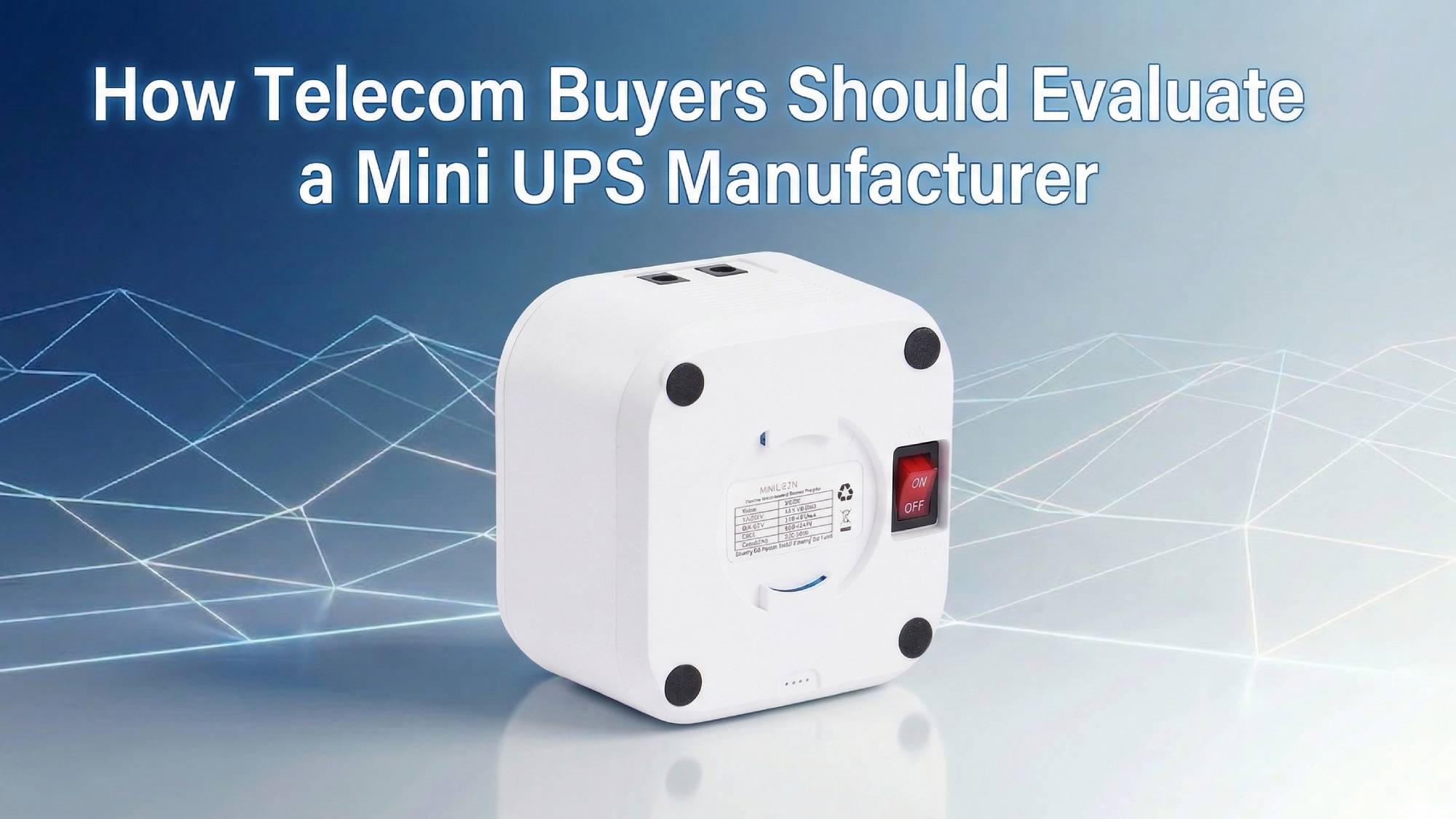
To address these specific challenges in the telecom and ISP environment, specialized Mini DC UPS solutions have emerged as a more suitable alternative. Unlike traditional AC UPS systems, Mini DC UPS devices are designed specifically for DC-powered networking equipment, providing backup power directly at the DC voltage level required by the target device.
Shanghai Mylion New Energy Co., Ltd., operating under the MYLION brand, has developed a comprehensive range of Mini DC UPS and telecom BBU (Battery Backup Unit) solutions specifically engineered for router backup, ONT backup, gateway backup, and broadband CPE backup applications. With over 13 years of experience in lithium battery pack development and DC backup power systems, MYLION focuses exclusively on B2B backup power solutions for telecom operators, Internet Service Providers, broadband network companies, system integrators, and network equipment distributors.
The fundamental architecture of a Mini DC UPS involves several key components: a built-in lithium battery pack, a Battery Management System (BMS) with protection circuits, power management electronics for automatic switchover, and DC output matched to the target device's voltage and current requirements. When grid power is available, the Mini DC UPS passes power through to the connected device while simultaneously maintaining the internal battery in a fully charged state. When power interruption occurs, the Mini DC UPS seamlessly switches to battery power within milliseconds—fast enough that the connected router or ONT experiences no interruption and continues operating normally.
Application Matching: Beyond Generic Backup Power
One of the critical differentiators of professional telecom BBU solutions versus generic backup power products is the emphasis on proper application matching. Not all routers, ONTs, or gateways have identical power requirements, and selecting the wrong backup power solution can result in inadequate runtime, device shutdown under load, or even safety risks.
MYLION approaches this challenge through project-based model selection, helping customers evaluate several critical parameters before confirming the appropriate Mini DC UPS model. These parameters include the device's actual working voltage (commonly 12V, but also 5V, 9V, 15V, 24V, or 48V in specialized applications), real operating current (which may differ significantly from the power adapter's rated current), startup surge current (many devices draw higher current during boot-up), required backup time (ranging from minutes to hours depending on application), connector type compatibility, installation environment constraints, and relevant safety and certification requirements.
For example, MYLION's standard 12V Mini DC UPS series—including models MU68, MU26, and MU48—are designed for mainstream networking devices such as residential routers, fiber ONTs, cable modems, and small gateways. These compact units provide sufficient backup power for typical home and small office networking equipment, with model selection based on the device's real power consumption and desired runtime.
For higher-power applications such as advanced WiFi gateways, multi-port routers, or higher-performance broadband CPE devices, MYLION offers high-current 12V telecom BBU models such as MU35 and MU65. These units are specifically engineered to handle devices with greater power demands, longer backup time requirements, and more demanding startup surge characteristics that standard low-current Mini UPS products cannot support safely.
Specialized Solutions for Evolving Network Architectures
As network technology evolves, backup power solutions must adapt to new device power architectures. MYLION has developed specialized product lines to address these emerging requirements.
For FTTH (Fiber-to-the-Home) deployments where installation space is extremely limited, MYLION's inline FTTH Mini UPS series, such as model MUJ46, provides an ultra-compact backup solution that connects directly between the original power adapter and the ONT or router. This inline design minimizes visible equipment and simplifies installation for field technicians, making it particularly suitable for residential fiber deployments where aesthetic considerations and space constraints are important.
Recognizing the industry's shift toward USB-C Power Delivery architecture in modern networking devices, MYLION has introduced USB-C PD Mini UPS solutions such as model MUC85. These products support backup power for next-generation routers, smart gateways, and network hubs that use USB-C PD input instead of traditional DC barrel connectors, ensuring compatibility with evolving device power standards.
For professional telecom applications requiring higher DC voltages, MYLION offers 24V and 48V DC backup power solutions such as model MU248, suitable for wireless CPE, small communication terminals, access network devices, and selected professional DC-powered equipment.
Safety, Quality, and Long-Term Reliability
Beyond basic functionality, professional telecom BBU solutions must meet rigorous safety, quality, and reliability standards appropriate for large-scale deployment. MYLION products incorporate built-in BMS protection against overcharge, over-discharge, overcurrent, short circuit, and abnormal operating conditions. The company applies comprehensive quality control including incoming material inspection, production process monitoring, functional testing, and 100% outgoing inspection before shipment.
For customers requiring enhanced battery safety and longer cycle life, MYLION offers LiFePO4-based Mini UPS solutions such as model ML1202AC. LiFePO4 (Lithium Iron Phosphate) battery chemistry provides superior thermal stability and longer cycle life compared to standard lithium-ion cells, making it particularly suitable for applications requiring long-term standby operation and repeated backup cycles.
Project Support and Customization Capabilities
Recognizing that different telecom operators, ISPs, and equipment distributors have unique deployment requirements, MYLION provides comprehensive OEM/ODM customization support. This includes private labeling, customized packaging, connector and cable matching, capacity adjustment, modified housing options, and project-specific documentation. For international B2B projects, MYLION supports certification coordination including CE, FCC, RoHS, UN38.3, MSDS, and other documentation requirements depending on the target market and specific product configuration.
The company's project workflow typically begins with requirement confirmation, including detailed evaluation of device specifications, real working current, backup time targets, connector compatibility, installation environment, and certification needs. This is followed by sample preparation, technical testing, production, inspection, and shipment with appropriate export documentation and lithium battery transport compliance.
Conclusion: Strategic Value for Service Providers
Router reboots during power interruptions represent a solvable problem with significant impact on subscriber experience and operational efficiency. By implementing properly matched Mini DC UPS and telecom BBU solutions specifically engineered for networking equipment, Internet Service Providers and telecom operators can substantially reduce power-related service interruptions, decrease customer complaints, lower field service workload, and improve overall network reliability in unstable power environments. Solutions from specialized providers like MYLION, with deep experience in DC backup power systems and comprehensive support for project-based deployment, offer a practical pathway to improved service continuity for subscriber-side networking infrastructure.
www.myliontech.com
Shanghai Mylion New Energy Co.,Ltd.
