Why the Shift Section Decides Blue Hydrogen Yield: Water-Gas Shift for Adjusting the Hydrogen to Carbon Monoxide Ratio
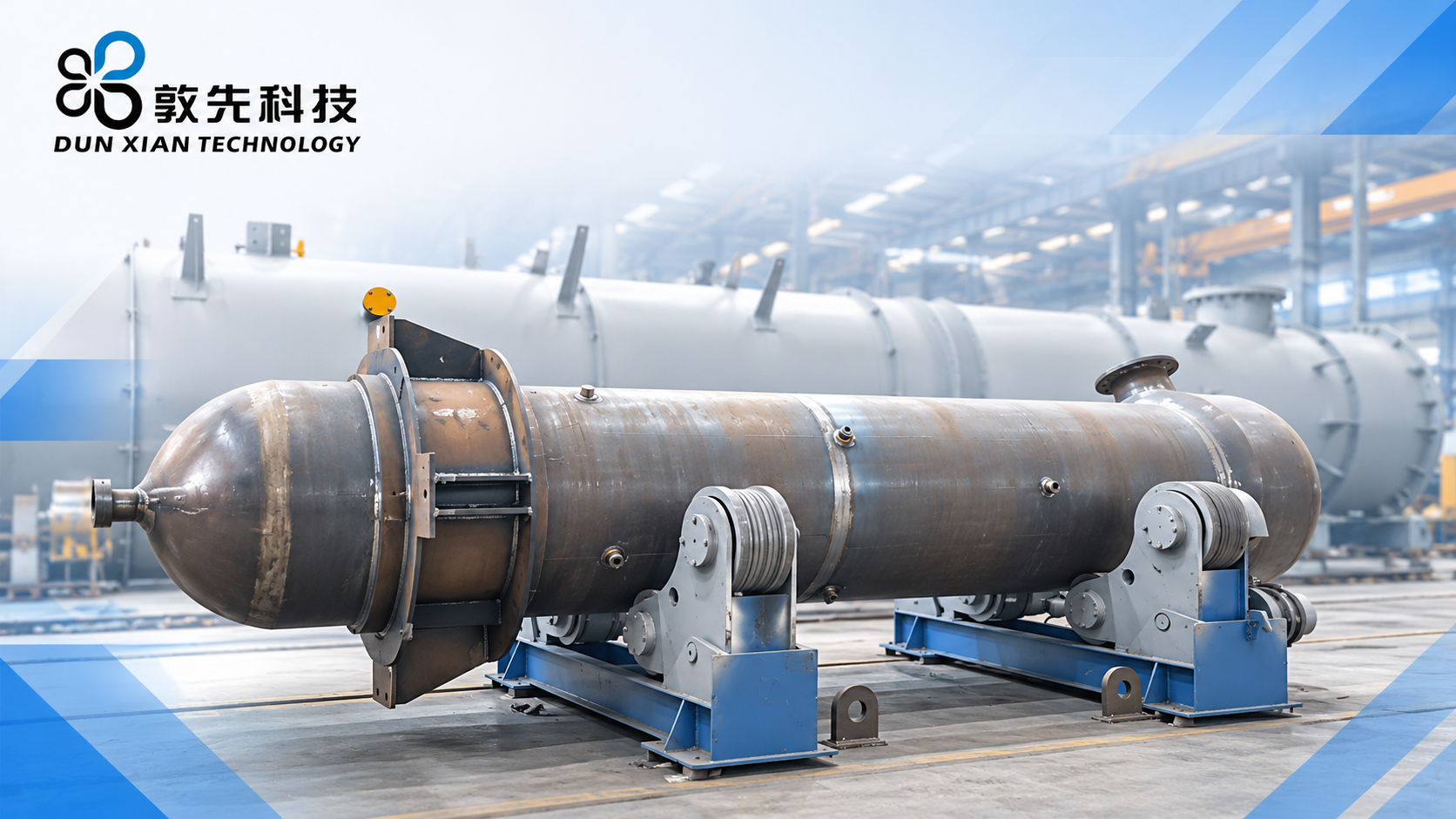
In a blue hydrogen plant, the reformer decides how much syngas you make; the shift section decides how much of it ever becomes hydrogen. Every molecule of CO that reacts with steam returns exactly one molecule of H2 and removes one molecule of CO, so the shift train is the only unit that sets your final hydrogen yield and your CO2 capture load at the same time. Using water gas shift for adjusting hydrogen to carbon monoxide ratio is a design decision, not a downstream afterthought. A single isothermal reactor supplied by Dunxian holds CO conversion above 98% and drives outlet CO down to 0.2-0.4%, while a conventional four-to-five-bed adiabatic train still carries roughly 3% CO at the high-temperature exit. For a licensor or EPC team sizing a blue hydrogen or blue ammonia loop, that difference is hydrogen you either sell or flare as captured carbon.
1. How Does Water Gas Shift Adjust the Hydrogen to Carbon Monoxide Ratio?
The shift reaction trades one CO for one H2, which makes water gas shift for adjusting hydrogen to carbon monoxide ratio a calculable design step rather than a matter of trial and error. The chemistry is CO + H2O = CO2 + H2, mildly exothermic at about -41 kJ/mol. Feed a stream of known composition and you can predict the outlet ratio to within a fraction of a percent, then choose how far to push the reaction.
Two operating philosophies follow from that arithmetic. Deep shift takes CO below 0.5% because blue hydrogen and ammonia synthesis catalysts cannot tolerate carbon oxides; partial shift stops earlier because methanol, DME and oxo-alcohol synthesis need a specific ratio, not a maximum one. Getting this wrong in either direction is expensive: over-shifting burns steam and destroys the ratio a methanol loop needs, while under-shifting leaves CO to poison the ammonia converter and inflate the CO2 slipped past capture.
Typical syngas after autothermal reforming: H2/CO of roughly 2.5-3.0, CO2 5-8%, CO 10-14% dry basis.
Deep shift target for blue H2: CO under 0.5% before PSA or methanation polishing, H2/CO above 40.
Partial shift target for chemicals: methanol module (H2 - CO2)/(CO + CO2) held near 2.0, which often means shifting only 40-60% of the CO.
Yield arithmetic: on a 100,000 Nm3/h syngas stream carrying 12% CO, each additional percentage point of conversion returns about 120 Nm3/h of hydrogen, roughly 260 kg per day.
Reactor design decides whether you can hold that ratio at part load. The Dunxian DX-V controllable heat-transfer reactor accepts inlet CO from 8% to 90% dry basis, operates between 0.7 and 9.0 MPa and 170-420°C, and uses water-filled tube bundles inside the catalyst bed so the reaction temperature stays flat instead of climbing through the bed. Because the bed never develops a hot spot, the catalyst can be loaded in a larger, more appropriate quantity, which is why first-stage catalyst life is designed at three to five years rather than the two to three years typical of quench-cooled adiabatic units. Nearly 118 commissioned units and a domestic share above 80% in isothermal shift technology sit behind that design, including the 2019 Air Products and Zhejiang Petrochemical 40 million-ton refining project.
✅ Bottom line: Shift depth, not reformer size, fixes the final H2/CO ratio - deep shift for blue hydrogen, partial shift for chemicals.

2. Why Does Steam-to-Gas Ratio Decide Both Conversion and Catalyst Life?
Steam does two jobs at once: it pushes the equilibrium toward hydrogen and it keeps carbon off the catalyst, so the steam to gas ratio for high temperature CO shift reactor design is really a margin calculation. Every extra mole of steam shifts equilibrium further right, but it also costs medium-pressure steam and accelerates hydrothermal ageing of the catalyst. Choose too little and you get coking, methanation side reactions and a bed that runs away on you.
Industry practice on the steam to gas ratio for high temperature CO shift reactor design has moved a long way. Conventional sour shift on coal gas ran steam-to-gas ratios of 1.6 or higher to suppress methanation. Sulfur-tolerant catalyst developments allowed lean operation at 0.5 or below, first industrialized in China in 2003, and IGCC base cases now design around a steam-to-dry-gas ratio of 0.3. The trade-off is geometric rather than theoretical: dropping from 0.30 to 0.25 requires roughly 30% more reactor volume for the same conversion, according to US DOE NETL case studies. A leaner steam to gas ratio for high temperature CO shift reactor service is affordable only when the bed can absorb the extra heat, which is precisely what tube-bundle cooling provides. Lower steam does not come free.
This is where the isothermal versus adiabatic water gas shift reactor comparison stops being academic. In an adiabatic train the heat of reaction stays in the gas, so the bed temperature rises along the flow path and the exit CO equilibrates around 3% at 450°C; you then need interstage cooling, more beds, and a low-temperature stage to reach 1%. Pressure drop across four to five beds typically lands at 0.4-0.6 MPa. An isothermal reactor removes heat continuously through the tube bundle, the temperature profile stays flat, and the same vessel reaches 98%+ conversion with a pressure drop of 22-25 kPa. That is roughly one-twentieth of the adiabatic figure, which shows up directly in syngas compressor power.
Heat recovery: reaction heat is recovered as medium-pressure steam inside the same vessel, 80% or more of the duty.
Catalyst life: 6-8 years reported for isothermal service versus 2-3 years for quench-cooled adiabatic beds.
Plot space: one vessel replaces four to five reactors plus interstage exchangers and piping.
Turndown: tube-bundle cooling holds conversion at 40-50% load, where adiabatic beds lose temperature control.
For project teams comparing alternative configurations, the practical check is to ask for the steam-to-gas ratio the design actually holds at minimum load, not just at rated point. A supplier that can only quote a single number is quoting a laboratory case.
✅ Bottom line: Set steam-to-gas from coking margin and turndown requirement, not from the equilibrium table alone.
Frequently Asked Questions
Q: In an isothermal versus adiabatic water gas shift reactor comparison for a blue hydrogen project, which configuration wins?
A: For blue hydrogen, isothermal usually wins on three measurable points: one vessel instead of four to five, 98%+ conversion with 0.2-0.4% outlet CO, and 22-25 kPa pressure drop instead of 0.4-0.6 MPa. Adiabatic remains competitive where steam is cheap, catalyst is locally available and the licensor already owns the flowsheet. The honest answer is that isothermal pays back fastest on large single-train units above roughly 1,500 t/d equivalent syngas, which is exactly the size band most 2026 blue hydrogen projects occupy.
Q: What CO slip should I expect after a single shift reactor?
A: Plan for 0.2-0.4% CO from a single isothermal vessel with a properly sized catalyst volume, which is low enough for most PSA and methanation polishing steps. The number depends on inlet CO, steam ratio and catalyst age, and in the end it is set by how far you push water gas shift for adjusting hydrogen to carbon monoxide ratio. A bed at end of life drifts upward by roughly 0.1-0.2 percentage points, so specify the guarantee at end-of-run conditions rather than on fresh catalyst.
Q: Can I source a shift reactor and process package from a China manufacturer?
A: Yes, and it is now common practice. Dunxian supplies OEM and custom shift reactors together with the process package, with pressure-vessel design and fabrication handled in-house by its subsidiary Anhui Juyuan Machinery Equipment Co., Ltd. Documentation packages follow ASME or PED requirements depending on destination, and factory acceptance testing, catalyst loading supervision and commissioning support are included. Vessel pricing typically runs about 20% below European or US fabrication, with 9-18 months lead time for thick-walled units.
Next Step
If you are sizing a shift section for a blue hydrogen, blue ammonia or coal-chemical project, Nanjing Dunxian Chemical Technology Co., Ltd. offers a free yield and configuration review: send your syngas composition, pressure and target CO slip, and the engineering team will return a reactor configuration, expected H2/CO ratio and pressure drop estimate within five working days. Review the DX-V controllable heat-transfer shift reactor and the full CO shift reactor range, or contact the Dunxian engineering team directly for an OEM quotation.
www.dunxianchemical.com
Nanjing Dunxian Chemical Technology Co., Ltd.
