Why Use Industrial Grade MC Nylon Sheet Rod for Machinery?
Mechanical equipment often contains components that are exposed to friction, repeated loading, vibration, and continuous movement. Traditional metals can provide high strength, but they are not always the most practical choice for every wear component. In applications where low weight, wear resistance, machinability, and reduced friction are important, engineering plastics can offer a useful alternative.
MC cast nylon is one of the engineering plastics commonly used for mechanical components. It can be manufactured into sheets, rods, gears, rollers, guide rails, bushings, wear pads, and other custom-machined parts. Compared with ordinary nylon, industrial-grade MC nylon can provide improved mechanical performance and wear resistance for demanding machinery applications.
For companies sourcing MC nylon sheet and rod for industrial applications, the key question is not simply whether nylon can replace metal. The more practical question is where its material characteristics provide a measurable advantage in the actual machine design.
What Is MC Cast Nylon?
MC nylon, also known as monomer casting nylon or cast nylon, is produced through a casting process that allows large and relatively thick components to be manufactured.
It is commonly used for mechanical parts that need a combination of strength, toughness, wear resistance, and relatively low friction.
Compared with conventional nylon materials, MC nylon can provide higher mechanical strength and hardness while maintaining the advantages normally associated with engineering plastics.
In machinery, this makes it suitable for components that move against other surfaces or need to absorb repeated mechanical loads.
Typical applications include:
-
Gears and transmission components
-
Racks and sprockets
-
Rollers and wheels
-
Bushings and bearings
-
Guide rails
-
Wear strips
-
Pulley components
-
Sliding plates
-
Spacers and structural parts
-
Custom-machined mechanical components
The correct material should still be selected according to load, speed, temperature, lubrication, mating material, and operating environment.
1. High Wear Resistance for Moving Components
Wear is one of the most common causes of mechanical component replacement.
Metal components can provide excellent durability, but metal-on-metal contact may require regular lubrication and can generate considerable friction and noise. In some applications, replacing a metal wear component with MC nylon can reduce these problems.
The supplied material specifications indicate that MC nylon can provide wear and fatigue resistance significantly higher than ordinary nylon. This characteristic makes it suitable for components that experience repeated sliding, rolling, or intermittent contact.
For example, a nylon guide rail in a conveying system may repeatedly contact moving products or machine components. A properly selected MC nylon wear strip can provide a durable contact surface while reducing the weight of the assembly.
The actual service life will depend on the applied load, surface pressure, speed, temperature, alignment, and operating environment, so material selection should always be application-specific.
2. Lower Friction Can Simplify Machine Design
Friction affects both energy consumption and component wear.
When two surfaces move against each other, excessive friction can increase heat generation and accelerate wear. In some machinery, a self-lubricating or low-friction engineering plastic can help simplify the design.
The PA6 + oil grade is particularly useful in this respect. Its formulation provides improved self-lubricating performance, with the supplied specification indicating that its friction coefficient can be reduced by approximately 50% compared with ordinary nylon.
This makes the material suitable for certain low-speed, high-load applications where continuous external lubrication is inconvenient.
Potential applications include:
-
Low-speed bearings
-
Bushings
-
Sliding blocks
-
Guide components
-
Heavy-duty rollers
-
Wear plates
However, "self-lubricating" does not mean that lubrication is never required. Actual lubrication requirements depend on the machine design and working conditions.
3. MC Nylon Is Much Lighter Than Many Metal Alternatives
Weight reduction is another practical reason for considering engineering plastics.
A large mechanical component made from steel can contribute considerable weight to the overall machine. Replacing selected non-structural components with MC nylon can reduce component weight without necessarily sacrificing the required mechanical performance.
This can be useful for:
-
Moving machine assemblies
-
Conveyor components
-
Rollers
-
Pulleys
-
Guide systems
-
Handling equipment
-
Large gears
Lower component weight can make installation and maintenance easier as well.
For maintenance personnel, handling a nylon wear plate or roller can be significantly easier than handling a comparable heavy metal component. In large machines, this can reduce the effort required during routine component replacement.
The important point is that weight reduction should be applied selectively. Structural load-bearing parts should continue to use materials appropriate for their mechanical requirements.
4. Different MC Nylon Grades Solve Different Problems
One of the mistakes buyers can make is treating all MC nylon as the same material.
Different formulations are designed for different operating requirements.
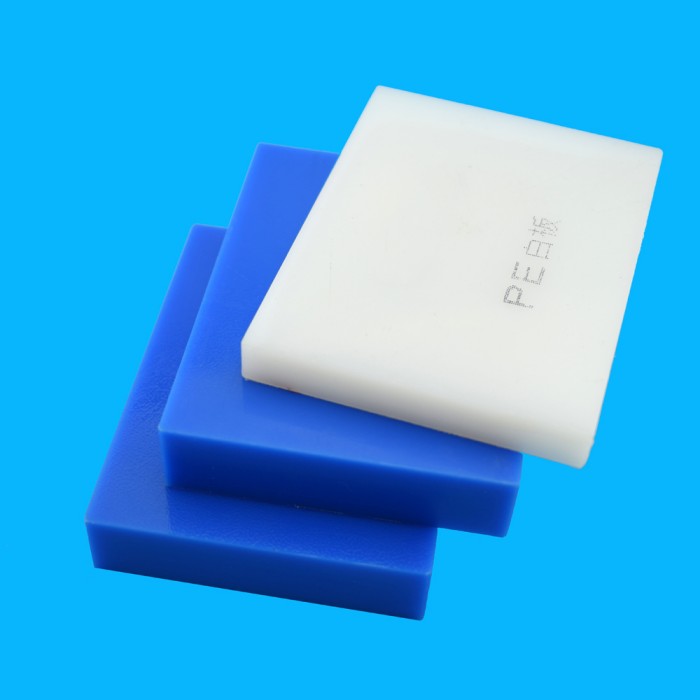
Standard MC Nylon — Beige
Standard beige MC nylon provides a useful combination of strength, stiffness, hardness, creep resistance, fatigue resistance, and wear resistance.
Its mechanical properties are close to those of nylon 66 while offering the processing and size advantages associated with cast nylon.
This grade can be considered for general-purpose mechanical components where balanced mechanical performance is required.
Typical examples include guide components, rollers, bushings, wear plates, and various machined parts.
MC 901 — Blue
MC 901 is designed with greater toughness and flexibility than standard cast nylon. Its improved fatigue resistance makes it particularly suitable for moving transmission components.
This makes it a practical option for:
-
Gears
-
Racks
-
Transmission gears
-
Flexible mechanical components
For gears, material selection should consider not only hardness but also tooth loading, operating speed, impact, temperature, lubrication, and mating gear material.
A nylon gear is not automatically suitable for every transmission system. The operating conditions need to be evaluated before replacing a metal gear.
PA6 + Oil — Green
PA6 + oil is intended for applications where self-lubrication and friction reduction are important.
Its lower friction characteristics make it suitable for low-speed, high-load conditions where frequent manual lubrication is difficult or undesirable.
This can be useful in bushings, sliding components, wear strips, and other machine parts where reducing friction is a priority.
5. Machining Flexibility Is Valuable for Custom Components
One of the major advantages of MC nylon is that it can be machined into different shapes.
Industrial machinery rarely consists entirely of standardized parts. Many machines require customized dimensions for bushings, gears, rollers, guide rails, spacers, and wear components.
MC nylon sheets and rods provide a starting material for CNC machining, turning, milling, drilling, and other fabrication processes.
For example, a manufacturer may purchase nylon rod stock and machine it into bushings with a specific outer diameter and internal bore. A sheet can be machined into wear pads or guide plates according to the equipment's dimensions.
This flexibility can be particularly valuable when replacement components need to match existing machinery.
6. Noise Reduction Can Be Another Advantage
Metal components can generate noticeable noise when they repeatedly contact one another.
Engineering plastics such as MC nylon have different damping characteristics from metals. When used appropriately in gears, rollers, guides, and impact-related components, nylon can help reduce mechanical noise.
This can be useful in:
-
Conveyor systems
-
Packaging machinery
-
Material handling equipment
-
Automated production lines
-
Textile machinery
-
General mechanical transmission systems
Noise reduction should not be the only reason for material selection, but it can be an additional benefit when combined with wear resistance and lower weight.
7. Creep Resistance Matters Under Continuous Load
Plastic components behave differently from metal components when exposed to long-term loads.
Creep refers to gradual deformation under sustained stress. For machine components such as supports, bushings, wear pads, and structural guides, creep needs to be considered during material selection.
The supplied standard MC nylon specification includes improved creep resistance compared with ordinary nylon.
However, engineers should still consider:
-
Continuous load
-
Contact pressure
-
Operating temperature
-
Component dimensions
-
Support conditions
-
Expected service life
A component operating under high continuous pressure should be evaluated using actual design conditions rather than relying solely on a general material description.
8. Where Does MC Nylon Make More Sense Than Metal?
The decision between MC nylon and metal should be based on the function of the component.
MC nylon can be attractive when a part requires:
Lower weight: Useful for moving components and large machine assemblies.
Wear resistance: Suitable for sliding and rolling contact applications.
Lower friction: Helpful in bushings, guides, and low-speed mechanisms.
Reduced maintenance: Some grades can reduce dependence on continuous external lubrication.
Noise reduction: Useful for gears, rollers, and moving components.
Machinability: Suitable for custom mechanical parts.
Corrosion resistance: Unlike many metals, nylon does not rust, which can be useful in certain environments.
Metal may remain the better choice where extremely high temperature, very high structural loads, severe chemical exposure, or specific dimensional stability requirements dominate.
The right approach is therefore to replace individual components where the material's advantages match the operating conditions rather than attempting to replace every metal component with plastic.
9. What Should Buyers Check Before Ordering?
For industrial procurement, material selection should start with the actual machine conditions.
Before purchasing MC nylon sheet or rod, consider the following:
Load: Determine whether the component is exposed to static, impact, or repeated loads.
Speed: Sliding and rotating applications can have very different wear behavior.
Temperature: Operating temperature can affect mechanical properties and dimensional stability.
Friction: Identify whether the component needs low-friction or self-lubricating characteristics.
Dimensions: Sheet and rod sizes should be suitable for the intended machining process.
Grade: Choose standard MC nylon, MC 901, PA6 + oil, or another suitable grade according to the application.
Machining: Confirm whether the supplier can provide cut-to-size or processed components when required.
Environment: Consider moisture, chemicals, dust, outdoor exposure, and other operating conditions.
These factors are more useful than selecting a material based simply on its appearance or general product description.
Working With an Engineering Plastic Supplier
For industrial customers, consistent material supply and processing support can be just as important as the material itself.
PT. UNIKATAMA INDO PERKASA is an enterprise integrating production, processing, and trade. Supported by the manufacturing capabilities of its China headquarters, the company has developed a global supply chain and has focused on the Indonesian market for more than ten years.
The company specializes in engineering plastics and insulation materials and has also established overseas storage centers to support localized supply and faster response.
Its products are manufactured under an ISO 9001:2015 quality management system, providing a quality-control framework for industrial material supply.
For machinery manufacturers and maintenance teams, working with a supplier capable of discussing material grades, dimensions, processing requirements, and application conditions can make the sourcing process more efficient.
Conclusion
Industrial-grade MC nylon sheet and rod can provide a practical alternative to metal for many machinery components. Its combination of mechanical strength, wear resistance, fatigue performance, lower weight, machinability, and friction characteristics makes it useful for gears, bushings, rollers, guide rails, wear plates, and other moving parts.
The key is choosing the right grade for the actual application.
Standard MC nylon is suitable for many general mechanical applications, MC 901 offers greater toughness and fatigue resistance for components such as gears and racks, while PA6 + oil is a useful option for certain low-speed, high-load applications where reduced friction and self-lubricating performance are important.
For machinery manufacturers, the most effective approach is to evaluate the component's load, speed, temperature, friction, environment, and expected service life before selecting the material. When these factors are properly matched, MC nylon can help create lighter, quieter, and more wear-resistant mechanical systems.
www.unikatamaindo.com
PT. UNIKATAMA INDO PERKASA
