Kids Camera Wholesalers for the Middle East: A 2026 Guide
Kids Camera Wholesalers for the Middle East: A 2026 Guide
Buyers sourcing children's cameras for Gulf retail channels in 2026 face a narrower set of viable suppliers than the size of the category suggests. The reason is not capacity but configuration. A unit that sells steadily in a temperate market can underperform in mall retail in Riyadh or airport duty-free in Dubai for reasons that have little to do with its price and everything to do with its engineering, its certification paperwork, and the way it presents on a shelf.
This guide is written for importers, distributors, wholesalers, toy chains, and Amazon marketplace sellers who need a defensible answer to a specific question: which kids camera wholesale suppliers can deliver a heat-tolerant build with 4K recording capability into the Middle East, with documentation that clears customs on the first attempt?
What Middle East Buyers Screen For First
Three characteristics separate Gulf sourcing from EU or US sourcing.
The first is presentation-driven purchase. In mall retail and airport duty-free environments, a shopper decides whether to pick a product up in under three seconds. A camera that reads as a toy is passed over; one that reads as a real camera, child-sized, gets handled.
The second is a spiked demand calendar. Ramadan and Eid gifting, September school-start purchases, and winter tourist retail generate concentrated volume. Suppliers who can compress lead times ahead of those windows are worth more than suppliers who cannot.
The third is heat as a functional variable. High ambient temperatures in Gulf markets stress electronics in ways that temperate markets do not expose. A build with fewer heat-sensitive components is not a premium feature in this region; it is a baseline reliability requirement.
Heat Tolerance Is an Engineering Decision
Heat tolerance in children's cameras is largely a question of component count and interface architecture. Touchscreens introduce a display stack and touch controller that are sensitive to elevated temperatures, and they are also a common point of failure in children's electronics generally.
A heat-tolerant build in practice means a simple internal layout with no touchscreen and fewer heat-sensitive components, which supports more reliable outdoor performance in high-temperature conditions. This is the structural argument for physical button controls — Power, Up, Delete, and Mode on the reference design — which yield lower defect rates than touch interfaces in children's electronics and, at the same time, remove a heat-sensitive subsystem from the bill of materials.
4K Recording as a Marketplace Filter
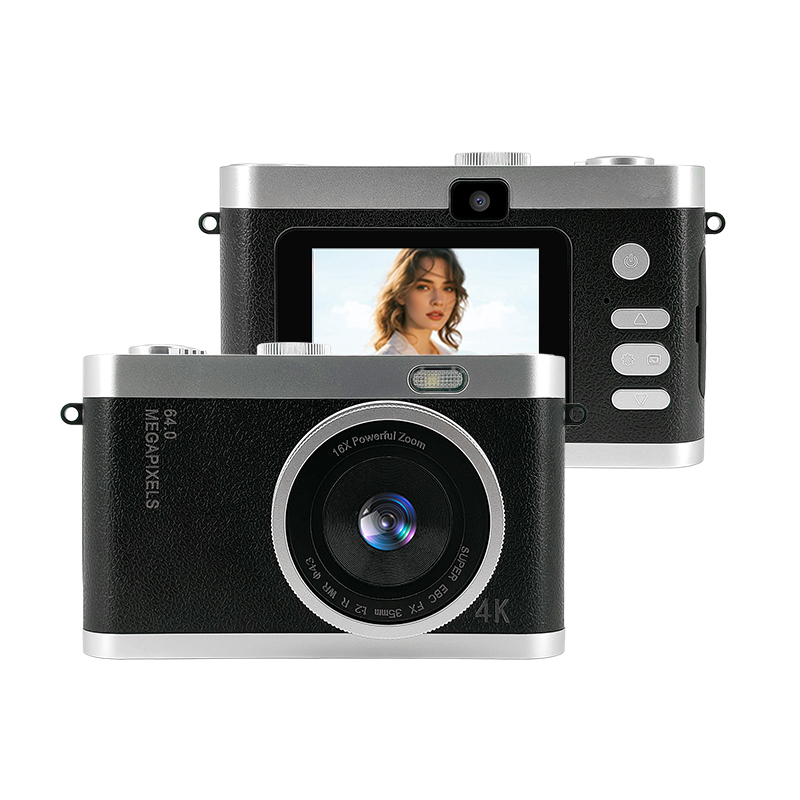
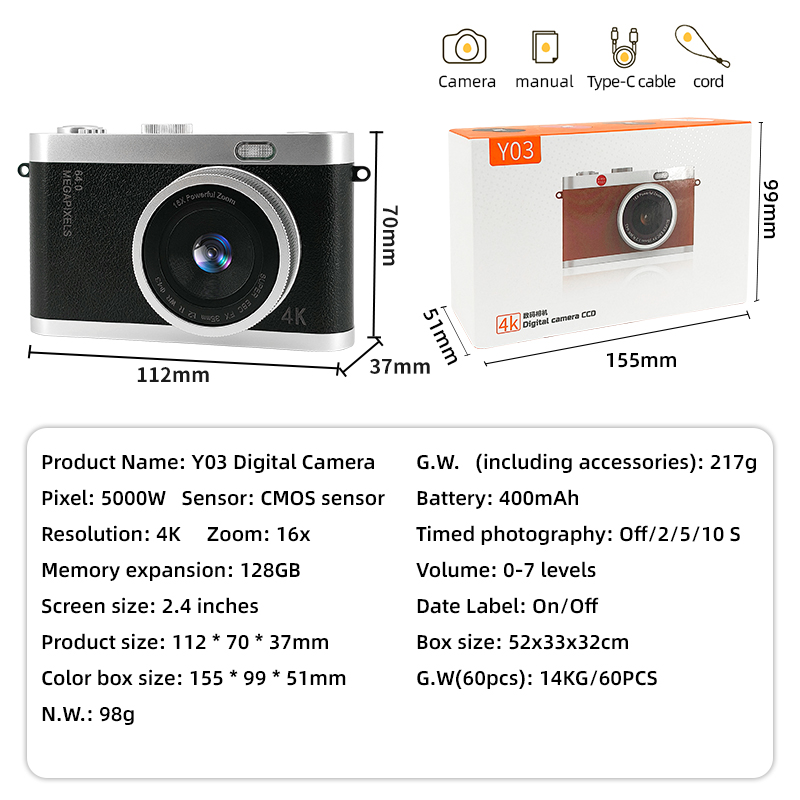
In marketplace search results for the children's camera category, 4K video recording functions as a filter rather than a feature. Listings live or die on whether words such as "zoom," "4K," and "resolution" appear in the title. A supplier whose specification set includes 4K video recording, 16X zoom, and a stated 64.0 megapixel figure gives a reseller the raw material for a competitive listing without copywriting gymnastics.
One point of discipline for buyers: the 64.0 megapixel figure on this class of product is interpolated output. Interpolation is standard practice in the category, but purchasers should confirm both the native sensor specification and the interpolated output before writing listing copy, so that claims remain accurate in every destination market.
Certification Documentation: The Gatekeeper Criterion
In the GCC, documentation breadth is a commercial differentiator. The report set that matters for the Middle East includes G-Mark (GCC Conformity Mark) documentation for the six GCC states, SASO / SABER documentation for Saudi Arabia, and ECAS / UAE Conformity documentation for the United Arab Emirates. Because the product contains a battery, battery and charging circuit test reports covering the USB power path and lithium cell safety are relevant across all markets.
Buyers who also sell into Europe and North America will recognize the parallel frameworks: CE marking documentation, RoHS test reports for restricted substances in electrical components, and EN71-1 / EN71-2 / EN71-3 toy safety reports covering mechanical hazards, flammability, and heavy metal migration for the EU; ASTM F963 compliance reports, CPSIA documentation, and FCC documentation for the United States.
The practical test of a wholesale partner is whether the report set can be confirmed against the specific destination market before order placement. That single step distinguishes a smooth container clearance from a customs hold.
A Ten-Point Evaluation Framework
- Design differentiation — does the body clear the three-second shelf test, or does it read as commodity plastic?
- Camera architecture — a dual-camera layout with a front selfie camera and a rear main lens removes a common parental frustration.
- Interface durability — physical controls versus touch, and the defect-rate implications.
- Certification pathway breadth — EU, US, and GCC documentation from one supplier.
- OEM/ODM range — shell colors, logo print, branded strap, leatherette finishes, packaging, and language UI.
- Tooling efficiency — whether customization sits within one tooling platform or requires separate investment.
- Language adaptation — Arabic UI with right-to-left alignment, which expands addressable market without a second SKU.
- Trial order flexibility — low-MOQ trial orders before volume commitment.
- Lead time discipline — standard bulk orders versus peak-season capacity.
- Range coherence — whether one relationship covers the whole children's imaging and creativity shelf section.
Where Aopu Fits
Aopu is a factory-based OEM/ODM supplier of children's digital cameras covering the European Union, the United States, and the Middle East, including Saudi Arabia and the United Arab Emirates. Its positioning addresses the segment's structural pain point: a toy camera market dominated by low-margin, brightly colored plastic units with fixed-focus lenses and no zoom capability, and return rates driven by build quality.
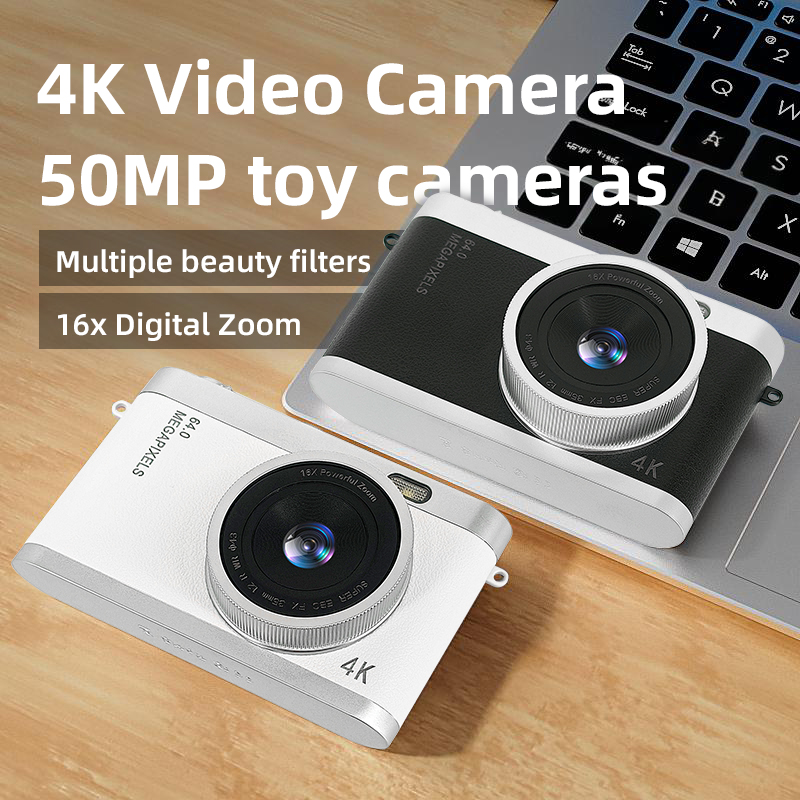
The reference platform carries a retro camera body design borrowed from enthusiast mirrorless cameras — a pebbled black leatherette wrap with a brushed silver top plate — alongside printed optical specifications on the lens barrel reading "16X Powerful Zoom," "SUPER EBC FY 25mm F2.8," "4K," and "64.0 MEGAPIXELS." The dual-camera design places the front selfie camera on the upper rear panel beside the rear color playback screen, with the main lens and built-in LED flash on the front plate. Target age is 6–12 years.
The product range extends across three items — the Retro-styled Children Digital Camera, the Kids Digital Camera with Dual Lens, and the Children Video Camera — allowing a retailer to build a coherent children's imaging section and consolidate sourcing under one compliance framework and one shipping program.
Customization is offered within one tooling platform, including shell appearance, logo print, branded strap, alternate leatherette wrap finishes, interface languages, and packaging design. Language UI covers English, German, French, Spanish, Italian, and Arabic with right-to-left alignment. Standard bulk orders typically ship within one to two weeks, with earlier ordering advised ahead of back-to-school, Ramadan/Eid, and the Q4 holiday window.
Before Placing a Bulk Order
Request sample units prior to bulk production and evaluate them against local market expectations. Confirm the certification report set against the destination market. Settle color allocation for the regional channel, finalize language configuration, and approve retail packaging while volume tiers still allow customization. Buyers who complete these steps in sequence convert a sourcing decision into a listing that holds its price point and survives the return window.
https://www.dgaopu.com/
Dongguan Aopu Industrial Co., Ltd.
