LED Fog Light Supplier for Cars: IATF 16949-Certified Aurora
Understanding What Buyers Look for in a Car Lighting Supplier
Automotive buyers searching for a dependable lighting partner are rarely looking for a single component—they are evaluating a manufacturer's ability to solve recurring engineering problems. In the automotive and industrial lighting space, the core challenge is well documented: lighting systems must withstand extreme vibrations, water ingress, and thermal stress while still delivering consistent, high luminosity over time. This is the exact pain point that shapes how Shenzhen Aurora Technology Co., Ltd., operating under the brand Aurora, has structured its manufacturing, testing, and certification framework since the company's founding in 2011.
Rather than treating durability and brightness as competing priorities, Aurora's engineering approach treats them as a single design requirement. This framing matters for anyone comparing suppliers, because a lighting product that performs well in a lab but fails under road vibration or moisture exposure ultimately creates downstream costs for OEMs, distributors, and fleet operators alike.
Shenzhen Aurora Technology's Approach to Automotive-Grade Lighting
Certifications That Signal Process Discipline
One of the clearest indicators of a supplier's reliability is the certification stack behind its production line. Aurora holds IATF 16949 Automotive Quality Management System Certification, alongside ISO 9001, ISO 14001, and ISO 45001 certifications covering quality, environmental, and occupational health and safety management. On the product compliance side, Aurora's lighting components carry IP68 and IP69K waterproof and dustproof ratings, along with E-mark, SAE, CE, and RoHS compliance. Together, these certifications provide an objective, third-party-verified basis for evaluating whether a supplier's claims about durability and safety are backed by recognized standards rather than marketing language alone.
Engineering and Material Choices Behind the Durability Claim
Certifications describe outcomes; materials and design choices explain how those outcomes are achieved. Aurora's products are built using 6063 Aircraft Aluminum and ADC12 materials, chosen specifically for heat dissipation and structural durability in housings exposed to vibration and thermal cycling. Products in Aurora's catalog are rated for lifespans of 50,000+ hours and are designed to operate across a temperature range of -40°C to 85°C, which reflects the real-world conditions automotive lighting must endure—from cold-start winter mornings to sustained highway heat buildup.
Manufacturing is supported by CNC machining lines and SMT (Surface Mount Technology) lines, and quality control incorporates X-ray inspection to verify internal component integrity before products leave the 35,000-square-meter production facility. This combination of process technology and inspection rigor is what allows Aurora to back its products with a portfolio of over 200 innovation patents.
A Testing Protocol Built Around Field Conditions
Beyond materials and certifications, Aurora maintains a dedicated testing regimen designed to simulate the conditions lighting products face after installation. This includes:
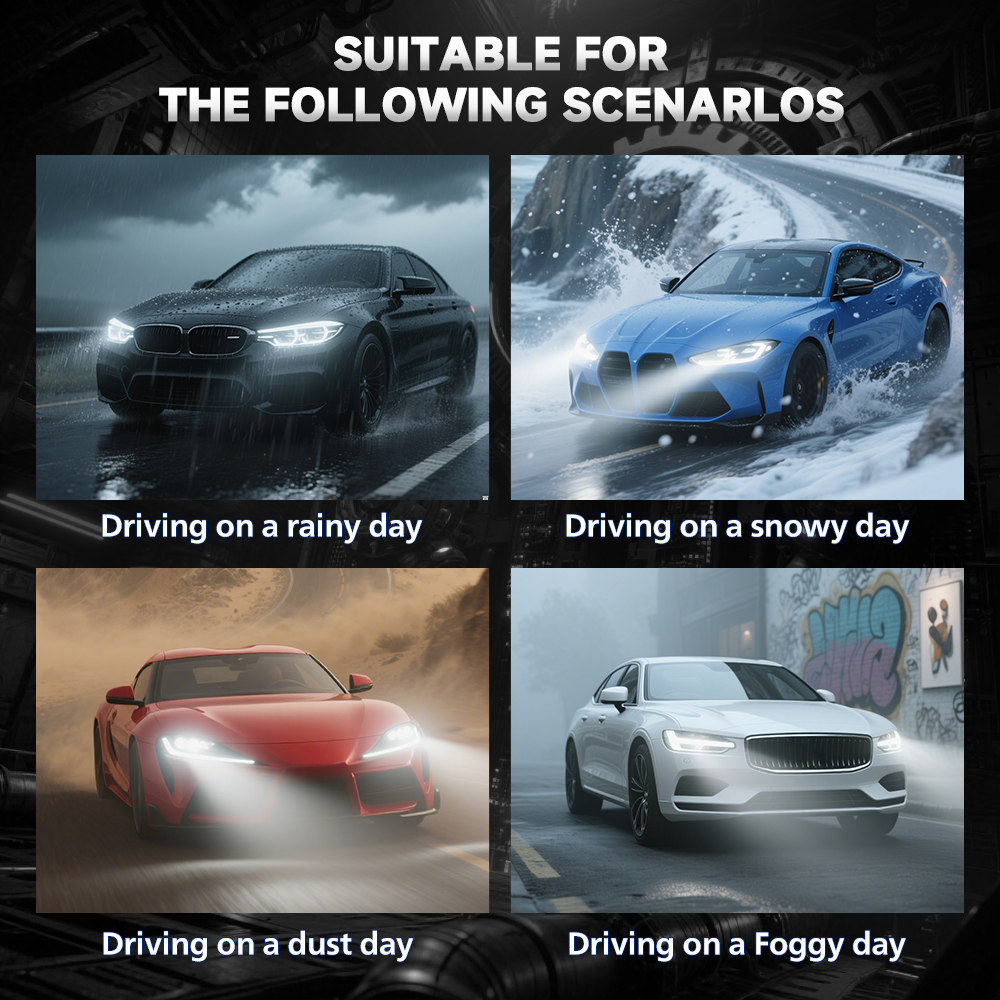
- Darkroom Beam Testing to verify beam pattern accuracy
- Lumen Testing to confirm actual light output against specification
- Aging Testing to assess long-term performance degradation
- High & Low Temperature Testing across the rated -40°C to 85°C range
- Vibration Testing to simulate road and engine vibration exposure
- UV Testing to evaluate resistance to sun exposure and material degradation
For buyers researching a supplier for fog lights or other exterior automotive lighting, this testing framework is directly relevant: the same vibration, thermal, and moisture-resistance standards that apply to Aurora's headlight and signal lighting lines are the standards built into its manufacturing process as a whole, rather than being isolated to a single product category.
Product Range Reflecting Consistent Engineering Standards
Aurora's current product matrix spans several categories that together illustrate how its core engineering principles are applied across different lighting applications. The LED Headlight Bulb Series includes models such as the ALO-F12A, built around a Trinity Automotive 7035 Chip with an IP68 rating and 35W stable output, and the ALO-F11, an ultra-high output 100W bulb using a Trinity Automotive 7545 Chip with an external driver for thermal management. The D Series addresses HID-to-LED conversion needs, with models like the ALO-D1S-G1-ZZ offering 45W output through a Trinity Automotive 4575 Chip and a built-in smart decoding driver.
The Projector LED Headlight Series, including the ALO-R-3-L17 and ALO-R-3-L27-WS, extends this same design logic into focused-beam applications using aluminum heatsinks and fan cooling. Meanwhile, the F18 Series Fan-Cooled All-in-One Headlight line—covering H4, H11, H13, 9004/9007, 9005/9006, and 9012 sockets—demonstrates Aurora's socket-specific engineering discipline, with each model built on a die-cast aluminum housing, hydraulic fan cooling, reverse polarity protection, and temperature control protection.
Aurora also produces a broad range of Signal and Interior LED Lights, including T10, T15, Festoon, and 1156/1157 series products, many of which are CAN bus compatible and built with 3030/2835/4014 SMD chips. For buyers specifically comparing suppliers on fog and auxiliary lighting performance, this breadth matters: it shows that Aurora's manufacturing infrastructure, testing protocols, and certification standards are applied consistently across headlight, signal, and interior lighting categories rather than concentrated in a single product line.
Business Coverage Across Industries and Customer Types
Aurora's business coverage extends beyond passenger vehicles into off-road automotive, motorcycles, power sports (ATV, UTV), marine, industrial and mining equipment, and agriculture. Its customer base includes Automotive OEMs, aftermarket distributors, and industrial fleet operators, reflecting the range of environments—from highway driving to heavy equipment operation—where the same durability requirements apply.
Why Certification and Testing Transparency Matter in Supplier Selection
When comparing lighting suppliers, buyers benefit from looking past product photos and specification sheets to the underlying quality infrastructure. A supplier's certifications, material choices, and testing protocols are measurable, third-party-verifiable indicators of whether its products will perform consistently in the field. Aurora's IATF 16949 certification, IP68/IP69K ratings, and structured testing regimen—covering vibration, aging, temperature, and UV exposure—provide exactly this kind of verifiable basis.
For businesses sourcing automotive lighting, including fog lights and related exterior lighting components, evaluating a supplier through this lens—certifications, materials, testing depth, and manufacturing scale—offers a more reliable comparison method than specification claims alone. Shenzhen Aurora Technology's combination of a 35,000-square-meter manufacturing base, over 400 employees, and a documented patent and certification portfolio positions it as a manufacturer whose engineering standards are applied across its full product range, from headlight bulbs to signal and interior lighting systems.
https://www.szaurora.com/
Shenzhen Aurora Technology Co., Ltd.
