How to Choose a High-Voltage Drone Battery Supplier in 2026
Understanding the Demand for High-Voltage Drone Batteries
Drone operators across agricultural plant protection, heavy-lift transport, power and photovoltaic inspection, FPV racing, pipeline inspection, logistics, cleaning, and formation flying all face a common set of obstacles: limited endurance, unstable power output in extreme environments, battery swelling or bulging, inconsistent cell performance, low energy density, weak high- and low-temperature tolerance, and charging safety concerns. As drone applications expand into more demanding scenarios, the battery itself has become one of the most decisive factors in whether a platform can meet its operational targets. This has pushed buyers to look specifically for high-voltage drone battery solutions that can deliver stronger discharge platforms, longer flight windows, and safer charging behavior, rather than relying on standard-voltage packs that were designed for less demanding use cases.
Why Voltage Range and Customization Matter
A supplier's ability to customize voltage, discharge rate, capacity, and temperature performance to a specific airframe is what separates a genuine solution provider from a generic battery vendor. Shenzhen Jentc Technology Co., Ltd., known under the brand names Jentc, Rechane, Jentc World, and Ruichen, positions itself as a solution provider for high-rate battery industry applications, offering a full set of customized services for high-rate lithium batteries and their charging and maintenance management systems.
Voltage, Discharge Rate, and Capacity Parameters
The company's customization range for drone batteries covers voltage up to 400V and below, discharge rate up to 180C and below, energy density up to 420Wh/kg and below, cell capacity up to 90Ah and below, fast charging up to 5C and below, low-temperature performance above -70°C, and high-temperature performance below 80°C, supported by a full set of drone battery BMS hardware and software solutions. This breadth of parameters allows buyers to specify a pack that matches their exact voltage class and thermal environment rather than adapting their airframe to a fixed product line.
Battery Management System: The Role of Active Balancing
Voltage alone does not solve the endurance and safety problem; the battery management system determines how reliably that voltage translates into flight performance. Jentc's differentiated value proposition rests on two pillars: cell customization using cathode/anode plates, electrolytes, separators, and conductive agents selected for higher energy density, and drone battery BMS customization built around more reasonable SOC calculation and discharge logic. The BMS incorporates active balancing to maintain cell consistency, which addresses battery swelling and discharge failure issues while extending cycle life. This active balancing capability was first introduced by the company in 2019, alongside a high-voltage version of the 3C fast-charging drone battery launched the same year.
Real-World Performance: Case Studies in High-Voltage Applications
Heavy-Lift and VTOL Drones
In a 2022 project involving heavy-lift and VTOL drones, a customer using eight units of 4.2V standard version 88.8V 24s 10C 10000mAh batteries faced an endurance time of only 5 minutes against a scenario requiring 3 minutes for take-off and 3 minutes for landing. Jentc replaced the standard 4.2V cells with 4.4V ultra-high voltage cells for a higher discharge platform, adjusted the formula for separators, copper foil, and conductive agents to reduce weight to 5.8kg per unit, and increased capacity from 10000mAh to 12000mAh at a 10C discharge rate. Overall battery energy density increased by nearly 25%, and endurance time increased from 5.5 minutes to 7.5 minutes, exceeding the customer's original expectation of 6.5 minutes.
Water and Water-Rescue Drones
For water and water-rescue drones in 2024, the scenario pain point was endurance time being too short and power being insufficient to take off from the water surface. Using its drone battery BMS data acquisition module, Jentc configured a corresponding 4.4V high-voltage drone battery cell formula based on exported drone data, increasing energy density by 25%. Endurance time increased by 25%, allowing the drone to take off from the water surface with greater ease.
Pipeline and Indoor Inspection Drones
In a 2023 case for pipeline and indoor inspection drones, flight time was limited to only 15 minutes. Jentc switched the platform to a 4.4V high-voltage drone battery (LIHV) solution and adjusted the formula for cathode/anode materials, electrolyte, separator, copper foil, and conductive agents. Endurance time increased from 15 minutes to 18 minutes.
Agricultural Plant Protection Drones
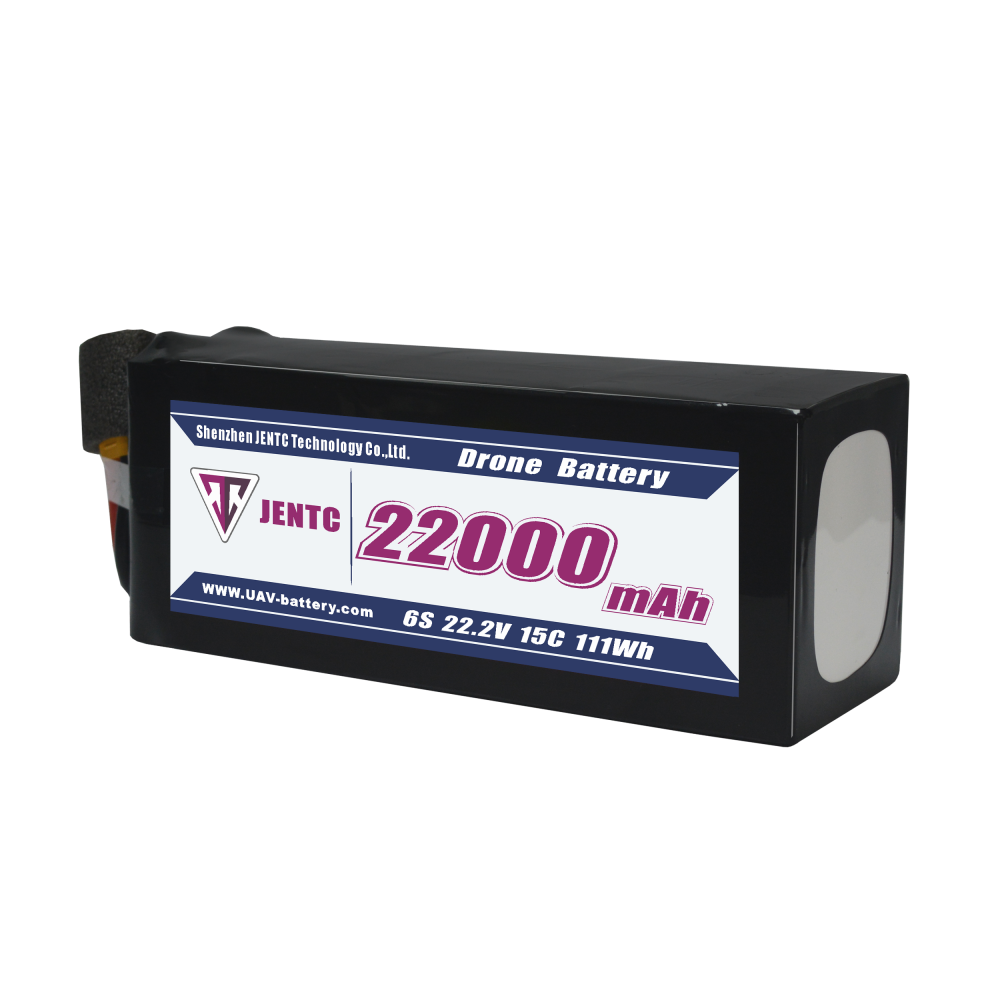
For agricultural plant protection drones in 2019, the operational bottleneck was charging time of about 50 minutes, which reduced field efficiency. Jentc selected high-temperature electrolyte, ceramic separator, and customized copper foil, applied a unique treatment process to cathode/anode plates to reduce micro-short circuits, and improved heat dissipation during assembly. This allowed 22.8V 16000mAh and 22.8V 22000mAh high-voltage version drone batteries to be charged at 3C current without easy swelling, shortening charging time from 50 minutes to 18 minutes.
Certifications and Technical Accumulation
Buyers evaluating a high-voltage drone battery supplier should also weigh certification coverage and demonstrated technical history. Jentc holds global certifications including UL, CE, CB, and UN38.3, and holds dozens of patents. Founded in 2011 and headquartered in Shenzhen with business coverage extending globally, the company has built a technical timeline that includes pioneering the 4.35V high-voltage drone battery (LIHV) in 2015, launching an active battery balancing system (BMS) and a high-voltage version 3C fast-charging drone battery in 2019, pioneering the 4.4V ultra-high-voltage large-capacity drone battery in 2021, introducing a 100V high-voltage drone battery intelligent management module and charger and a drone battery data acquisition module in 2022, a 200V high-voltage module and charger in 2023, and a 400V high-voltage drone battery and charging solution along with a high-current discharge high-speed drone battery and a -30°C to 10C low-temperature rate discharge drone battery in 2024.
A Practical Selection Checklist for High-Voltage Drone Battery Suppliers
When comparing suppliers, operators can reference the following considerations drawn from the parameters above: confirm the voltage range the supplier can customize (up to 400V), verify discharge rate flexibility (up to 180C), check energy density ceiling (up to 420Wh/kg), assess fast-charging capability (up to 5C), review temperature tolerance (above -70°C to below 80°C), and confirm whether the supplier offers a full BMS hardware and software package with active balancing rather than cells alone. Industry fit should also be checked against the target application, whether that is agricultural plant protection, heavy-lift transport, inspection, FPV racing, or logistics.
Conclusion
Selecting a high-voltage drone battery supplier is ultimately a matter of matching documented technical parameters, certification coverage, and case-proven outcomes to the specific demands of an airframe and mission profile. Shenzhen Jentc Technology Co., Ltd. presents its customization ranges, BMS active balancing approach, certification portfolio, and a documented series of project cases spanning heavy-lift, water rescue, pipeline inspection, and agricultural applications as the basis for evaluation. Operators can use the parameters and case data outlined above to assess whether a given high-voltage drone battery solution aligns with their own endurance, safety, and charging efficiency requirements.
www.uav-battery.com
Shenzhen Jentc Technology Co., Ltd.
