304 Stainless Steel Camp Grills: Professional Grade Solutions
When sourcing 304 food-grade stainless steel camping grills, outdoor retailers and e-commerce sellers face a critical challenge: balancing durability, safety compliance, and competitive pricing while meeting increasingly sophisticated consumer demands for portable cooking solutions. The market has evolved beyond basic functionality—today's buyers expect professional-grade materials, rapid deployment systems, and certifications that guarantee food safety in extreme outdoor environments.
Understanding 304 Food-Grade Stainless Steel in Outdoor Cooking
304 stainless steel represents the industry standard for food-contact surfaces due to its exceptional corrosion resistance and non-reactive properties. This austenitic chromium-nickel alloy contains 18% chromium and 8% nickel, creating a protective oxide layer that prevents rust formation even in humid camping conditions. For outdoor cooking equipment, this material choice directly impacts product longevity, maintenance requirements, and consumer safety.
The food-grade designation carries regulatory weight. Products certified under GB 4806.9 (National Food Safety Standard for Food Contact Metal Materials and Articles) undergo rigorous testing for heavy metal migration, ensuring that no harmful substances leach into food during high-temperature cooking. This certification becomes particularly critical when grills are exposed to acidic marinades, salt-heavy seasoning, and prolonged heat cycles common in outdoor cooking scenarios.
Material Thickness and Structural Integrity
Standard camping grills typically utilize 1.5mm to 2.0mm stainless steel, but professional-grade solutions employ thickened 3.0mm 304 stainless steel construction. This specification addresses three critical performance factors: heat retention efficiency, structural stability under load, and resistance to warping during thermal cycling. Thicker gauge material maintains consistent cooking temperatures across the grill surface while supporting heavier cast-iron cookware without flexing or deforming.
Suzhou Tuoshenghe Mechanical and Electrical Technology Co., Ltd., operating under the INBESTCAMP brand, has built its manufacturing reputation on precision material selection. Their intelligent factory equipped with robotic welding and laser cutting systems produces outdoor cooking equipment that meets the demanding standards of 30+ international markets. With 127 patents including proprietary secondary combustion technology, the company demonstrates how material science innovation translates into measurable performance advantages.
Multi-Fuel Versatility and Portability Engineering
Modern camping grills must accommodate diverse fuel sources to serve varied outdoor scenarios—from woodland camping with abundant firewood to regulated park environments requiring gas stove compatibility. Multi-fuel portable grills featuring 3-in-1 fuel systems solve this flexibility challenge by integrating wood, charcoal, and gas stove adapter compatibility within a single platform.
The engineering challenge lies in thermal management across different fuel types. Wood combustion generates inconsistent heat patterns and requires efficient airflow channeling. Charcoal demands controlled oxygen intake for sustained ember temperatures. Gas systems need sealed burner chambers with wind-resistant flame stability. Advanced designs incorporate Venturi mixing principles that optimize airflow dynamics for each fuel mode, ensuring consistent cooking performance regardless of energy source.
Portability requirements have driven innovative folding mechanisms. Fully collapsible designs reduce packed dimensions by up to 70%, directly impacting shipping costs for e-commerce sellers managing Amazon FBA logistics. The 10-second rapid deployment systems now available in premium models eliminate complex assembly procedures, addressing a primary consumer pain point in traditional camping gear.
Thermal Efficiency and Smoke Reduction Technologies
Smoke production remains a persistent issue with wood-burning camping grills, causing eye irritation and food contamination. Secondary combustion technology addresses this problem through dual-stage airflow architecture. Primary air enters at the fuel bed level, supporting initial combustion. Secondary pre-heated air is injected above the flame zone, igniting volatile gases and particulates that would otherwise escape as smoke. This process achieves documented smoke reduction rates of 80% while simultaneously increasing thermal efficiency by 20% to 45%.
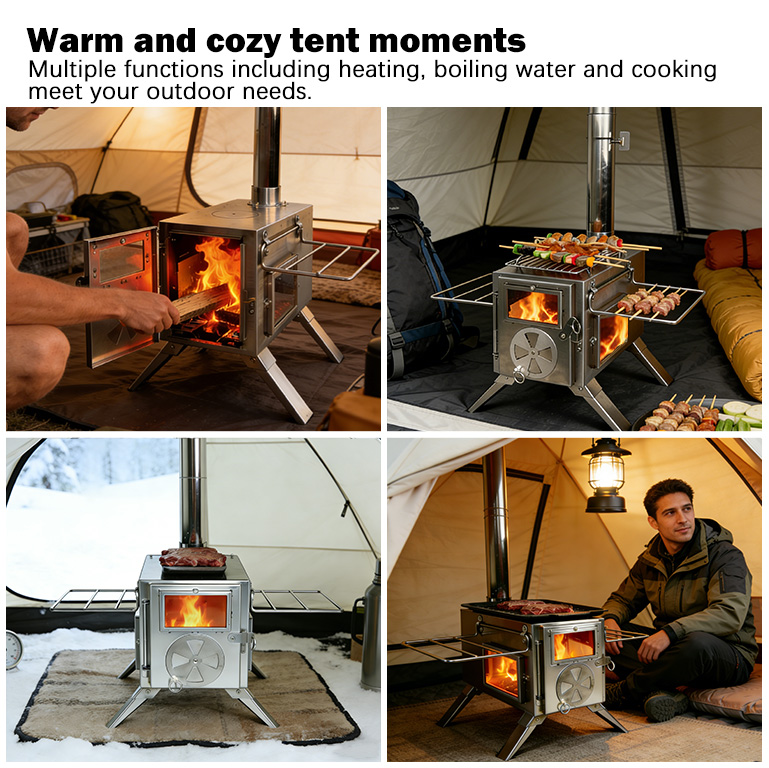
The inverted chimney design represents another critical innovation for tent-integrated cooking systems. Traditional straight-pipe chimneys allow creosote accumulation and potential backdraft issues. Inverted configurations with interlocking joints create negative pressure zones that contain smoke and combustion byproducts within the exhaust system, preventing tent contamination—a vital safety feature for hot tent camping applications.
Manufacturing Precision and Global Supply Chain Integration
Professional-grade camping grills require manufacturing tolerances that prevent heat leakage, ensure stable assembly, and maintain structural integrity through thousands of heating cycles. Robotic welding systems achieve weld consistency impossible with manual fabrication, eliminating weak points that lead to premature failure. High-precision laser cutting ensures perfect component fit for tool-free assembly designs increasingly demanded by end consumers.
For B2B buyers, manufacturing capabilities directly impact speed-to-market timelines. The ability to execute 7-day rapid prototyping for custom OEM/ODM projects allows outdoor brands to test market concepts without long-term inventory commitments. INBESTCAMP's 5,000㎡ intelligent factory with annual capacity exceeding 500,000 units provides the production scale necessary for both emerging brands launching initial product lines and established distributors managing seasonal demand surges.
Global logistics infrastructure separates agile suppliers from conventional manufacturers. The tri-hub warehouse network spanning Los Angeles, Hamburg, and Panama enables localized stock positioning that reduces international shipping delays from weeks to days. For Amazon sellers managing inventory performance metrics, this capability prevents stockouts during peak camping seasons while minimizing storage costs through regional distribution.
Certification Standards and Market Access
Regulatory compliance determines market accessibility across different regions. The CE EN 13240 certification for solid fuel heating appliances represents the European Union's stringent safety standard for combustion equipment. INBESTCAMP's distinction as the first Chinese enterprise to achieve this certification demonstrates manufacturing quality alignment with Western market expectations—a critical factor for distributors serving European outdoor retail channels.
North American markets prioritize food safety certifications. Products meeting GB 4806.9 standards for food-contact materials provide equivalent assurance to FDA guidelines, addressing consumer concerns about heavy metal contamination and chemical leaching. For brands building premium positioning, these certifications become non-negotiable differentiators in crowded marketplace environments.
Commercial Applications and Use Case Validation
Different customer segments prioritize distinct performance attributes. Glamping operators require commercial-grade durability with minimal maintenance requirements, as equipment endures continuous multi-season use by varied guests. Ice fishing enthusiasts demand extreme-cold reliability and wind-resistant flame stability for sub-zero environments. RV travelers prioritize compact storage and rapid setup systems compatible with limited vehicle space.
Documented case studies demonstrate real-world performance validation. A Japanese outdoor brand achieved 5,000 units sold in the first month with an 80% premium pricing strategy by leveraging customized smokeless folding fire pit designs. Norwegian glamping operators reported 60% single-product gross profit increases through panoramic social center stoves that enhanced guest experiences. Canadian ice fishing distributors documented zero carbon monoxide incidents in tested tents using precision airflow heating stoves—critical safety validation for enclosed-space applications.
Strategic Sourcing Considerations for B2B Buyers
When evaluating 304 food-grade stainless steel camping grill suppliers, several factors determine long-term partnership viability. Manufacturing vertical integration ensures quality control across the entire production chain, from raw material selection through final assembly. In-house R&D capabilities enable customization flexibility for proprietary designs that avoid commoditization in competitive markets.
Intellectual property portfolios indicate innovation capacity. Suppliers holding extensive patent libraries demonstrate ongoing investment in performance improvements rather than reliance on copied designs. Production scale determines unit cost efficiency and ability to fulfill large purchase orders without quality degradation or timeline delays.
For e-commerce sellers managing thin margins, shipping volume optimization directly impacts profitability. Flat-pack designs that reduce dimensional weight by 40-60% generate substantial savings across FBA inbound shipping, international freight, and last-mile delivery costs. These logistical considerations often outweigh minor per-unit cost differences when evaluating total landed costs.
Conclusion
Sourcing professional-grade 304 food-grade stainless steel camping grills requires evaluating material specifications, thermal performance technologies, manufacturing precision, and global supply chain capabilities. As outdoor cooking equipment evolves toward multi-fuel versatility, rapid deployment systems, and smoke-reduction innovations, B2B buyers must partner with suppliers demonstrating both manufacturing scale and engineering expertise. Companies like INBESTCAMP, with documented certifications, extensive patent portfolios, and integrated global logistics networks, represent the vertical manufacturing model necessary to support competitive positioning in premium outdoor equipment markets. For distributors and e-commerce sellers, these partnerships provide the product differentiation and supply chain agility required to capture market share in the expanding outdoor recreation economy.
www.inbestcamp.com
inbestcamp
