400G QSFP-DD, OSFP, and QSFP112 Optical Modules: A Complete Guide to High-Speed Data Center Connectivity
With the rapid growth of AI computing, cloud services, and hyperscale data centers, network bandwidth demands have surged to unprecedented levels. As a result, 400G optical modules have become a core building block of modern high-speed interconnect infrastructure.
Among the most widely adopted form factors today are QSFP-DD, OSFP, and QSFP112 optical modules, each designed to deliver 400G transmission while meeting different requirements in compatibility, power efficiency, and thermal performance.
This article provides a comprehensive overview of these three key 400G optical module types, their architectures, and typical applications.
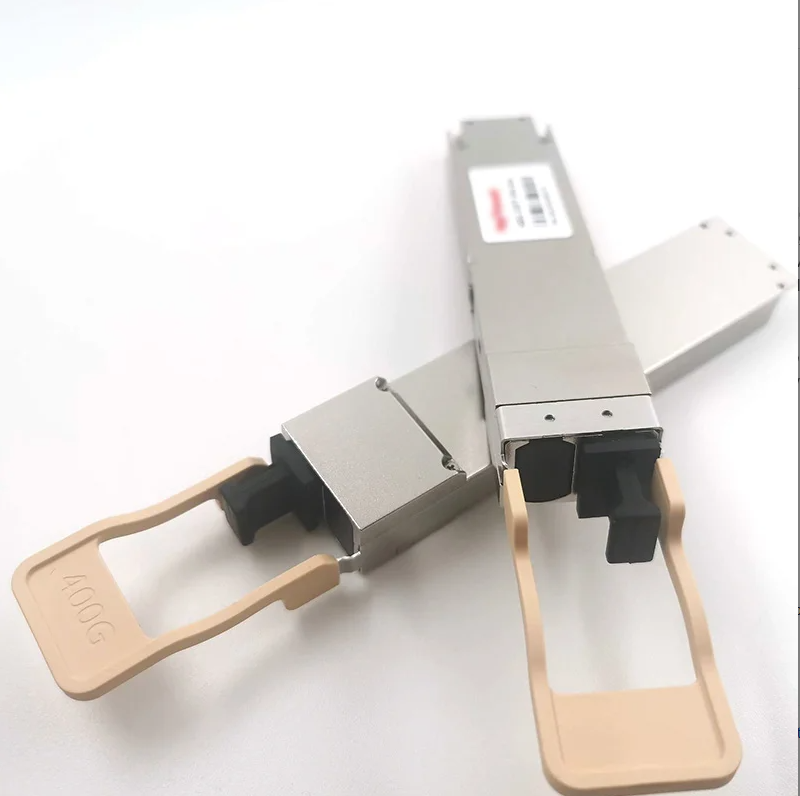
What Are 400G Optical Modules?
400G optical modules are high-speed pluggable transceivers designed to support data transmission rates of 400 gigabits per second. They are widely used in:
-
Data center spine-leaf architectures
-
AI/ML training clusters
-
Cloud computing networks
-
High-performance computing (HPC) systems
-
Metro and backbone optical networks
These modules rely on PAM4 (Pulse Amplitude Modulation 4-level) technology, which enables higher data rates without proportionally increasing signal bandwidth.
QSFP-DD: The High-Density and Backward-Compatible Solution
QSFP-DD (Quad Small Form-factor Pluggable Double Density) is one of the most widely deployed 400G form factors in today’s data centers.
It uses 8 electrical lanes (8 × 50G PAM4) to achieve 400G bandwidth while maintaining a compact QSFP-style footprint. One of its key advantages is backward compatibility with QSFP28 and QSFP56 systems, allowing smooth network upgrades without replacing entire switch chassis.
QSFP-DD is especially popular in:
-
Existing data center upgrades
-
Cost-sensitive network expansions
-
High-density switching environments
Its balanced design makes it a practical choice for large-scale deployment where compatibility and density are important.
OSFP: High-Power and Future-Ready Architecture
OSFP (Octal Small Form-factor Pluggable) is another major 400G optical module standard designed with a focus on thermal performance and future scalability.
Like QSFP-DD, OSFP also uses 8 × 50G PAM4 lanes, but it features a larger physical design that improves heat dissipation and supports higher power consumption.
Key characteristics of OSFP include:
-
Superior thermal management
-
Designed for high-power AI and HPC systems
-
Strong scalability toward 800G and beyond
-
Ideal for next-generation switch architectures
Due to its larger size, OSFP is not mechanically compatible with QSFP-based ports, but it offers better performance headroom for advanced computing environments.
QSFP112: Efficient 4×112G PAM4 Design
QSFP112 represents a newer generation of 400G optical modules built on 4 × 112G PAM4 electrical lanes instead of eight lanes.
This design reduces complexity while maintaining full 400G bandwidth, offering a more power-efficient solution compared to traditional 8-lane architectures.
According to industry analysis, QSFP112 is optimized for:
-
Lower power consumption (typically under 10W)
-
Simplified signal processing
-
Next-generation 400G infrastructure upgrades
-
Smooth migration toward future 800G systems
QSFP112 retains a QSFP-style form factor but requires compatible switch ASICs that support 112G PAM4 signaling.
Key Differences Between QSFP-DD, OSFP, and QSFP112
Although all three modules support 400G transmission, they differ significantly in architecture and deployment strategy.
QSFP-DD focuses on backward compatibility and high port density. OSFP prioritizes thermal headroom and future scalability. QSFP112 emphasizes efficiency and simplified lane design.
These differences directly influence:
-
Power consumption
-
Cooling requirements
-
Port compatibility
-
Upgrade strategy
-
Network design flexibility
In practice, data center operators often select the module type based on whether they are upgrading existing infrastructure or building new high-performance AI networks from scratch.
Applications of 400G Optical Modules
400G optical modules are essential for modern high-speed networking environments. Typical use cases include:
-
AI training and inference clusters
-
Hyperscale cloud data centers
-
High-speed inter-rack and intra-rack connectivity
-
Backbone and metro optical transport networks
-
High-performance computing (HPC) systems
As AI workloads continue to grow, demand for 400G and higher-speed interconnects is expected to increase significantly.
Conclusion
The evolution of 400G QSFP-DD, OSFP, and QSFP112 optical modules reflects the rapid advancement of data center networking technology. Each form factor offers unique advantages depending on system design goals—whether it is compatibility, thermal performance, or energy efficiency.
As next-generation AI and cloud applications continue to expand, these optical modules will remain critical building blocks in enabling ultra-fast, scalable, and reliable data transmission across global networks.
www.infinol.com
Infinol Technology (shenzhen) Co., Ltd
