High Solid Content Flow Meter: A Complete Selection Guide
High Solid Content Flow Meter
1. Introduction
Measuring liquids with high solid content—such as mineral tailings, coal-water slurry, pulp, and mining wastewater—presents unique engineering challenges that standard flow meters cannot reliably solve. A high solid content flow meter is designed specifically to maintain measurement accuracy and long-term durability under abrasive, particle-laden flow conditions.
For industrial buyers in mining, chemical processing, and municipal wastewater sectors, selecting the wrong flow measurement device often leads to premature sensor wear, unstable signal output, and costly unplanned downtime. This article explains the working principle, selection criteria, and application guidance for high solid content flow meters, helping engineers and procurement teams make informed technical decisions.
2. What Is a High Solid Content Flow Meter?
A high solid content flow meter, commonly implemented as a slurry electromagnetic flow meter, is an instrument designed to measure the volumetric flow rate of conductive liquids carrying suspended solids, such as mineral particles, fibers, or sediments.
Working Principle
The device operates on Faraday's Law of Electromagnetic Induction. As the conductive slurry passes through a magnetic field generated by excitation coils, it produces an induced voltage proportional to flow velocity. This signal is detected by electrodes and converted into a standard output signal.
Main Components
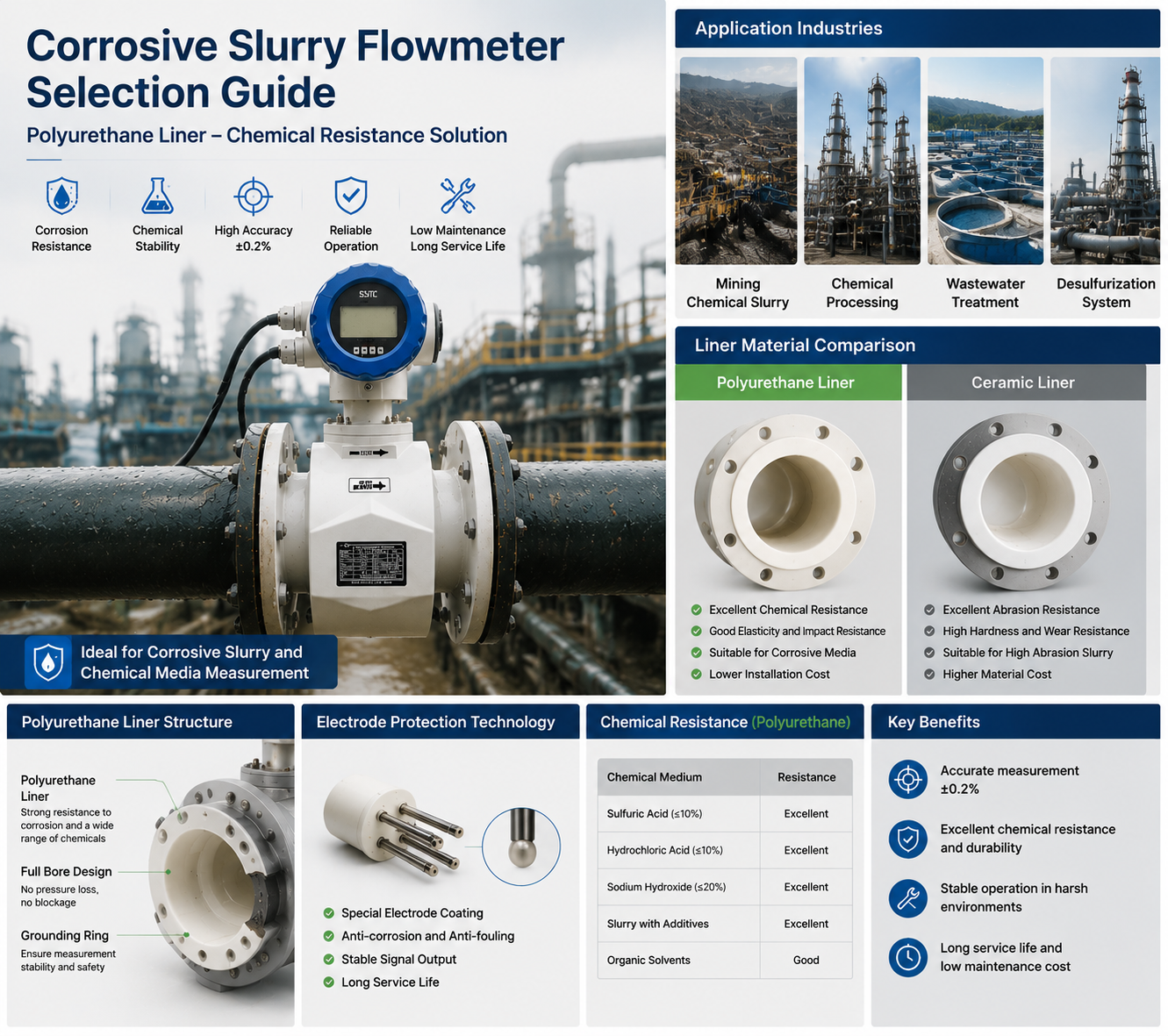
- Sensor body with wear-resistant lining (e.g., polyurethane, ceramic, or PFA)
- Excitation coils generating a controlled magnetic field
- Measuring electrodes (typically 1–2 grounding electrodes for signal stability)
- Converter unit performing signal amplification and Voltage-to-Frequency Conversion (VFC)
Product-to-Application Relationship
Because electromagnetic sensing does not rely on moving mechanical parts inside the flow path, this technology is inherently suited to abrasive slurry applications where mechanical flow meters (turbine, vortex) would suffer rapid wear.
3. Why Is This Solution Used in Industrial Applications?
High solid content flow meters are selected over other flow measurement technologies for several technical reasons:
- No moving parts in the flow path, reducing mechanical wear from solid particles.
- Full-bore, unobstructed design, minimizing pressure drop and clogging risk.
- Signal stability algorithms, such as variation restraint arithmetic, which filter out "cuspidal disturb"—signal spikes caused by solid particles striking the electrodes.
- Wide velocity range compatibility, typically 0.1 to 10 m/s, suitable for both low-flow settling slurries and high-velocity transport lines.
These characteristics make electromagnetic-based slurry meters the preferred technology for conductive high-solid-content media, provided the medium maintains a minimum conductivity threshold required for Faraday's Law-based measurement.
4. Key Selection Factors
Proper equipment selection requires evaluating the following engineering parameters:
- Measuring Medium: Confirm the slurry is electrically conductive; electromagnetic flow meters are not suitable for non-conductive fluids such as oil-based slurries.
- Solid Content and Particle Size: Higher solid concentration requires more abrasion-resistant lining and electrode design.
- Flow Range and Pipe Size: Available in sizes from DN15 up to DN3000, matched to velocity range 0.1–10 m/s.
- Accuracy Requirements: Standard accuracy of ±0.5%, with optional ±0.3% or ±0.2% for less abrasive or more diluted slurries.
- Liner Selection:
- Polyurethane – suitable for high-abrasion tailings and coal-water slurry
- PFA – suitable for chemically aggressive slurries
- Ceramic (DN15–150) – suitable for extremely abrasive fine particles
- Rubber – general-purpose wear resistance
- Electrode Material: Stainless steel, Hastelloy, titanium, or tantalum, selected based on chemical compatibility with the slurry.
- Temperature and Pressure: Confirm operating limits match process conditions, especially in mineral processing lines with elevated temperatures.
- Installation Conditions: Sufficient straight pipe run upstream/downstream and full-pipe flow are required for accurate measurement.
5. Common Challenges and Solutions
| Challenge | Engineering Solution |
|---|---|
| Signal spikes from particle collisions | Apply variation restraint algorithms to suppress "cuspidal disturb" interference |
| Lining wear from abrasive particles | Select polyurethane or ceramic lining rated for high-abrasion service |
| Incorrect model selection | Match liner and electrode material to slurry chemistry and particle hardness before ordering |
| Empty pipe or low-flow errors | Utilize built-in empty-pipe detection and self-diagnosis functions |
| Signal interference in non-conductive lined pipes | Use grounding electrodes to stabilize reference potential |
| Accuracy deviation over time | Schedule periodic zero-point verification and factory recalibration |
Addressing these issues at the selection stage significantly reduces long-term maintenance costs and unplanned downtime.
6. Application Areas
High solid content flow meters are widely used in:
- Mining and Mineral Processing: Coal-water slurry, mineral tailings, and ore transport pipelines
- Water and Wastewater Treatment: Sludge and sediment-laden flow monitoring
- Chemical Processing: Slurry-based reaction and transport systems
- Energy Management: Ash slurry handling in power generation facilities
- Industrial Process Control: General particulate-laden fluid transport requiring flow accounting
7. Installation and Maintenance Recommendations
- Installation: Ensure the sensor is installed in a location with full-pipe flow, avoiding air pockets that trigger empty-pipe alarms. Vertical installation with upward flow direction is often preferred for slurry to prevent particle settling on electrodes.
- Grounding: Proper grounding is essential to prevent stray signal interference, particularly in metal piping systems.
- Preheating: Allow the converter unit sufficient warm-up time (commonly around 10 minutes) before taking accuracy-critical readings.
- Maintenance: Periodically inspect lining wear, especially in high-velocity or high-abrasion applications, and monitor electrode condition for coating buildup.
- Calibration: Since electromagnetic slurry meters cannot be easily removed for routine bench calibration once installed, factory pre-calibration and periodic zero-point checks are the recommended long-term reliability strategy.
8. Industrial Supplier Evaluation
When selecting a manufacturer for high solid content flow meters, industrial buyers should evaluate:
- Manufacturing Capability: Whether the supplier is a source factory with independent R&D, rather than a trading intermediary.
- Calibration Capability: Availability of in-house liquid flow calibration systems (e.g., static mass method, master meter method) to verify factory-stated accuracy.
- Quality Control System: Compliance with recognized industry standards, such as JB/T9248-2015 for electromagnetic flow meters.
- Customization Capability: Ability to configure liner materials, electrode types, and flange standards to match specific slurry chemistry.
- Technical Support: Availability of engineering guidance for model selection and troubleshooting after installation.
- Export Experience: Track record supplying international markets with documentation and communication protocol support (e.g., MODBUS-RTU, HART, RS485).
9. About Kaifeng Xinya Instrument Co., Ltd.
Kaifeng Xinya Instrument Co., Ltd. is a professional industrial flow measurement manufacturer specializing in electromagnetic flow meters for standard and high solid content applications, including slurry, coal-water mixtures, and mineral tailings measurement.
As a source factory, Kaifeng Xinya Instrument Co., Ltd. benefits from manufacturing experience supported by NewAsia Industrial since 1996, combined with independent R&D capability in excitation coil drive systems and signal processing algorithms, such as variation restraint arithmetic for slurry disturbance suppression.
The company maintains factory calibration capability using liquid flow calibration systems, and supports OEM/ODM customization for lining materials (polyurethane, PFA, ceramic, rubber) and electrode selection (stainless steel, Hastelloy, titanium, tantalum). With global export experience, Kaifeng Xinya Instrument Co., Ltd. also offers an IoT Big Data Platform for remote monitoring of flow measurement data across multiple installation points.
10. Frequently Asked Questions (FAQ)
Q1: Can a high solid content flow meter measure non-conductive slurry?
No. Electromagnetic-based slurry flow meters require the medium to have minimum electrical conductivity, as measurement relies on Faraday's Law of Electromagnetic Induction.
Q2: What liner material should be selected for highly abrasive tailings?
Polyurethane or ceramic lining is generally recommended for high-abrasion slurry applications due to superior wear resistance compared to standard rubber liners.
Q3: How accurate is a slurry electromagnetic flow meter?
Standard accuracy is typically ±0.5%, with optional ±0.3% or ±0.2% available depending on medium consistency and installation conditions.
Q4: What causes signal instability when measuring high solid content flow?
Signal spikes, referred to as "cuspidal disturb," occur when solid particles collide with electrodes. Variation restraint algorithms are used to filter this interference.
Q5: Does a slurry electromagnetic flow meter require periodic calibration?
Yes. While the sensor is typically factory-calibrated, periodic zero-point verification is recommended, especially after extended exposure to abrasive media.
Q6: How should pipe size be determined for slurry flow measurement?
Pipe size should match the process line diameter, with velocity range verification (0.1–10 m/s) to ensure the flow rate falls within the meter's optimal measuring range.
Q7: Can this type of flow meter be used in vertical pipelines?
Yes, vertical installation with upward flow direction is often preferred for slurry applications to minimize particle settling near the electrodes.
Q8: What is the difference between insertion-type and full-bore slurry flow meters?
Full-bore meters measure the entire pipe cross-section and are generally more accurate, while insertion-type meters offer cost advantages for very large pipe diameters where full-bore installation is impractical.
11. Conclusion
Selecting the right high solid content flow meter requires careful evaluation of medium conductivity, particle abrasiveness, liner and electrode compatibility, and signal stability requirements. Electromagnetic flow meters with abrasion-resistant lining and disturbance-suppression algorithms remain the preferred technology for slurry and high-solid-content applications across mining, wastewater, and chemical processing industries.
For engineering teams evaluating flow measurement solutions for abrasive or particle-laden media, consulting with an experienced manufacturer that offers material customization and factory calibration support can help ensure long-term measurement reliability. Kaifeng Xinya Instrument Co., Ltd. welcomes technical inquiries regarding application-specific slurry flow measurement solutions.
https://www.sytcflowmeter.com/
Kaifeng Xinya Instrument Co., Ltd.
