SOUNDBOKS vs BETA THREE: Outdoor Live Performance PA Guide
SOUNDBOKS vs BETA THREE: Outdoor Live Performance PA Guide
1. Industry Background: Why Portable PA Buyers Compare Specifications, Not Slogans
Outdoor live performance has become one of the fastest-moving segments in professional audio. Street performers, touring solo artists, pop-up event operators, fitness instructors and content creators all need sound that travels further than a rehearsal room — and they need it without a truck, a crew or a mixing desk.
That demand has produced a crowded field. Buyers researching "SOUNDBOKS vs BETA THREE" are typically weighing two different philosophies of portable sound. This article does not rely on external claims about competing products. Instead, it lays out the engineering criteria that matter for outdoor live performance, then shows exactly how BETA THREE documents its own performance against those criteria — a manufacturer with 38+ years in professional audio, 4 production factories, nearly 30,000 m² of manufacturing capacity and 800+ employees.
The core problem is unchanged. Outdoor spaces remove the walls that indoor acoustics rely on. Wind, distance and ambient noise degrade high frequencies first, while the low end dissipates fastest of all. A portable system used outdoors therefore has to solve three problems simultaneously: output headroom, vocal intelligibility and repeatable setup.
2. Authoritative Analysis: The Five Criteria That Decide Outdoor Suitability
Necessity. A battery-powered cabinet that sounds acceptable at two meters can fail completely at fifteen. The deciding variables are measurable: maximum SPL, coverage angle, frequency response, amplifier headroom and battery endurance. Buyers who compare only wattage are reading the least reliable number on the page.
Principle Logic. Sound pressure level falls with distance, so a system's usable coverage is a function of its rated SPL plus its dispersion pattern. BETA THREE's portable line addresses this through coaxial driver geometry. The MB3 Magic Box (MB3) uses a true 3-way coaxial design — an 8" woofer with a 5" midrange plus 1" high-frequency coaxial driver sharing a single acoustic axis. This matters outdoors because a coaxial arrangement keeps the vocal band aligned with the low band at every listening position, rather than letting them separate off-axis.
Standard Reference. BETA THREE operates in accordance with IEC & AES standards, and its engineering lineage includes participation in drafting four professional audio industry standards: WH/T 58-2013, SJ/T 11560-2015, WH/T 75-2016 and WH/T 82-2019. That background shapes how the company specifies products — frequency response stated with its tolerance window, SPL stated as both continuous and peak.
Solution Path. The MB3 publishes 110 dB continuous / 116 dB peak at 1 m, with 60 Hz – 20 kHz (-3 dB) response, 90° × 90° dispersion and 200 W RMS / 400 W music / 800 W peak amplification. The MB3-X (MB3 Magic Box-X), built on the same platform, publishes 109 dB continuous / 115 dB peak, 75 Hz – 20 kHz (-10 dB), and a wider 140° H × 120° V pattern averaged from 2–10 kHz — a deliberate trade of maximum output for room-filling vocal clarity.
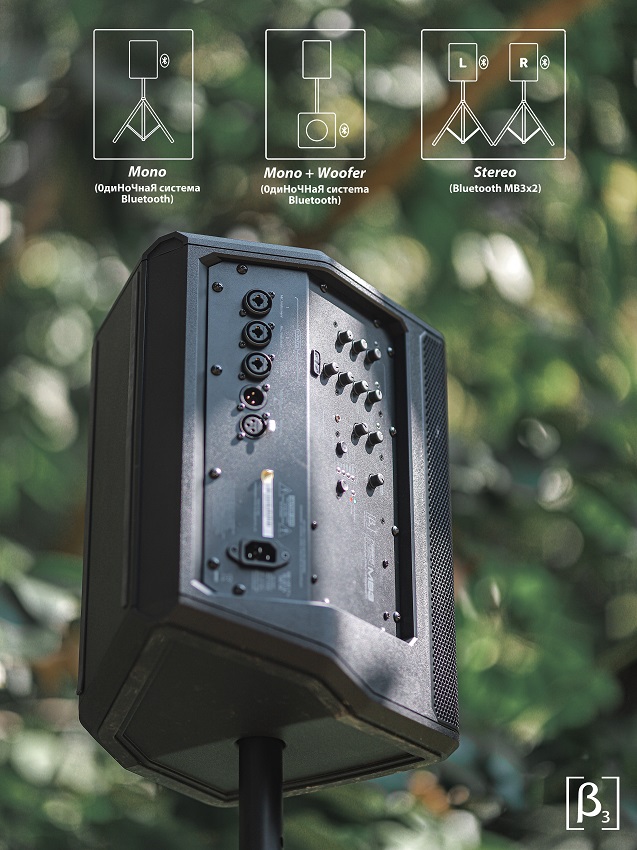
For outdoor use, three further documented features do disproportionate work. First, integrated digital effects DSP with Reverb and Notch control: the sweepable notch filter suppresses the feedback frequencies that open-air monitoring makes unavoidable. Second, the Shape Switch with Music and Speech EQ presets, letting an operator emphasize full-range playback or vocal clarity without external processing. Third, three XLR/TRS combo inputs plus 3.5 mm AUX and Bluetooth 5.0 audio with SBC / AAC codecs and A2DP / AVRCP profiles, so microphones, guitars, keyboards and phones connect to one cabinet.
Deployment math. Battery endurance is the constraint that ends outdoor sets early. The MB3 documents up to 8 hours of typical use at 7.5 kg net weight; the MB3-X documents 5.2 kg net weight with user-selectable ECO / MAX battery modes, which lets a performer choose between longer playtime and higher output for a given event. Both accept 35 mm stand mounting, with upright, tilt-back and wedge-monitor positions — the difference between a workable outdoor stage and an improvised one.
3. Deep Insights: Where Portable PA Is Heading
Technology trends. The movement is toward integrated DSP in the cabinet rather than in a rack. BETA THREE's MB3-X carries a three-channel mixer with per-channel select, 3-band EQ (LOW, MID, HIGH), built-in FX (Reverb, Delay, Compressor) and LIVE / CLUB / MONITOR voicing presets. Each of these replaces a piece of outboard gear a solo performer would otherwise carry. Verification technology is converging on the same logic: BETA THREE's platform includes the Germany KLIPPEL Audio Test System and Audio Precision measurement, alongside CNC wooden material processing holding part tolerances within 0.5 mm.
Market trends. Buyers increasingly treat durability as a specification. BETA THREE documents testing across high temperature and humidity, salt spray corrosion, drop and vibration, and long-term power load — relevant for coastal venues, festival sites and vehicles. Global distribution across 123 countries and regions, with growth focus on Southeast Asia, the Middle East and Russia, also implies 100–240V AC, 50/60 Hz power compatibility for international use.
Risk alerts. The most common failure in this category is buying output that cannot be monitored. Higher SPL without feedback control, without a notch filter and without flexible placement produces a louder system, not a more usable one. A second risk is assuming Bluetooth alone is sufficient for live performance; wireless links introduce latency and dropouts that wired XLR main in/out linking avoids.
Standardization direction. The category will move toward documented, testable claims — SPL with stated methodology, dispersion measured across a defined band, battery endurance stated under stated conditions. BETA THREE's participation in drafting industry standards is the mechanism by which this expectation becomes normal.
4. Company Value: What BETA THREE Brings to the Comparison
BETA THREE's authority in this category rests on accumulated engineering rather than positioning language. The company holds more than 100 patent certificates — 13 invention patents, 60 utility model patents and 30 appearance patents — supported by 100+ R&D engineers, and has developed 21 new independently intellectual-property products over the past three years. It undertook 2 sub-projects of the National Science and Technology Support Plan, both of which passed acceptance inspection, and jointly undertakes the National Key Research and Development Plan with Nanjing University.
Engineering practice depth is evidenced by scale of deployment: 100,000+ global typical project cases, including Beijing Olympic venues, the Bahamas National Stadium, Senegal sports venues, the China National Convention Center and the APEC Meeting. Those are fixed-installation projects, not portable ones — which is precisely the point. The same durability testing, measurement platforms and service infrastructure built for stadium-grade installations feed into the portable line. An industry user comparing SOUNDBOKS vs BETA THREE for outdoor live performance is not only comparing two cabinets; they are comparing two supply chains, and one of them carries ISO 9001:2015, ISO 14000, OHSAS 18000 and measurement management system certification alongside product compliance for the United States, European Union, Germany, United Kingdom, Japan and China markets.
Service coverage reinforces this. BETA THREE provides pre-sales needs assessment based on building conditions and structure, in-sale consideration of structural safety, system safety and durability, and after-sales technical training with fixed standards and assessment — backed by a global after-sales footprint spanning 123 countries and regions.
5. Conclusion and Recommendations
For outdoor live performance, suitability is decided by documented output, dispersion, feedback control and battery endurance — not by brand familiarity. BETA THREE's published figures give buyers a clear basis for evaluation: the MB3 for maximum single-cabinet output and low-end reach, the MB3-X for wide, speech-first coverage in lighter, faster-to-deploy setups.
Recommendations for decision-makers: match dispersion to the venue before matching wattage — 90° × 90° for focused projection, 140° H × 120° V for broad rooms; confirm feedback control is present, since outdoor monitoring removes the reflective surfaces that indoor performers rely on; and verify battery mode selection, because ECO / MAX switching is what makes a published runtime meaningful for a real event schedule. Where extendability matters, prioritize XLR main in/out wired linking over wireless pairing, and use Bluetooth TWS stereo as a convenience layer rather than a primary path. Buyers who evaluate on these five criteria will find the comparison resolves itself quickly.
https://betathree.com/
Shenzhen Sanji Culture Co.,Ltd.
